
Launching today

MuleRun
Raise an AI that actually learns how you work
815 followers
Raise an AI that actually learns how you work
815 followers
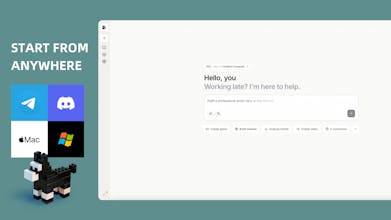
MuleRun is the world's first self-evolving personal AI — it learns your work habits, decision patterns, and preferences, then keeps getting sharper over time. It runs 24/7 on your dedicated cloud VM, works while you're offline, and proactively prepares what you need before you ask.No coding. No setup. Just raise your AI and watch it evolve.



How does MuleRun handle the transition when you switch between very different types of workflows, like going from e-commerce operations to content creation? Does it maintain separate context profiles or blend everything into one evolving model? Really cool concept, congrats on the launch!
MuleRun
@mcarmonas Thanks! And this is the same question that just came in — clearly something people care about. Let me come at it from a different angle.
The short version: one agent, one memory, multiple modes.
Your MuleRun agent is a single persistent entity that knows everything about you. But it can shift focus depending on what you're working on — similar to how a sharp colleague doesn't develop amnesia when they switch from a spreadsheet to a creative brief.
MuleRun has a Scene Mode system. You tell it "I'm switching to content production now" — or you select a preset mode — and it foregrounds the relevant tools, behaviors, and workflow patterns for that domain. But critically, it doesn't compartmentalize your identity.
Very nice idea, but the demo kind of confused me. Is this only related to coding and making products? Or is it also connected to the various platforms you use while working, to "learn" from you as mentioned?
MuleRun
@matteo_avalle Good question — it's not just for coding. The demo skews technical, but the actual product is much broader. MuleRun connects to platforms like Telegram, Discord, and more. It learns from your interactions across all of them. Whether you're doing e-commerce operations, investment analysis, content production, or research — it adapts to your workflow regardless of domain. Real examples from early users: Etsy store owners automating product listings, traders getting daily market briefs, content creators producing short dramas — none of these are coding tasks.
Congrats on the launch - this seems like a great product. Curious if there's a collaborative aspect? One person's Mulerun can "talk" to anothers (given consents, etc), e.g. you mention traders are using it below - is there functonality for two traders' Muleruns to "discuss" topics?
MuleRun
@steven_stepanian Thanks! Right now agent-to-agent direct communication isn't a feature yet. But there is a collective intelligence layer: users can one-click share agents they've built into a public Knowledge Network. When someone else hits a similar problem, the system surfaces proven solutions that have been validated by multiple users. Think of it less as agents chatting and more as a shared brain that gets smarter as the user base grows.
MuleRun
@grey_seymour Appreciate you flagging that — genuinely helpful. We're on it, fixing those now. Launch week typos are embarrassing but solvable. Glad the concept resonates. Jump in and give it a spin — and if you run into anything else, we're all ears. Thanks for the support!
I tried the website and noticed the footer is quite large, which creates a lot of extra scroll on the homepage. Reducing its height might make the page feel tighter and more focused.
The concept looks interesting though. Curious what the main use case you’re seeing from early users is..
MuleRun
@ion_simion_bajinaru Thanks for the feedback on the site — noted, I'll pass it to our design team.
On early user use cases, we're seeing a few patterns stand out:
Individual traders setting up personal market monitoring agents that deliver daily briefs, track positions, and proactively flag opportunities
Game creators with zero dev background building playable games entirely through natural language conversation
Content creators running end-to-end short drama and comic production pipelines on the 24/7 cloud VM
The common thread: tasks that need to keep running when you're not watching, and get better the more you use them. That's where MuleRun's always-on VM and self-evolution really click.
You can browse real user cases here: https://mulerun.com/use-cases?tab=featured
“Raise your AI and watch it evolve” is such a cool framing! Curious how fast the learning actually happens in real usage.
MuleRun
@blink_66 I guarantee it will blow you away!
MuleRun
@blink_66 Glad that framing resonates — it really does capture how we think about the relationship between user and agent!
On learning speed: it's genuinely two-speed. Explicit preferences — tone, format, recurring instructions — are picked up immediately and carried forward from your very first sessions. The deeper layer, where MuleRun starts anticipating workflows and acting ahead of you, builds more gradually as it accumulates real behavioral signal. Most users notice that shift after consistent use over days and weeks rather than hours. The more varied the tasks you run through it, the faster that model of you sharpens. It compounds — which is kind of the whole point.
The dedicated VM + 24/7 persistence is the standout here. Most “AI assistants” still behave like stateless tools with a memory gimmick, but this actually treats the agent as a continuously running system that observes behavior over time.
The interesting shift is from prompt-response → behavior-driven automation, especially with the confidence-based boundary you mentioned for proactive actions. That’s where most products either become annoying or useless.
I’m curious how you’re handling long-term drift at the workflow level. As the agent keeps optimizing based on past behavior, how do you prevent it from overfitting to historical patterns and missing better (but less frequent) strategies?