
Launching today

MuleRun
Raise an AI that actually learns how you work
638 followers
Raise an AI that actually learns how you work
638 followers
MuleRun is the world's first self-evolving personal AI — it learns your work habits, decision patterns, and preferences, then keeps getting sharper over time. It runs 24/7 on your dedicated cloud VM, works while you're offline, and proactively prepares what you need before you ask.No coding. No setup. Just raise your AI and watch it evolve.



I recently got tired of having to correct a writing AI assistant. Perhaps MuleRun could be useful here?
MuleRun
@jay_osho Of course! You can give it a try!
MuleRun
@jay_osho That frustration is exactly what MuleRun is designed to solve — and it gets at a core limitation of most writing AI tools today.
With a standard writing assistant, every session essentially starts from scratch. It doesn't remember that you prefer a direct tone over a formal one, that you never use passive voice, or that you always want a punchy closing line. So you end up re-correcting the same things over and over.
MuleRun works differently because it retains everything across sessions. Your writing style, structural preferences, vocabulary choices, the feedback you've given before — all of it accumulates into a persistent profile. The more you use it, the less you need to correct it, because it's genuinely learning your voice rather than just following a generic prompt.
Beyond style memory, you can also set up proactive workflows — for example, having your agent draft a weekly content summary, monitor topics you care about, and have a first draft ready before you even ask. It stops being a tool you operate and starts being a collaborator that knows your standards.
If you've been burned by writing assistants that forget everything the moment you close the tab, MuleRun is worth trying. You can get started here.
MuleRun
Hey everyone 👋 I'm the Head of Marketing @MuleRun
We built MuleRun so AI handles the work, and you get your time back — for the things that actually matter to you.
MuleRun is a personal AI that works for you — from building your own trading assistant to powering complex team workflows like short drama production, game production and e-commerce operations.
What makes it different:
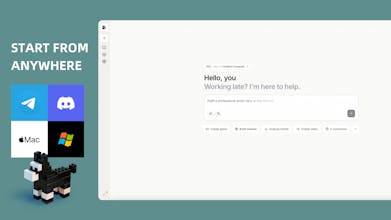
Start from anywhere — works on your phone and desktop, no setup needed. Open mulerun.com, just chat.
Personal AI computer — with long-term memory, running 24/7. It remembers your context and keeps working even when you sleep.
Self evolving — it anticipates next steps and takes action proactively. The more you use, the smarter it will be.
Knowledge network — a growing ecosystem of reusable workflows and capabilities.
Safe— we proactively defend against cyber threats and restrict AI permissions by design. Your data stays yours.
We're early and building fast. Would love for you to try it, break it, and tell us what's missing. Every piece of feedback matters at this stage.
@ines_defirenza The self-evolving angle is interesting. How does it handle situations where a user's habits change significantly, like switching jobs or starting a new project type? Does it adapt forward or does old context start working against you?
MuleRun
@olia_nemirovski Really sharp question — this is one of the more nuanced challenges in building a truly personal AI, and something we've thought carefully about.
The short answer is: old context should never work against you, and the system is designed to adapt forward.
MuleRun's memory isn't a static snapshot that accumulates indefinitely without discrimination. When your behavior shifts significantly — new task types, different communication patterns, a new domain of work — the agent picks up on those signals through your actual usage. New patterns, consistently reinforced, progressively carry more weight than older ones that are no longer being activated.
Beyond passive adaptation, users also have direct control. You can explicitly update your agent's context — telling it you've changed roles, started a new project, or want it to deprioritize certain learned behaviors. MuleRun also supports different scene modes tailored to specific use cases, such as investment, marketing, coding, or research, so switching contexts can be as deliberate as selecting the mode that fits your current work. These settings persist and can be updated at any time without losing what's still relevant.
The goal is for accumulated context to feel like an asset you can curate, not a constraint you're locked into. A great human colleague who's worked with you for years doesn't forget everything when you change jobs — but they do update their understanding of what you need now. That's the behavior we're aiming for.
It's an area we're actively continuing to refine, and honest feedback from users navigating real transitions is genuinely valuable to us. Would love to hear how it holds up for you in practice.
@ines_defirenza That context curation angle resonates. I've been juggling a few different projects at once and the biggest friction isn't the AI forgetting things, it's carrying over assumptions from one context into another where they don't apply. If MuleRun handles that well in practice, that's a real differentiator.
MuleRun
@chris_payne_emba Thank you — and this is one of the most thoughtful questions we've received, so it deserves a real answer.
On how MuleRun decides what to act on proactively versus what to wait for: the distinction comes down to confidence and consequence. For tasks that are highly routine, clearly recurring, and low-risk to get wrong — think scheduled reports, daily briefings, monitoring tasks — MuleRun will execute proactively once the pattern is established, because the cost of acting without asking is low and the value is high. For tasks that are more consequential, context-dependent, or where the agent's confidence in the right approach is lower, it surfaces a recommendation and waits for your confirmation before proceeding. The goal is to be genuinely useful without being presumptuous.
This is also why the 24/7 dedicated VM matters beyond just uptime. It gives the agent a persistent environment to observe real behavioral patterns over time — not just the explicit instructions you give, but the sequence of how you work, what you revisit, what you delegate, and what you handle yourself. That behavioral signal is what allows the proactive layer to be calibrated rather than arbitrary.
On how personas evolve over weeks: what users typically describe is a gradual shift in the nature of their interaction. Early on, it feels more like a capable assistant you're directing. Over time, as it accumulates your domain knowledge, decision logic, and communication preferences, it starts to feel more like a collaborator that's already done the groundwork before you arrive. Some users find it begins anticipating entire workflows — not just individual tasks — based on patterns it has internalized.
The honest answer is that the evolution looks different for everyone, because it's shaped by how each person actually works. That's by design. We'd genuinely love to hear what your experience looks like after a few weeks if you give it a try.
MuleRun
Here's what that looks like in practice. A 3-person Etsy team doing $10M GMV is using MuleRun as their 24/7 e-commerce operator — automatically listing products, screening for IP infringement, researching trending items, and generating product images in bulk, all without adding headcount. A trader with no engineering background built a personal investment assistant that monitors markets around the clock, executes based on his strategy, and proactively initiates post-trade reviews. A content creator is running a full short drama production pipeline — her Mule keeps writing and pushing the story forward even when her laptop is closed. And a first-time game developer with zero coding experience shipped a playable game just by describing what he wanted in plain language. Explore more real workflows here →
@ines_defirenza Really interesting approach! I’m curious as MuleRun scales and more workflows are added, how do you prioritize which tasks the AI should act on proactively versus wait for confirmation? I’d love to see how the balance evolves.
KnowU
Curious what some of the most interesting workflows people are building with MuleRun so far.
MuleRun
@carlvert Welcome to explore our Knowledge Network! What I find most interesting is Learning Game Generator
MuleRun
@carlvert Great question! Our users has been building some incredible workflows. Here are a few standouts:
Game Development (zero coding): Users describe their ideas in plain language and MuleRun builds fully playable games — from Tetris to Texas Hold'em. Try some here
E-commerce on Autopilot: A 3-person Etsy team doing $10M GMV uses MuleRun as their 24/7 digital employee — auto-listing products, checking IP infringement, and researching trends. See the workflow
Personal Investment Assistant: Traders build agents that monitor markets 24/7, execute strategies, and proactively initiate post-trade reviews — learning your risk preferences over time. Check it out
Always-on Content Creation: Creators use MuleRun to continuously generate comic/drama scripts — the agent keeps working even when the laptop is closed. See examples
The magic is that users aren't just running automations — they're raising a self-evolving digital partner that proactively works for them 24/7. What's your use case? We'd love to help you get started!
Congrats on the launch. An AI that can keep working while you're offline is a big deal for founders and others juggling many things at once. How does this knowledge network work? Can you share workflows between users or is it all private to you?
MuleRun
@simonk123 Thank you! Users must actively publish a workflow after creation for it to be visible to everyone. The more knowledge users publish, the more sophisticated the knowledge network becomes, and the smarter our Mule gets!
MuleRun
@simonk123 Thank you! You've nailed exactly why we built it — founders and busy professionals shouldn't have to babysit their AI.
On the Knowledge Network: it works on two levels.
Individual level — your agent learns you. Every interaction, decision, and preference gets retained. Your MuleRun agent builds a persistent profile of your working style, risk tolerance, communication habits, and domain knowledge. The longer you use it, the more it anticipates what you need before you ask.
Collective level — community intelligence, opt-in sharing. When you build a workflow or solve a problem in a novel way, you can choose to share that agent into the public network. Shared agents are weighted by how many users have validated them. When someone else faces a similar task, MuleRun automatically surfaces the highest-performing, community-validated agent for that scenario — so you benefit from the collective experience of the entire user base, not just your own history.
Everything is opt-in. Your private data, conversations, and workflows stay in your own isolated cloud VM by default and are never shared without your explicit action. Think of it like open-source, but for agent workflows — you contribute if you want to, and you benefit either way.
The flywheel effect is real: the more people use MuleRun, the smarter every individual agent gets. You can explore some of the shared workflows our community has already built here.
Tate-A-Tate
Unlike other chatbots, this one doesn’t quit when I close the app.
MuleRun
@eeeeeach Yes! Our computer feature remains active and online continuously once it's turned on.
MuleRun
@eeeeeach Exactly — and that's one of the most fundamental differences between MuleRun and a traditional chatbot. Most AI tools are essentially reactive: you open them, ask something, get an answer, and everything stops the moment you close the tab.
MuleRun is built on a different premise entirely. Every user gets a dedicated cloud virtual machine running 24/7. Your agent lives there — not in your browser. The browser is just the entry point. So whether you're sleeping, in meetings, or simply offline, your agent keeps executing: running scheduled tasks, monitoring data, deploying services, generating reports, and proactively preparing what you'll need when you're back.
It's the difference between a chatbot and a digital employee who actually keeps working after you leave the office. See it in action here.
How to determine whether the direction of self-evolution is what users truly need?
MuleRun
@flora07 That's a good question. I believe a core criterion is the ability to proactively identify users' pain points and propose solutions. It means acts before you ask.
MuleRun
@flora07 Really thoughtful question — and one we think about deeply.
The short answer is: the user is always in control of what gets learned. MuleRun's self-evolution isn't a black box running on assumptions. It's grounded in three concrete signals.
Explicit feedback. Users can directly correct, redirect, or reinforce their agent's behavior at any time. If MuleRun's suggestion misses the mark, you tell it — and that becomes part of its learning.
Behavioral patterns. The agent observes how you actually work: which outputs you use, which you discard, how you modify suggestions, what tasks you repeat. Actual behavior is a far more honest signal than stated preference.
Community validation. On the collective level, workflows and agents that get shared and repeatedly adopted by other users in similar scenarios rise in weight. This acts as a real-world filter — if a pattern genuinely solves problems for many people, it surfaces; if it doesn't, it fades.
The goal is not for MuleRun to evolve in a direction it thinks is best — it's to evolve in the direction your actual usage confirms is valuable. We're also continuously improving how we surface these learning signals transparently to users, so you can see and adjust what your agent has learned about you.
Self-evolution should feel like a trusted colleague getting better at their job, not an algorithm drifting in an unknown direction.
MockRabit
Congratulations @sylvunny ! It's looking promising. I would like to learn what inspired you to launch this?
MuleRun
@ishwarjha Thanks a lot! Our team has always aimed to build a truly user-centric AI agent, and "always on" is a key benchmark for us.
MockRabit
@sylvunny I am going to use it over the next few days and return back with solid feedback about its usefulness and relevance in my use case.
MuleRun
@ishwarjha Thank you so much — really means a lot on launch day!
The core inspiration was a simple but persistent frustration: AI tools were getting incredibly powerful, yet they still behaved like vending machines — you put in a query, you get an output, and the moment you walk away, everything resets. There was no continuity, no memory, no initiative.
We kept asking: what would it look like if AI actually worked the way a great human colleague does? Someone who remembers your preferences, learns your working style over time, keeps making progress even when you're not in the room, and occasionally comes to you with something you didn't think to ask for — but needed.
That vision is what became MuleRun. Not a smarter chatbot, but a self-evolving personal AI that runs 24/7 on its own dedicated environment, grows with you, and proactively works on your behalf. We wanted to give everyone — not just developers or technical teams — access to that kind of leverage.
The goal has always been to return the power of AI creation and evolution to every individual person, regardless of their technical background. We're just getting started, and the community's early creativity has already exceeded our expectations!