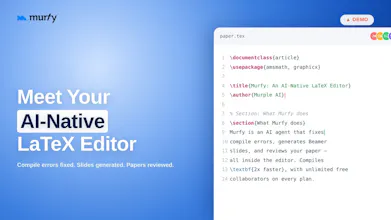
Murfy is a team of AI agents for the entire research writing workflow. Murfy helps to write and review your paper in context, fix LaTeX compile errors on the spot, verify reference papers and generate Beamer slides in minutes. Work with unlimited collaborators, real-time editing, free to start.
I'm Shounan, founder of Murple, the team behind Murfy.
Over the past 15 years I've written 10+ papers accepted at top-tier AI conferences (AAAI, EMNLP, SIGGRAPH, IROS), all in Overleaf. Every single time, the research wasn't the hard part, it was the writing. (Here's My Google Scholar if you're curious)
Formatting references at 2 A.M. before a deadline. Chasing co-authors for edits I needed yesterday. LaTeX compile errors with no useful message. Rebuilding the same slides from scratch for every single conference.
I kept asking myself: we have AI agents now, why is research writing still this hard?
So we built Murfy. Not another AI writing assistant bolted onto an editor, but an agent that actually works through the writing process with you: drafts with you, reviews your paper, revises based on reviewer comments, fixes your compile errors, and builds your Beamer slides.
Researchers in 120+ countries are using it now, and we're growing 50-100% month over month.
There's still a lot we want to improve, though, so I'd love to hear from anyone who's ever fought with a technical writing tool:
What’s the one part of research or technical writing that you hate doing and wish an AI agent would just take care of?
Tell me in the comments. I read all of them, and they'll shape what we build next.
@shounan_an One of the devs behind Murfy here!! It’s been a lot of fun (and a lot of LaTeX debugging) getting to this point. Excited to finally share it with everyone. Let us know what’s broken or annoying!!
I work on Murfy's backend. My side of it comes down to one thing: your compile should be fast, reproducible, and completely unremarkable. If it's ever not, this thread is a good place to tell me.
Report
@shounan_an Having real-time collaboration alongside contextual AI agent editing solves the biggest bottleneck in group papers. congrats🙌
@vikramp7470 Exactly! With Murfy, the AI agent sees the full paper context, so AI suggestions are actually relevant, not generic. Would love to hear what your biggest pain point is in collaborative research paper writing!
@vikramp7470 This was one of the trickiest parts to build, too. Thanks so much for the kind words!
Report
@shounan_an the fact that it can fix compile errors is actually pretty interesting. does it just fix the error, or can it figure out when the fix has messed up the formatting somewhere else?
@kamal_sharma26 Engineer at Murfy here, jumping in for Shounan.
The honest answer is: partly, but not for layout issues yet. The fix isn’t one-shot. Murfy compiles, edits, and recompiles up to three times, so if a fix causes another error, the next round can catch it. We also check the diff for shortcuts like deleting an \includegraphics or \input, or enabling draft mode just to make the error disappear.
But Murfy doesn’t inspect the rendered PDF yet. It reads the source and compile log, so it won’t notice if a package changes the line breaks or pushes a figure onto the next page. That’s a real limitation. That’s also why fixes aren’t applied automatically. You get an inline diff to accept or reject, along with a preview PDF so you can check the layout yourself.
@kamal_sharma26 Great question and Jaegeon gave you the honest technical picture.
I'd add the philosophy behind it: we deliberately didn't make it fully automatic. Research papers are too important to have AI silently fix something you didn't approve.
The diff + preview approach keeps you in control. The agent handles the tedious debugging loop, but the final call is always yours.
This is exactly the principle of research community just reinforced many times, AI assists the researcher decides.
I've never considered attempting to publish to arXiv, but if I did, I imagine @Murfy AI would be super clutch and save me a ton of hassle dealing with LaTeX!
Report
Congratulations @shounan_an ive tested it and it feels fast and it does solve issue for multi collaboration, only 2 issues i found in my 2nd iteration while adding and editing a Report
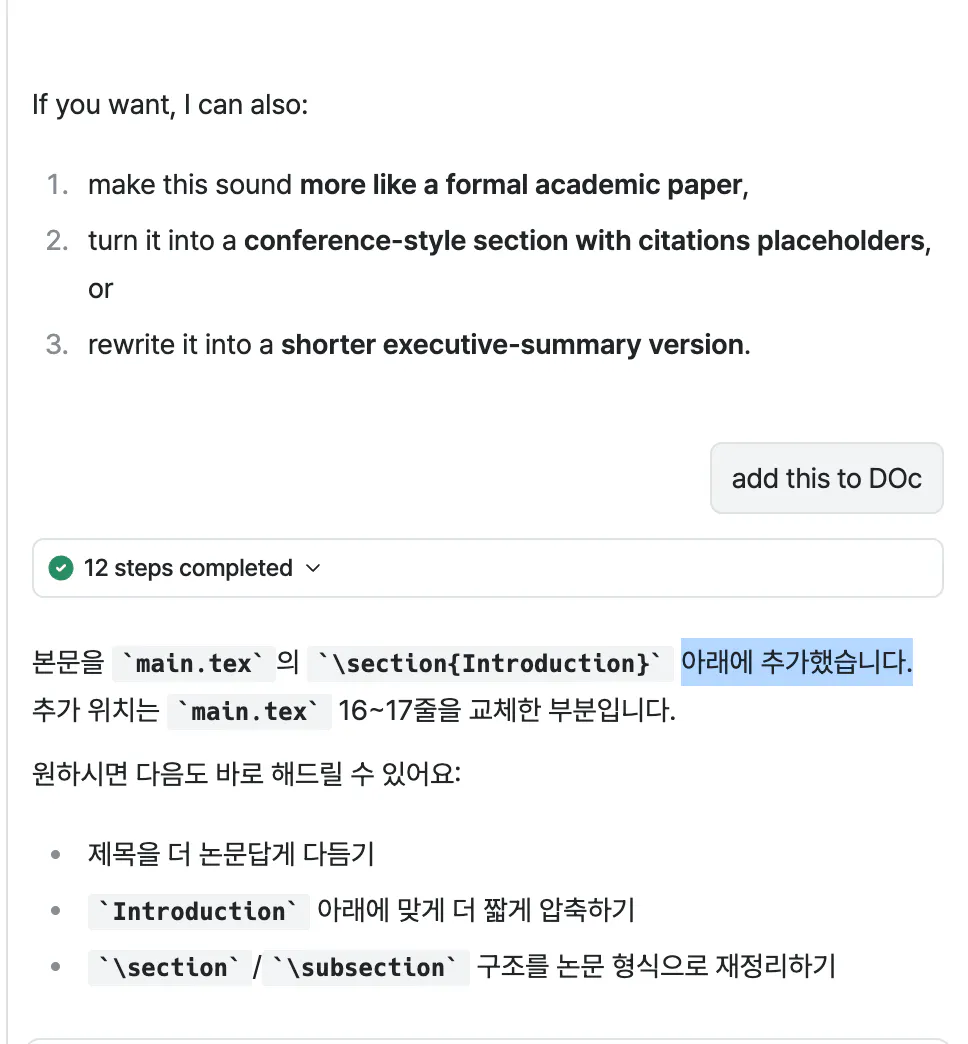
1. Even after replacing my report in the latex editor i was not able to get rid of the first page saying "Murfy Guide" 2. I was chatting with Murfy AI and somehow it responded with Korean language (Hangugeo)
Thanks for testing it twice and sharing such detailed feedback. This is genuinely helpful.
1. About the "Murfy Guide" first page:
It can be added from two separate places, so it's easy to remove one and miss the other. Please check your main .tex file for both of these:
- \input{murfy-guide.tex}
- \murfyguide
Remove both and recompile. If the page is still there, please use "Report bug" in the profile menu so we can take a closer look at your project.
2. About the Korean replies:
That one's on us. Some of our internal instructions are written in Korean, and occasionally that leaks into the response. We're working on a proper fix.
Sorry for the inconvenience, and thanks again for taking the time to report this.
Report
@jaegeon_jo This is exactly what i love about product hunt, it connects ppl who genuinely want to make good product and not just money, it is a pleasure to test and feedback such good tools, once again congratulations and #1 ahead ☝🏻
@raunaks_99 This means a lot :D thank you! Thoughtful feedback like yours is exactly what helps us build a better product. Really glad we connected here!!
Report
How does this compare to overleaf by digital science?
@rick_segal1 Honestly, Overleaf is the standard for online LaTeX editor, and it has years of maturity and a huge ecosystem behind it.
The main difference is that Murfy is built around paper-writing process, not just editing LaTeX. Its AI works more like an agent than a chat box: it reads the project files, suggests changes as a diff, compiles the paper, and works through errors until they’re fixed. You can accept or reject each change.
Murfy can also review the finished paper from the compiled PDF. It checks whether the claims are supported by the paper’s own evidence, challenges weak assumptions, and returns a referee-style report with a rating and confidence score.
We also don’t limit collaborators on the free plan, so you can invite your whole lab.
Where Overleaf is still ahead is maturity and integrations. We’re much newer, and we know we still have plenty to improve.
Great reply. I'm wonder tho, on the notion of AI and academic papers. Isn't there a risk the paper gets flagged/rejected as AI created? I'm 100% not an expert at all in this space, just really curious regarding walking that line between AI and academics. We do live in interesting times. Good luck with the product.
@rick_segal1 That’s a very fair concern, and one we think about a lot. Our goal isn’t to have AI write the research or make claims on the researcher’s behalf. It’s to take care of the repetitive work around writing (such as formatting, fixing LaTeX errors, checking consistency, handling revisions, and preparing slides) so researchers can spend more time on the actual ideas and evidence.
We’re still figuring out that line along with the rest of academia, but that’s the direction we want to build toward.
@rizzykicks Great question! It varies a lot by experience level.
Junior researchers save the most time on LaTeX itself via code assistance and compile error fixing. The learning curve disappears fast.
Senior researchers get the most value from deep AI paper reviews, which catch weaknesses, reproducibility issues, and reviewer-style feedback before submission. Iterating on that loop is where the real time savings stack up.
Advisorstold us the biggest win is visibility, seeing who changed what and when through revision history, plus AI-verified reference checking that used to be pure manual work.
Which stage are you at? Happy to dig into what Murfy can do for your specific workflow :)
Report
Thank you for publishing the product. I was a heavy LaTex User and it was my favorite way to write my thesis. Still I use Latex for lot of different purposes. Good Luck.
@sabber_ahamed Thank you for the kind words. Hearing this from a long-time LaTeX user means a lot to us. We know there's still plenty to improve, and we'll keep working to make it better. Thanks for the good wishes.
@sabber_ahamed Thank you so much Sabber! Wish you good luck too :)
Report
💡 Bright idea
answering the actual question: reformatting the same paper's citations and bibliography for a different venue after a rejection is my most hated part. every conference has its own citation style and reference format, and redoing that by hand for the third submission of the same paper feels like pure busywork with zero intellectual content. if Murfy can detect the target venue's style and just re-flow the references, that alone would sell me.
@galdayan That's actually the exact situation that gave us the idea-even the third submission part. We've also seen people ask Murfy things like, "Convert this ACM paper to the Elsevier template" or "Make this fit the KCC format."
We're working on it now. The idea is that you choose the target venue, and Murfy handles the class, packages, structure, and bibliography style, then fixes any compile errors along the way. You'll still get a diff so you can review everything.
Bibliographies are the tricky bit, since changing the .bst file doesn't always cover everything. We'd rather show you what changed than silently rewrite your references.
@galdayan Resubmission after rejection, almost the same paper, different format: pure busywork with zero intellectual content. You nailed it.
That feature is coming in Murfy very soon.
Would love to test it against a real case when it's ready, what venue are you targeting next?
Report
@shounan_an a NeurIPS workshop track, actually - tighter page limit and a different citation style than the venue we got rejected from, so it's good timing to have a real test case for the reformatting feature once it's out. happy to send over the diff between the two versions if that's useful for testing edge cases on your end.
Murfy AI
Hey Product Hunt!
I'm Shounan, founder of Murple, the team behind Murfy.
Over the past 15 years I've written 10+ papers accepted at top-tier AI conferences (AAAI, EMNLP, SIGGRAPH, IROS), all in Overleaf. Every single time, the research wasn't the hard part, it was the writing. (Here's My Google Scholar if you're curious)
Formatting references at 2 A.M. before a deadline. Chasing co-authors for edits I needed yesterday. LaTeX compile errors with no useful message. Rebuilding the same slides from scratch for every single conference.
I kept asking myself: we have AI agents now, why is research writing still this hard?
So we built Murfy. Not another AI writing assistant bolted onto an editor, but an agent that actually works through the writing process with you: drafts with you, reviews your paper, revises based on reviewer comments, fixes your compile errors, and builds your Beamer slides.
Researchers in 120+ countries are using it now, and we're growing 50-100% month over month.
There's still a lot we want to improve, though, so I'd love to hear from anyone who's ever fought with a technical writing tool:
What’s the one part of research or technical writing that you hate doing and wish an AI agent would just take care of?
Tell me in the comments. I read all of them, and they'll shape what we build next.
Murfy AI
@shounan_an One of the devs behind Murfy here!! It’s been a lot of fun (and a lot of LaTeX debugging) getting to this point. Excited to finally share it with everyone. Let us know what’s broken or annoying!!
Murfy AI
I work on Murfy's backend. My side of it comes down to one thing: your compile should be fast, reproducible, and completely unremarkable. If it's ever not, this thread is a good place to tell me.
@shounan_an Having real-time collaboration alongside contextual AI agent editing solves the biggest bottleneck in group papers. congrats🙌
Murfy AI
@vikramp7470 Exactly! With Murfy, the AI agent sees the full paper context, so AI suggestions are actually relevant, not generic. Would love to hear what your biggest pain point is in collaborative research paper writing!
Murfy AI
@vikramp7470 This was one of the trickiest parts to build, too. Thanks so much for the kind words!
@shounan_an the fact that it can fix compile errors is actually pretty interesting. does it just fix the error, or can it figure out when the fix has messed up the formatting somewhere else?
Murfy AI
@kamal_sharma26 Engineer at Murfy here, jumping in for Shounan.
The honest answer is: partly, but not for layout issues yet. The fix isn’t one-shot. Murfy compiles, edits, and recompiles up to three times, so if a fix causes another error, the next round can catch it. We also check the diff for shortcuts like deleting an \includegraphics or \input, or enabling draft mode just to make the error disappear.
But Murfy doesn’t inspect the rendered PDF yet. It reads the source and compile log, so it won’t notice if a package changes the line breaks or pushes a figure onto the next page. That’s a real limitation. That’s also why fixes aren’t applied automatically. You get an inline diff to accept or reject, along with a preview PDF so you can check the layout yourself.
Murfy AI
@kamal_sharma26 Great question and Jaegeon gave you the honest technical picture.
I'd add the philosophy behind it: we deliberately didn't make it fully automatic. Research papers are too important to have AI silently fix something you didn't approve.
The diff + preview approach keeps you in control. The agent handles the tedious debugging loop, but the final call is always yours.
This is exactly the principle of research community just reinforced many times, AI assists the researcher decides.
Osaurus
I've never considered attempting to publish to arXiv, but if I did, I imagine @Murfy AI would be super clutch and save me a ton of hassle dealing with LaTeX!
Congratulations @shounan_an ive tested it and it feels fast and it does solve issue for multi collaboration, only 2 issues i found in my 2nd iteration while adding and editing a Report
1. Even after replacing my report in the latex editor i was not able to get rid of the first page saying "Murfy Guide"
2. I was chatting with Murfy AI and somehow it responded with Korean language (Hangugeo)
@shounan_an For refrence
Murfy AI
@raunaks_99
Thanks for testing it twice and sharing such detailed feedback. This is genuinely helpful.
1. About the "Murfy Guide" first page:
It can be added from two separate places, so it's easy to remove one and miss the other. Please check your main .tex file for both of these:
Remove both and recompile. If the page is still there, please use "Report bug" in the profile menu so we can take a closer look at your project.
2. About the Korean replies:
That one's on us. Some of our internal instructions are written in Korean, and occasionally that leaks into the response. We're working on a proper fix.
Sorry for the inconvenience, and thanks again for taking the time to report this.
@jaegeon_jo This is exactly what i love about product hunt, it connects ppl who genuinely want to make good product and not just money, it is a pleasure to test and feedback such good tools, once again congratulations and #1 ahead ☝🏻
Murfy AI
@raunaks_99 This means a lot :D thank you! Thoughtful feedback like yours is exactly what helps us build a better product. Really glad we connected here!!
How does this compare to overleaf by digital science?
Murfy AI
@rick_segal1 Honestly, Overleaf is the standard for online LaTeX editor, and it has years of maturity and a huge ecosystem behind it.
The main difference is that Murfy is built around paper-writing process, not just editing LaTeX. Its AI works more like an agent than a chat box: it reads the project files, suggests changes as a diff, compiles the paper, and works through errors until they’re fixed. You can accept or reject each change.
Murfy can also review the finished paper from the compiled PDF. It checks whether the claims are supported by the paper’s own evidence, challenges weak assumptions, and returns a referee-style report with a rating and confidence score.
We also don’t limit collaborators on the free plan, so you can invite your whole lab.
Where Overleaf is still ahead is maturity and integrations. We’re much newer, and we know we still have plenty to improve.
@jaegeon_jo,
Great reply. I'm wonder tho, on the notion of AI and academic papers. Isn't there a risk the paper gets flagged/rejected as AI created? I'm 100% not an expert at all in this space, just really curious regarding walking that line between AI and academics. We do live in interesting times. Good luck with the product.
Murfy AI
@rick_segal1 That’s a very fair concern, and one we think about a lot. Our goal isn’t to have AI write the research or make claims on the researcher’s behalf. It’s to take care of the repetitive work around writing (such as formatting, fixing LaTeX errors, checking consistency, handling revisions, and preparing slides) so researchers can spend more time on the actual ideas and evidence.
We’re still figuring out that line along with the rest of academia, but that’s the direction we want to build toward.
Thanks for raising it and for the kind words!
Astute
Congratulations on the launch @shounan_an This looks slick. What part of the research workflow are users saving the most time on so far?
Murfy AI
@rizzykicks Great question! It varies a lot by experience level.
Junior researchers save the most time on LaTeX itself via code assistance and compile error fixing. The learning curve disappears fast.
Senior researchers get the most value from deep AI paper reviews, which catch weaknesses, reproducibility issues, and reviewer-style feedback before submission. Iterating on that loop is where the real time savings stack up.
Advisors told us the biggest win is visibility, seeing who changed what and when through revision history, plus AI-verified reference checking that used to be pure manual work.
Which stage are you at? Happy to dig into what Murfy can do for your specific workflow :)
Thank you for publishing the product. I was a heavy LaTex User and it was my favorite way to write my thesis. Still I use Latex for lot of different purposes. Good Luck.
Murfy AI
@sabber_ahamed Thank you for the kind words. Hearing this from a long-time LaTeX user means a lot to us. We know there's still plenty to improve, and we'll keep working to make it better. Thanks for the good wishes.
Murfy AI
@sabber_ahamed Thank you! It’s always great to hear from a fellow LaTeX user. Hope Murfy can be useful for some of your future work!
Murfy AI
@sabber_ahamed Thank you so much Sabber! Wish you good luck too :)
answering the actual question: reformatting the same paper's citations and bibliography for a different venue after a rejection is my most hated part. every conference has its own citation style and reference format, and redoing that by hand for the third submission of the same paper feels like pure busywork with zero intellectual content. if Murfy can detect the target venue's style and just re-flow the references, that alone would sell me.
Murfy AI
@galdayan That's actually the exact situation that gave us the idea-even the third submission part. We've also seen people ask Murfy things like, "Convert this ACM paper to the Elsevier template" or "Make this fit the KCC format."
We're working on it now. The idea is that you choose the target venue, and Murfy handles the class, packages, structure, and bibliography style, then fixes any compile errors along the way. You'll still get a diff so you can review everything.
Bibliographies are the tricky bit, since changing the .bst file doesn't always cover everything. We'd rather show you what changed than silently rewrite your references.
Still in development, but coming soon!
Murfy AI
@galdayan Resubmission after rejection, almost the same paper, different format: pure busywork with zero intellectual content. You nailed it.
That feature is coming in Murfy very soon.
Would love to test it against a real case when it's ready, what venue are you targeting next?
@shounan_an a NeurIPS workshop track, actually - tighter page limit and a different citation style than the venue we got rejected from, so it's good timing to have a real test case for the reformatting feature once it's out. happy to send over the diff between the two versions if that's useful for testing edge cases on your end.