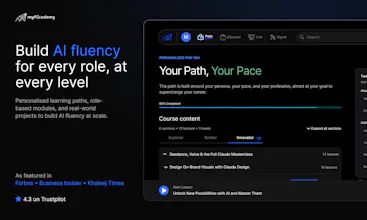
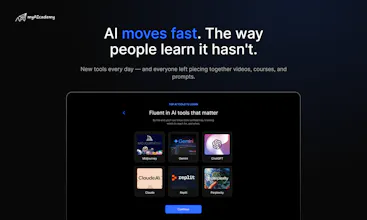
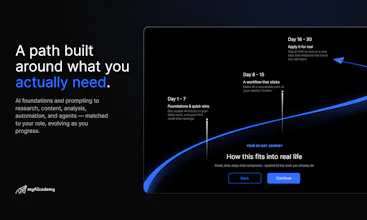
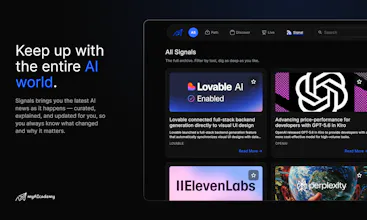
myAIcademy builds personalized AI training around your role, goals, and the tools you actually use. Learn through follow-along lessons, practice safely with simulations of real AI tools, and get step-by-step guidance from Aimy while you work. Generic courses and prompt libraries that quickly go stale, while myAIcademy continuously refreshes its content as AI changes, so your skills keep up too.
No reviews yetBe the first to leave a review for myAIcademy
A lot of AI courses teach tools but people struggle to apply them at work. How do you make sure learners actually build useful workflows?
Congrats @malika_malik1 & team!
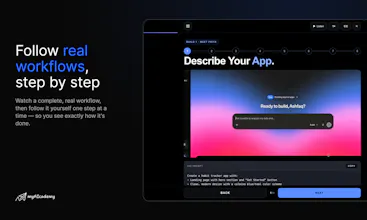
@hamza_afzal_butt Thank you, Hamza! We focus on helping people learn, practise and apply real workflows. Each learner receives short, practical lessons built around their profession and the tools they need, with a focus on completing real tasks using best practices rather than learning theory. They then rebuild the workflow independently inside our simulator checkpoints and receive feedback on exactly how to improve.
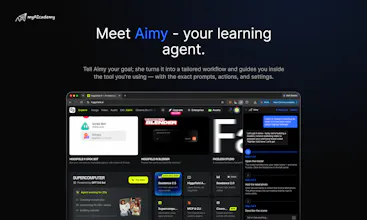
We are also launching Aimy very soon. Users will be able to open Aimy inside any tool, describe what they want to accomplish, and choose whether Aimy guides them through the task step by step or executes it for them. The goal is to turn learning into confident, practical application at work.
Report
I like the focus on learning AI around the actual role. That feels much more useful than taking a generic course.
@edward_paul3 thanks Edward. generic courses tell you what the tool does. they don't tell a finance analyst or a recruiter what to do with it in their actual week. that's the bit we're trying to close.
I'm Ashfaq, Head of Design at myAIcademy. If you have any design questions, feedback, or ideas on how the experience could be better, I'd love to hear them, feel free to reach out or drop them here.
@malika_malik1 How do you handle updating lessons so quickly when tools change every few days, and is the simulator running real API environments or guided mock setups?
Report
Maker
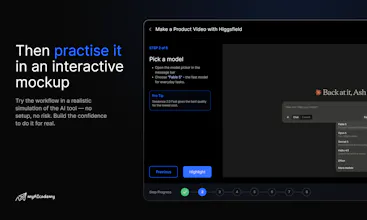
@tehreem_fatima5 Great question. We treat lessons as structured, versioned workflows rather than static content. Our monitoring pipeline tracks model releases, feature changes, deprecations and UI updates, maps each change to the affected lessons, and triggers the relevant content for regeneration and review. This is how we maintain the 72-hour update cycle at scale. The checkpoints use stateful, purpose-built simulations rather than live third-party APIs. Each learner action is captured and evaluated against the expected workflow and step-level rubric, allowing us to identify exactly where they struggled and provide targeted feedback. This also makes assessments consistent, secure and accessible without requiring paid tool access or exposing organisational data.
Report
The simulations sound interesting. Practicing with realistic AI tools before using them at work could make learning less intimidating.
@filxa_adam Thank you—that’s exactly why we built them. Our simulations called checkpoints give professionals a safe place to practise realistic, role-specific tasks before applying those skills to real work. It’s about building confidence through doing, not just watching.
the part I'd want to see thought through more is the jump from Aimy guiding someone through a checkpoint in the simulator to Aimy "executing the task with them" inside their real tools, per the reply above. a simulated workflow is safe by construction, there's nothing real to break. the moment Aimy is authorized inside someone's actual CRM or inbox, that's a different category of risk than "the lesson is a bit stale," and it's the same permissions problem every agent-in-your-tools product eventually has to answer. is that scoped per-persona already, or is it still an open design question for when Aimy ships?


myAIcademy
@hamza_afzal_butt Thank you, Hamza! We focus on helping people learn, practise and apply real workflows. Each learner receives short, practical lessons built around their profession and the tools they need, with a focus on completing real tasks using best practices rather than learning theory. They then rebuild the workflow independently inside our simulator checkpoints and receive feedback on exactly how to improve.
We are also launching Aimy very soon. Users will be able to open Aimy inside any tool, describe what they want to accomplish, and choose whether Aimy guides them through the task step by step or executes it for them. The goal is to turn learning into confident, practical application at work.
I like the focus on learning AI around the actual role. That feels much more useful than taking a generic course.
myAIcademy
@edward_paul3 thanks Edward. generic courses tell you what the tool does. they don't tell a finance analyst or a recruiter what to do with it in their actual week. that's the bit we're trying to close.
myAIcademy
Hi everyone,
I'm Ashfaq, Head of Design at myAIcademy. If you have any design questions, feedback, or ideas on how the experience could be better, I'd love to hear them, feel free to reach out or drop them here.
Looking forward to your reviews!
Mailwarm
Congrats on today's launch!!
myAIcademy
@tehreem_fatima5 Great question. We treat lessons as structured, versioned workflows rather than static content. Our monitoring pipeline tracks model releases, feature changes, deprecations and UI updates, maps each change to the affected lessons, and triggers the relevant content for regeneration and review. This is how we maintain the 72-hour update cycle at scale.
The checkpoints use stateful, purpose-built simulations rather than live third-party APIs. Each learner action is captured and evaluated against the expected workflow and step-level rubric, allowing us to identify exactly where they struggled and provide targeted feedback. This also makes assessments consistent, secure and accessible without requiring paid tool access or exposing organisational data.
The simulations sound interesting. Practicing with realistic AI tools before using them at work could make learning less intimidating.
myAIcademy
@filxa_adam Thank you—that’s exactly why we built them. Our simulations called checkpoints give professionals a safe place to practise realistic, role-specific tasks before applying those skills to real work. It’s about building confidence through doing, not just watching.
Dial
the part I'd want to see thought through more is the jump from Aimy guiding someone through a checkpoint in the simulator to Aimy "executing the task with them" inside their real tools, per the reply above. a simulated workflow is safe by construction, there's nothing real to break. the moment Aimy is authorized inside someone's actual CRM or inbox, that's a different category of risk than "the lesson is a bit stale," and it's the same permissions problem every agent-in-your-tools product eventually has to answer. is that scoped per-persona already, or is it still an open design question for when Aimy ships?