
Launching today

Neuralingo Language Learning
slowly inch your way to mastery: try, fail, learn, get good
79 followers
slowly inch your way to mastery: try, fail, learn, get good
79 followers
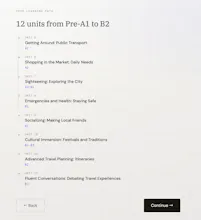
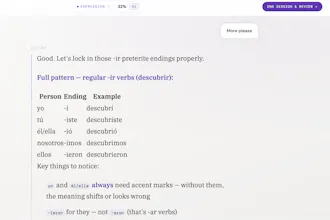
6 learning modes cover - in theory - all you need to know to truly get good at a new language. Reading, writing, listening, pronunciation, conversation and language understanding. Each exercise uses vocabulary and grammar that you're slightly insecure in, so you can make mistakes, understand why and get a bit better every day. The learning algorithm is based on the "forgetting curve" and "desirable difficulty" research from neuroscience.






Really clean UX on this. How are you handling rate limiting on the API side?
Neuralingo Language Learning
@lumidrivetech Thanks! We are using slow_api - rate limits on all routes incl. signup, verification, billing, and of course the model responses. Text is not so much, but the speech stuff can get expensive. The backend is FastAPI btw.
Neuralingo Language Learning
Most language apps make things too easy so you feel good but don't actually learn. How many languages does it currently support, and does the pronunciation mode work well for non-Latin script languages?
Neuralingo Language Learning
@ben_gend I agree, and I think these apps are targeting people that have only lukewarm interest in learning a language. It's more a "get the feeling of being in Italy while being at home" kind of thing. So, it becomes entertainment more than education. A friend in Germany said "Duolingo is not really working, but it's the most productive thing I do with my phone". I am not sure, I hope we can find a way to navigate this in marketing.
Re: pronunciation mode:
AzureSDK is used for this and it is remarkably accurate. But I wouldn't call the pronunciation mode good overall yet for any language, because so much depends on the calibration between the user's voice and the speech tool. E.g. We have a Portuguese native speaker who is learning German who has a hard time with the consonants, which makes her pronunciation very different from the target. It works and it is helpful, however the Expression mode (translating into the target language) is where most of the actual understanding is gained. Once people understand the language they can listen to it. Once they can do that, they can pronounce it (fine-tuning).
What language do you want to learn and have you tried the pronunciation mode for it already?
Re: supported languages: I am copy/pasting from my earlier comment:
We use LanguageTool (Docker) and deepL for verification of the AI responses. We use AzureSDK for the pronunciation analysis and GoogleSpeech for TTS. So, the limiting factor is what these tools support.
The main languages are: English, Spanish, French, German, Italian, Portuguese, Japanese, Korean, Mandarin Chinese, Vietnamese. There are others, like Swedish, Arabic, Russian, Greek... which are supported, but not from all tools. E.g. LanguageTool doesn't support Swedish, so you may get a few more AI hallucinations. Farsi doesn't have a great TTS voice available. And so on..
For the beta, we have left the list of languages quite large to see how the users' experiences are. Perhaps we need to remove some in the future.
Good luck with your launch!
Learning a language properly through apps is really hard (I'm struggling to learn German with Duolingo actually), and I think your app can really solve this problem!
I'm curious to know more about the method you talk about in the website: did you do some deep research on neuroscience or are there neuoscientists in your team who helped you develop the app?
Neuralingo Language Learning
@pamela_arienti Thank you Pamela! Interesting that you're learning German - I bet you are not loving the grammar cases (Dativ, Akkusativ, ...). It would be interesting to hear your comparison between your progress made from Duolingo and neuralingo.
The core neuroscientific findings are that we remember very little when we passively consume material and significantly more when doing it actively. There are 3 key active learning methods with increasing effectiveness: group discussion, learning by doing, explaining (most effective). We basically eliminated all the passive ones and replaced them with active ones, e.g. the AI does not tell you the mistakes right away, but it asks you to go through what you wrote and compare it to the correct solution and spot your mistakes yourself.
Desirable difficulty is also a key neuroscientific concept: Each exercise is just a tiny bit more difficult than the previous one, so that you're making about 1-3 mistakes. You're always a bit outside your comfort zone, but it's challenging, not overwhelming. (I think that's very important, because when we see progress, we continue, but if we get overwhelmed - which we often do in traditional language learning - we stop)
The neuroscience that exists goes far deeper than we've applied in neuralingo currently. I did it myself, but I am hoping that someone with a neuroscientific background will join the advisory board.
P.S. Perhaps we should add you to our free neuralingo German group - 8 German learners from Chile, Peru, Turkey, Iran, Philippines - they are going to Germany for work. You could set meetings with them to practice.
@oldcarnewradio @Neuralingo Language Learning
Hi Julius! It's my first time to know AI product via makers' real story which's really cool and vivid. Here's my perspective from not professional but real language learner.
1. 🤩👍Good aesthetic taste which makes me have attention and intent to go deeper! THAT IS IMPORTANT FOR language learning App. You know what I mean.
2. Honestly I have left my Duolingo cuz I do not need a game app which only use one language explaining another. 😓What I need to learn is a vivid and like storytelling bridge between cultures not only languages. Neuraligo really delivers a new learning experience.👍
3. I wonder if you guys develop speak features it will be much more convenient.💬
Neuralingo Language Learning
@laura_yang1 Hi Laura - Thank you for your kind words! Glad you like the UI - it cost me a lot of nerves to set up - it was either too techy or too academic 😃
That's exactly the position we want to develop in the market -- the language learning platform that actually works, not a game. Please share updates about your progress - that's really the only goal neuralingo has. You can use the feedback button on any page or via email to julius@neuralingo.academy.
Re: Speaking feature: Have you seen the speaking/conversation mode? You can hold a real-time conversation, either in writing or by speaking. What I've learned from the 1:1 tutoring over the last years is that the most important progress happens in the Expression mode (translating into your target language). Example: Sometimes students ask me to do more listening exercises, because they say they cannot do them well. Then we do them, and they don't do well again. So they think they just need to do more of them. But when we give them the same text from the listening exercise to read - and they cannot understand, then how can they expect to pass the listening exercise?
My point is: I know it's a bit boring, but if you can, spend as much time as possible in the Expression mode to build good language understanding.
What language are you learning?
Seeing this at a really good time as I am trying to polish up my Swedish! Seems like an awesome application, congrats on the launch! What languages do you support atm?
Neuralingo Language Learning
@tom_blk Wow, Swedish is interesting. I was on an exchange year in the US once where I lived with a Swedish room mate. That was when Sweden launched Spotify and no one knew what is was yet 😃
Thank you for your kind words. We support Swedish, and you would be the first student - so it would be interesting to hear your thoughts.
Re: supported languages: We use LanguageTool (Docker) and deepL for verification of the AI responses. We use AzureSDK for the pronunciation analysis and GoogleSpeech for TTS. So, the limiting factor is what these tools support.
The main languages are: English, Spanish, French, German, Italian, Portuguese, Japanese, Korean, Mandarin Chinese, Vietnamese. There are others, like Swedish, Arabic, Russian, Greek... which are supported, but not from all tools. E.g. LanguageTool doesn't support Swedish, so you may get a few more AI hallucinations. Farsi doesn't have a great TTS voice available. And so on..
For the beta, we have left the list of languages quite large to see how the users' experiences are. Perhaps we need to remove some in the future.
The pronunciation exercises are helpful because I can hear mistakes and correct them immediately.