
Nuphos
The AI-Native DevOps Workspace.
747 followers
The AI-Native DevOps Workspace.
747 followers
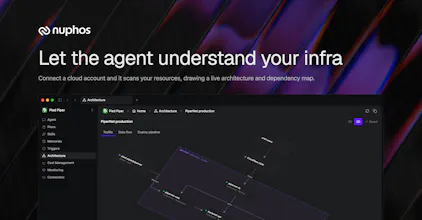
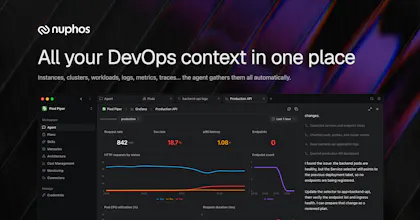
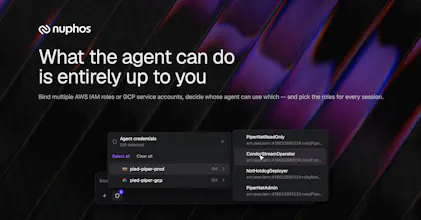
Nuphos gives engineering teams a shared environment where AI agents can learn your infrastructure, investigate issues, and operate production systems.
747 followers
747 followers




Tabbit AI
Congrats! Is it free?
Nuphos
@olliez1 Yes! The all-in-one DevOps workspace is free forever. If you want to add the AI agent, paid plans start at $29/month per workspace. You can start free and upgrade whenever you’re ready 😊
Full details here: nuphos.ai/pricing
Nuphos
@olliez1 Yes! You can use it free as a team shared DevOps workspace. And also we have 1 month free for the Dev plan ($29/month) that you can try the AI features~
Minduck
This looks really exciting! One thing I’m curious about: how would you see Nuphos fitting into the workflow of a solo developer or a one-person team?
I build and experiment with multiple small products and AI projects, but I don’t necessarily have a large SaaS infrastructure or a dedicated DevOps team.
Would Nuphos still be useful at this stage? If so, what would be a good real-world use case for someone like me to start with?
Or is Nuphos currently more suited to larger teams that already have a fairly complex production infrastructure?
Would love to understand where a solo builder fits into the Nuphos vision.
Nuphos
@timliao Great question. I’d say Nuphos becomes more valuable as your infrastructure gets more complex, but you definitely don’t need a dedicated DevOps team to use it.
For a solo builder, a good starting point is simply connecting the cloud/Kubernetes setup behind your projects and using Nuphos as one place to understand what’s running, investigate issues, and keep an eye on cost or reliability.
In fact, solo developers often have the opposite problem: there’s no DevOps engineer to ask when something breaks at 2am.
That said, our strongest use cases today are teams already running real production infrastructure across multiple services or tools. That’s where the shared context, approvals, memory, and cross-stack investigation become much more valuable.
Nuphos
@timliao Definitely. As a solo builder, you still have infrastructure—you’re just wearing both the developer and operator hats. A good starting point is to connect one cloud account read-only and ask Nuphos to inventory what’s running, explain an unexpected cost, or investigate a failing deployment; any changes can remain approval-gated. Larger teams benefit from shared context and collaboration, but they aren’t a prerequisite.
Nuphos
@timliao Love this question! Honestly, solo devs might get the most out of it — the whole idea is that you don't need a DevOps team, because Nuphos kind of is your DevOps team.
If you're running a few side projects, infra work still lands on you — deploys, random 2am crashes, digging through logs. Just connect a cloud account or cluster you already have, and when something breaks, tell the agent — it checks logs, looks at the deployment, and suggests a fix. Basically an on-call engineer for projects that would never justify hiring one.
So definitely not big-teams-only. Curious what your stack looks like though — happy to point you to a good starting spot!
Nuphos
@timliao Thanks, Tim — great question. Solo builders are very much part of the Nuphos vision.
You don’t need a large infrastructure or a dedicated DevOps team to benefit. In fact, when you’re building alone, every hour spent switching between deployment dashboards, logs, cloud consoles, and infrastructure tools is time taken away from the product.
A practical starting point would be using Nuphos to manage and understand the production environment for one of your small apps: seeing what’s running, keeping operational context in one place, and investigating deployment or infrastructure issues without having to become a DevOps specialist.
Larger teams naturally get additional value from shared context and collaboration, but for a solo developer the core benefit is leverage—being able to operate several products with less overhead and more confidence.
We’d love to learn more about your setup as we continue shaping the solo-builder experience.
Nuphos
@timliao The real dividing line isn’t team size—it’s how much infrastructure you’re responsible for. A solo developer running production workloads across cloud services, databases, or Kubernetes is already a strong fit. You’re still doing platform work; you’re just doing it without a platform team.
The point about running kubectl not being the hard part really resonated with me. Agents can already execute commands. The bigger challenge is making sure teams understand what they are doing and feel comfortable giving them access to production. Nuphos seems to be solving the right problem.
Nuphos
@luke_pioneero Glad to hear this! The way we address the Trust issue is through the default read-only first access. We believe that trust is earned and the human-in-the-loop process is a must.
Nuphos
@luke_pioneero Exactly. As an engineer building Nuphos, I’ve found that executing the command is usually the easy part. The harder part is showing the evidence, assumptions, and proposed change clearly enough that an operator feels comfortable proceeding, especially in production. That trust boundary is a big part of what we’re building around.
Nuphos
@luke_pioneero Exactly. The command itself is rarely the hard part.
The real challenge is giving the agent enough context to make a good decision, while making its reasoning, permissions, and actions understandable to the team.
That trust layer is a big part of what we’re building with Nuphos. Thanks Luke!
Nuphos
@luke_pioneero That’s exactly how we think about it. Production access shouldn’t be an all-or-nothing leap. Teams should be able to start with visibility, see how the agent behaves, and gradually expand its authority as confidence grows.
BiRead
This feels like the right direction for AI in DevOps. Running commands is the easy part — understanding the infrastructure, permissions, past incidents, and how a team actually operates is much harder.
Really like the read-only-by-default + approval approach too. Agents touching prod need context and guardrails, not just more autonomy. Congrats on the launch!
Nuphos
@ll_wen We greatly appreciate your perceptive comment. Executing commands is straightforward, yet grasping infrastructure, permissions, incident history and actual team operations poses the real challenge. Our read‑only‑by‑default approval workflow is built to provide critical context and safety guardrails for production‑facing AI agents. Thank you for celebrating our launch with us!
Nuphos
@ll_wen Exactly, especially given the fact that the term AIOps has been around for quite a while. But until today even with all the coding agents and IDE tools, the way we manage infra is pretty much still the same as previous times. The guardrails and context are still relying on the human-in-the-loop process!
Nuphos
@ll_wen Exactly. Running the command is usually the easy part.
The harder part is giving the agent enough context to understand why something should change, while keeping the boundaries around what it’s allowed to do explicit.
That’s a big part of how we think about Nuphos. Thanks for the thoughtful comment!
Nuphos
Coming from the marketing side of the team, I’ve been preparing for this launch for a long time.
I’ve watched Nuphos take shape through every piece of copy, every image, and every video we created.
The living runbook is probably the feature I’m most excited about. Too much valuable incident knowledge gets buried in Slack, only to be rediscovered at 2 a.m. months later.
So happy to finally see Nuphos live 🎉
Give it a try! We’d genuinely love to hear any feedback, especially what feels wrong or where it breaks.
Nuphos
Nuphos team here! 👋
My favorite part is the exact moment when monitoring FIREs, Nuphos agent starts investigating, and the context lands in our Slack channel. The agent gets to work automatically, with prod access under-watched, human approved. Being platform engineer myself, the collaborative workspace is what empowers me the most.
Nuphos
Launch day! I worked on growth side, it’s fun watching Nuphos evolve. From “can we stop hogging across 10 tools for every incident?”, to something we now use in our own infrastructure, dogfooding every single day. Can't wait to see more devops engineer start using Nuphos, bringing more thoughts on the idea of AIOps!