

oobo
Git layer that preserves the why behind AI-written code
101 followers
Git layer that preserves the why behind AI-written code
101 followers
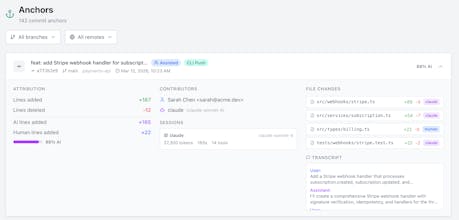
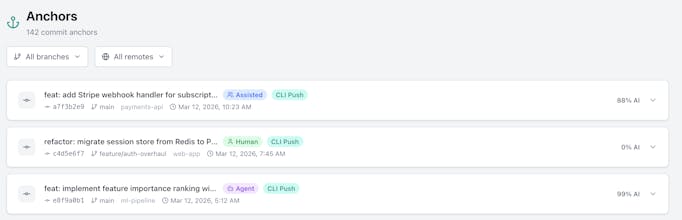
Oobo is Git for agents (and humans). It enriches your repo with additional context about AI usage, helping agents and teams understand why something was built, how decisions were made, and what happened around the code, not just in the final diff.

oobo
Congrats on the launch Teddy!
Is there a way to search for something across chats?
For example, I'm using Cursor and Claude Code for different chats, and sometimes I change something but forget which chat I asked in. So I'd love to be able to find when I changed something.
Really nice product, btw.
oobo
Thanks @alex_paun1. And yes, that actually happens more often than not, I'm the same, chat sessions all over the place with different agents.
We do have (for now a very basic search on the CLI) and you can do:
hope this helps, and thank you!
Really nice product! I can imagine this being huge for handoffs, especially when one person or agent starts something and another one has to continue it. Are you already seeing that use case?
oobo
Yes absolutely @elena_jay - handoffs are one of the strongest use cases.
If you think about it, every time you push code to Git, you're handing work off to your future self or to your team.
But what gets shipped is only the final form of the code without additional context, and everything else around how you arrived at a conclusion, why you built something the way you did, and the more intimate parts of the process, including both your prompting and the agent's thinking, usually gets lost.
Very cool product Teddy!
The “why” behind the code is often more valuable than the code itself a few weeks later. How are you deciding what context deserves to be preserved?
oobo
Thanks for the feedback @nninaaa - the more context is preserved, the better. By default (and for privacy reasons), we only capture the metadata (token usage, models, attribution (human vs. agent)) but then the user can opt-in to preserve the whole chat session with:
in which case, the transcript is filtered through gitleaks for any sensitive information.
How does Oobo capture and structure AI decision context without significantly increasing repository size or slowing down existing Git workflows?
oobo
Great question @mordrag, three design decisions make this work:
1. Git runs first, Oobo enriches after. Oobo sits in front of git as a transparent proxy (alias git=oobo). When you run git commit or oobo commit, the real git binary executes first and completes at full native speed. Only after a successful commit does Oobo attach metadata such as session links, attribution, token counts. If anything goes wrong with the enrichment step, the commit still succeeds. Oobo never blocks git.
2. Metadata lives on a separate orphan branch, not in your code history. Anchor data is written to an orphan branch (oobo/anchors/v1) using low-level git plumbing commands, so your working tree, index, and code history are never touched. Each anchor is a small JSON file (~1-2 KB) keyed by commit hash. It doesn't show up in git log, doesn't affect diffs, and doesn't bloat your main branch. Entries are sharded by hash prefix (similar to git's own object storage), so concurrent agents writing anchors never create conflicts.
3. Heavy data stays local by default. Full transcripts, search indexes, token analytics, and cross-project queries all live in a local SQLite database, not in the repo at all. Only lightweight metadata syncs through git. Transcript sync is opt-in (we call it "transparency mode") and even then, transcripts are redacted before they leave your machine.
The net effect: a typical commit adds maybe 50-100ms of overhead and a few KB to a branch you'll never look at directly. Your git log, your diffs, your CI are all unchanged.
Congrats on the launch! Is the end user for a finance team looking at token spend measurement or developer productivity (à la DORA)?
oobo
Hey thank you @lakshya_bakshi!
It's primarily for agent productivity and visibility.
Oobo helps engineering leaders understand agent-driven work: what was built, why it was built, where time and tokens went, and where things may be getting stuck.
As agents become first-class builders, teams need a better way to understand, review, and manage how software gets made.
It's also useful for individual developers.
generates a GitHub-like AI readiness graph similar to the one below:
then,
lets you share the chat sessions and
helps you quickly find why something was implemented in the first place.
That export piece is especially relevant now that some companies, and even Y Combinator in its updated application form, are open to seeing transcripts or working sessions as proof of how someone actually builds with AI.
Congrats on the launch! I see it's largely for engineering teams, but is there a use case for non-coders trying to build products with AI? I can definitely see this helping me :)
oobo
Thank you @kirandjiska!
Today almost everyone is a "coder" in some way, even if they're not writing code directly, because their AI tools and agents are doing it on their behalf.
If you use Claude, Cursor, or similar tools, you can have them use `oobo` in the background. That gives you visibility into what was generated, how the session evolved, what was discussed in chat, usage patterns, and even rough token/cost estimates.
So while we started with engineering teams in mind, it'ss also very useful for non-coders building products with AI who want more clarity and control over what their agents are actually doing.