Hey everyone, Siddhant here, founder of @PeakRoutine
First and foremost thank you.
We genuinely never imagined we'd crack the top 10, let alone land at #4. The engagement, the comments, the kind words you made our day, and we mean that.
Some of the feedback we received left us both surprised and deeply moved. It's one of those rare moments where you realize the work you've been quietly doing in the background actually resonates with real people.






ChatWebby AI
The correlation engine is the part that stands out to me, surfacing relationships across sleep, HRV and sunlight is genuinely hard to do well at n=1. How many days of synced history do you typically need before the AI starts surfacing confident patterns rather than noise?
PeakRoutine
@zain_sheikh Appreciate that — the n=1 correlation problem is honestly the hardest part to get right
Real answer: it's recurrence-driven, not a fixed day count. We backfill ~90 days the moment you sync, so a lot of the first patterns show up on day one. After that, a high-frequency daily signal (sunlight → that night's sleep) firms up in ~2–3 weeks since you get a data point every day; rarer behaviors take proportionally longer.
So ballpark: confident single-link patterns in a couple of weeks (or instantly if your history already shows them), multi-variable stuff over a month or so. And anything that hasn't earned confidence stays "noticing," not advice — we'd rather under-claim than surface noise.
PeakRoutine
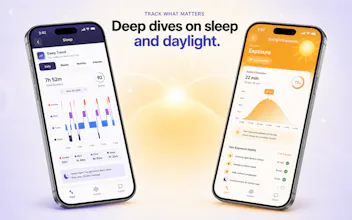
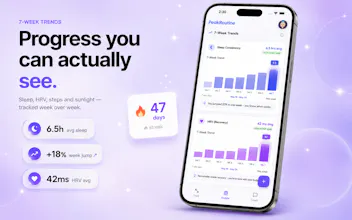
@felix_masera Thanks so much — you've nailed exactly what we set out to do. Most apps personalize on intent ("I want to lose weight"), we personalize on state ("your HRV dropped 18% this week and your sleep efficiency is at 71% — here's what that means for today").
Out of the box we pull from Apple Health, which means anything feeding into it works — Apple Watch, Oura, WHOOP, Garmin, and manual logs for nutrition, mood, and hydration. We're hardware-agnostic by design so you're not locked into one ecosystem.
Direct integrations (WHOOP, Oura Ring, AmazFit etc) are next on the roadmap. Would love to hear what you're tracking — always shapes what we prioritize! 🙏
@siddhant_gupta12 Apple Watch user here — mostly sleep and HRV. The Apple Health-first call is the right one, locking people into one ring/strap from day one is what kills adoption in this category. Going to try the daily summary this week, the "state vs intent" framing alone is worth the install.
PeakRoutine
@felix_masera 100% agree — and honestly, that was one of our earliest and most important product decisions. We kept seeing people drop off health apps not because they lost motivation, but because the app only worked with their specific device. Apple Health as the data layer means you bring your own setup — Watch, Oura, WHOOP, whatever — and PeakRoutine just works.
Sleep + HRV is actually one of the richest signal combinations we work with. HRV tells you how recovered you are, sleep tells you why — together they paint a surprisingly clear picture of what your body is ready for that day.
Would love to hear what you think after your first week of daily summaries, and feedback/suggestion on the app.
PeakRoutine
@sakshi_patil8 Thank you so much ✨ Both great questions:
On your data — it's encrypted in transit and at rest, never sold, and never shared with advertisers. You stay in control: you choose what syncs from Apple Health, and you can export or delete everything whenever you want. It's your health data, full stop.
On personalization — it's the opposite of generic. Every recommendation is built off your baselines and your patterns, not population averages. So instead of "everyone should get 8 hours," it's more like "your deep sleep drops on the nights you train after 7pm — here's what to try." The notifications work the same way: they fire off your actual trends and recovery, so they show up when they're relevant to you, not on a generic schedule. The whole point is advice that sounds like it's about you — because it is.
@siddhant_gupta12 Congrats, cool concept!! Could you expand a bit on the degree of specificity for the advice the product provides? For example if it suggest a diet change, will it suggest specific brands of food that should be purchased and consumed each day of the week based on nutritional facts, etc. or is it a bit broader than that?
PeakRoutine
@millwiller
Great question! PeakRoutine sits in a sweet spot between generic advice and overwhelming prescriptions.
The recommendations are intentionally behavior-focused rather than brand-specific — so instead of "buy Brand X protein bar," you'd see something like "your HRV trends higher on days you log omega-3-rich meals, and lower on days with high-glycaemic or high-saturated-fat foods" with suggested food categories to act on.
The reasoning: research consistently shows that hyper-specific meal plans (buy this, eat that on Tuesday) have very low follow-through rates. What actually drives habit change is understanding why a behavior matters for your biomarkers — then giving you the flexibility to act on it in a way that fits your life.
That said, deeper nutritional specificity (macro targets, meal timing windows) is absolutely on our roadmap as we layer in more data sources. Would love to hear what level of specificity would be most useful for you!
@siddhant_gupta12 that's super helpful, thanks! So it basically will guide someone to very specific nutritional attributes / themes but then leave it up to the user to determine exactly how to incorporate that into their diet. It may help to add in a layer of additional specificity if people want it, but not sure if it'd be worth the work especially data you've seen on the effectiveness of being overly specific
memi
Biomarkers plus coaching is way more useful than another dashboard yelling at me. How do you keep the advice simple enough to actually follow?
PeakRoutine
@sarveshsea Ha — "dashboard yelling at me" is basically this app's villain origin story
The trick is restraint. It might spot ten things but won't dump ten on you — it gives a short ranked list and leads with one priority, the single move that matters most right now. And each step is small and concrete: not "improve your sleep," but "20 min of morning light before 10am, 4 days this week." Plus a quick why, so it reads as a reason, not a nag. Fewer things, said plainly, that fit a real day.
Documentation.AI
Other than the Apple health data, does it also sync with other wearables?
PeakRoutine
@roopreddy Great question! Today it all comes through Apple Health — which means any device that writes to Apple Health (Apple Watch, Oura, Garmin, etc.) already syncs automatically, so we're not locked to one wearable.
Native per-device integrations and Android support are next on the roadmap. Anything specific you're hoping to connect?
GrowMeOrganic
I wear a whoop band. Whoop already has coaching feature. Would Peak Routine still be useful?
PeakRoutine
@iamanantgupta Totally fair question — Whoop's coaching is genuinely solid at what it does. Honest answer: PeakRoutine isn't trying to replace your Whoop, it adds a different layer on top.
Whoop goes deep on recovery and strain inside its own metrics, with one general coach. We're built around breadth and habits instead:
It correlates across your whole picture — sleep, HRV, activity, sunlight, even mood/journaling — not just strain and recovery. That sunlight + mood angle is where a lot of the "aha" lives, and it's mostly outside Whoop's lane.
6 specialist coaches with memory (Sleep, Recovery, Nutrition, etc.) instead of one general voice.
The big one: it's a habit-building engine, not just a daily score. It turns insights into small daily goals and helps you actually stick with them — the part most of us bounce off once the novelty fades.
So if Whoop already keeps you on track, honestly, amazing. But if you've got great data and still aren't changing the daily habits, that gap is exactly what we're built for.