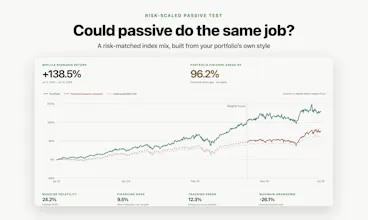
Brokerages like Fidelity shows your balance overtime, not whether your investing decisions added value. Personal Portfolio Analyst rebuilds performance from your Fidelity exports and delivers a verdict: did you beat passive, and did the volatility, drawdowns, and concentration risk make it worth it? It even builds a risk-matched passive replica of your portfolio to see if simple indexing could have done the same job. Open source with inspectable methodology.
How did GPT-5.6 change the ambition or scope of what you shipped?
Maker
GPT-5.6 moved the ambition from "a portfolio tracker" to an institutional-grade methodology evaluator. Features I'd have cut as too expensive for a solo builder became affordable: ten-factor style analysis, and a train/holdout passive-replica test that asks whether a simple index mix could have done your portfolio's job. Each of those is a small research project; with GPT-5.6 driving Codex they became days, not months.
It also changed how I enforce quality: I built a harness around the agents. Architecture checks, licensing and publication-safety gates, complexity tracking so generated code had to clear the same bar I would. The result is that one person shipped a local-first, open-source analytics suite with every assumption disclosed in-app, in a timeframe where I'd previously have shipped a returns chart. The model speed up the roadmap magnitudes of order.
Report
Maker
📌
Hey Product Hunt 👋
I've been picking stocks for years, and Fidelity could never answer the one question that mattered: was any of it actually worth it versus just buying an index fund?
So I built Personal Portfolio Analyst. You export your data from Fidelity, and it rebuilds your cash-flow-aware returns, compares them against passive benchmarks, and stress-tests the result: does your edge survive volatility, drawdowns, and concentration risks? It constructs a small passive ETF mix matched to your portfolio's style and risk, and tells you whether simple indexing would have done the same job.
A few deliberate choices:
• Everything runs locally. Your data never leaves your machine
• It's an evaluator, not a broker: no trading, no recommendations
• Open source. Every assumption is disclosed inside the app
There's a bundled demo portfolio, so you can poke around without importing anything.
I'd love feedback. Especially from anyone who's tried to honestly answer "did I beat the market?" What would make the verdict more trustworthy for you?
Report
@barry_gitarts Upvoted. I like that you focused on answering a practical question investors actually care about instead of adding another trading tool, and keeping everything local is a thoughtful design choice. How do you account for dividends, taxes, and cash deposits when calculating long term performance against the benchmark?
Report
Maker
@spotch_founder Thanks Nick. At this time the comparison is not tax aware, in theory we could add identification of tax drag.
In regards to dividends and deposits, the importer ingests Fidelity activity CSVs which tracks deposits, withdraws, transfers and other possible cash flows timestamped. That enables us to generate the return series that is not surfaced to Fidelity users.




@barry_gitarts Upvoted. I like that you focused on answering a practical question investors actually care about instead of adding another trading tool, and keeping everything local is a thoughtful design choice. How do you account for dividends, taxes, and cash deposits when calculating long term performance against the benchmark?
@spotch_founder Thanks Nick. At this time the comparison is not tax aware, in theory we could add identification of tax drag.
In regards to dividends and deposits, the importer ingests Fidelity activity CSVs which tracks deposits, withdraws, transfers and other possible cash flows timestamped. That enables us to generate the return series that is not surfaced to Fidelity users.
@barry_gitarts I see