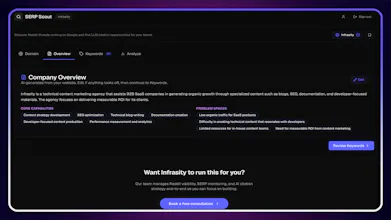
Find Reddit threads where your product belongs. Reddit Opportunity Finder surfaces high-intent discussions, maps the subreddits your ICP lives in, suggests human-sounding replies, and alerts you when your brand or keywords are mentioned. Plus see which Reddit threads rank on Google and get cited by ChatGPT before your competitors do.
No reviews yetBe the first to leave a review for Reddit Opportunity Finder by Infrasity
Maker
📌
Hey Product Hunt! 👋 Shan here, founder of Infrasity.
We built Reddit Opportunity Finder because we kept seeing the same problem with our B2B SaaS clients they had no idea their competitors were being recommended on Reddit threads that rank on Google & LLM, while they were completely absent.
Paste any domain → we scrape your company, generate GEO-optimized keywords, surface every Reddit thread Google ranks for those keywords, and track whether ChatGPT, Perplexity, Claude & Gemini mention you or your competitors.
The whole analysis runs in under 60 seconds. No API keys. No configuration needed.
We've already used this internally for top B2B SaaS startups and it's changed how they think about content and AI search visibility entirely.
Today we're opening it up.
Would love to hear your feedback especially if you find reddit threads where you're missing but should be showing up. That's exactly the gap this tool was built to close.
Try it free at infrasity.com/reddit-opportunity-finder 🚀
Report
I'm curious about the LLM citation tracking feature. How exactly does this work under the hood? Are you actually querying ChatGPT in real-time with different prompts to see if it mentions specific companies, or are you using some kind of historical dataset? And does it account for the fact that LLM's responses can vary quite a bit depending on how you phrase the question
Report
Maker
@tushar_panda For each LLM (ChatGPT, Claude, Perplexity, Gemini), we run multiple prompt variations based on your keywords - usually 5-7 different phrasings like "What are the best [category] tools?" or "Recommend solutions for [problem].
You're right that responses vary by phrasing. We account for this by showing you if your brand appears across any of those queries, and which Reddit threads the LLMs cite when they mention you or competitors.
It's more about "are you in the conversation at all" rather than "you'll always be mentioned."
Considering adding custom prompt input for v2 if that would be useful for your use case.
Thanks for the thoughtful question!
Report
The LLM citation tracking is the sleeper feature here. I recently found a competitor in my space getting recommended by ChatGPT, and when I dug into why, it traced back to their presence in Reddit threads and blog posts that LLMs were indexing. Most founders don't realize that Reddit threads are becoming training data for AI recommendations.
Does it show which specific threads are being cited by each LLM, or just whether your brand appears in their responses?
Report
Maker
@krisba95 Exactly right. The "Reddit threads as training data" insight is precisely why we built this feature.
To answer your question: Yes, we show which specific Reddit threads each LLM is citing. Not just whether your brand appears, but the actual source threads being referenced.
So when ChatGPT recommends a competitor, you can see the exact Reddit thread it's pulling from. Same for Claude, Perplexity, and Gemini. This lets you trace back the recommendation chain and understand why certain brands are appearing.
The competitive intel value is significant here. You can see not just that a competitor is being mentioned, but which specific Reddit conversations are giving them that visibility across multiple LLMs.
Really appreciate you highlighting this feature. It's the one that surprised us most during testing but turned out to be incredibly valuable.
Report
Will this be actually driving any results? Like I get it, it would churn out the threads in which we should be present and it would help the brands increase the brand overall visibility but point is is there any number attached to it ? How many conversations are required to get the first lead from the Reddit Mentions in the relevant discussions? @arvish_suresh
Report
Maker
@raghav_tripathi2 Fair question. This is primarily a discovery and intelligence tool, not a direct lead gen guarantee.
What we've seen from clients: The value comes from knowing WHERE to show up, not just showing up everywhere. Most teams were either ignoring Reddit entirely or engaging randomly without knowing which threads actually matter for visibility.
On the "how many conversations to first lead" question - it varies wildly by industry and how you engage. We've had B2B SaaS clients get qualified demos from 2-3 well-placed helpful comments in high-traffic threads. Others use it purely for competitive intel and content strategy, not direct engagement.
The ROI case is strongest when you factor in the time saved. Finding these threads manually used to take our team 3-4 hours per client. Now it's 60 seconds.
Think of it more as "stop flying blind on Reddit" than "guaranteed lead generation machine."
Does that make sense for your use case, or are you looking for something more directly tied to conversion?
Report
Most B2B founders don't even know which Reddit threads are sending traffic to their competitors. By the time they find out, the competitor already owns that conversation. @arvish_suresh which industries are you seeing this the most in?
Report
Maker
@shivansh_mishra14 You're describing exactly what we kept seeing with clients.
On industries: B2B SaaS and Dev Tools are where this hits hardest. Think project management tools, analytics platforms, API services, developer tools, monitoring solutions. These categories have highly active Reddit communities where people genuinely ask for recommendations.
We're also seeing it with marketing tools, sales enablement software, and cybersecurity products. Basically anywhere there's a "What's the best tool for X?" thread that ranks on Google.
What surprised us: AI/ML tools are getting hit especially hard right now. Reddit threads comparing AI models, vector databases, LLM orchestration tools are ranking extremely well and getting cited by ChatGPT constantly. If you're in that space and not tracking this, you're losing ground daily.
Consumer apps less so, unless they're in productivity or finance categories where people actively seek recommendations on Reddit.
What industry are you in?
Report
This looks really useful, but I'm wondering about the business model. Right now it says "free to try" - what does that mean exactly? Is there a limited number of analyses, or is it free for a trial period? And what's the pricing going to look like once you move beyond the free tier? Would love to understand if this is viable for a small startup vs enterprise budgets.
Report
Maker
@saumya_s Totally fair to ask upfront. "Free to try" means you can run analyses without a credit card right now. We're keeping it open during the Product Hunt launch so people can actually test it and see value before committing.
On pricing: We're still finalizing the tiers, but the general direction is a freemium model with limits on analyses per month for the free tier, and paid plans that unlock unlimited analyses, ongoing monitoring, and team features.
For small startups, we're thinking in the range of typical SEO/marketing tool pricing (think Ahrefs starter tier, not enterprise). For enterprise with multiple brands and team collaboration, higher tier.
Honest answer: We're using this launch week to validate what features people actually care about before locking in pricing. Would rather get the model right than rush it.
Happy to chat more about your specific use case if you want to DM.
This is great. I love that the analysis pulls from different providers without having to set anything up. One suggestion would be to add a weight to each 'opportunity'. Posts from years ago may not be as relevant to be mentioned on. Also, a real-time Slack alert for mentions related to those keywords would be useful. Although, I think that might exist elsewhere, but I'd pay for it.
Looking forward to trying it out more.
Report
Maker
@aviatordavid Really appreciate this feedback, especially the specificity.
The weighting suggestion makes total sense. Right now we surface everything, but you're right that a 3-year-old thread with 12 upvotes shouldn't carry the same priority as a recent high-engagement thread that's actively ranking. We've been thinking about a relevance score that factors in recency, engagement, Google ranking position, and LLM citation frequency. This pushes us to prioritize it.
On the Slack alerts for real-time mentions: That's exactly the direction we're heading for the paid tier. The one-time analysis is valuable for discovery, but ongoing monitoring is where the real leverage is. Would love to chat more about your specific use case if you're open to it.
Thanks for trying it out and for the constructive input. Feedback like this is exactly what we need right now.




I'm curious about the LLM citation tracking feature. How exactly does this work under the hood? Are you actually querying ChatGPT in real-time with different prompts to see if it mentions specific companies, or are you using some kind of historical dataset? And does it account for the fact that LLM's responses can vary quite a bit depending on how you phrase the question
@tushar_panda For each LLM (ChatGPT, Claude, Perplexity, Gemini), we run multiple prompt variations based on your keywords - usually 5-7 different phrasings like "What are the best [category] tools?" or "Recommend solutions for [problem].
You're right that responses vary by phrasing. We account for this by showing you if your brand appears across any of those queries, and which Reddit threads the LLMs cite when they mention you or competitors.
It's more about "are you in the conversation at all" rather than "you'll always be mentioned."
Considering adding custom prompt input for v2 if that would be useful for your use case.
Thanks for the thoughtful question!
The LLM citation tracking is the sleeper feature here. I recently found a competitor in my space getting recommended by ChatGPT, and when I dug into why, it traced back to their presence in Reddit threads and blog posts that LLMs were indexing. Most founders don't realize that Reddit threads are becoming training data for AI recommendations.
Does it show which specific threads are being cited by each LLM, or just whether your brand appears in their responses?
@krisba95 Exactly right. The "Reddit threads as training data" insight is precisely why we built this feature.
To answer your question: Yes, we show which specific Reddit threads each LLM is citing. Not just whether your brand appears, but the actual source threads being referenced.
So when ChatGPT recommends a competitor, you can see the exact Reddit thread it's pulling from. Same for Claude, Perplexity, and Gemini. This lets you trace back the recommendation chain and understand why certain brands are appearing.
The competitive intel value is significant here. You can see not just that a competitor is being mentioned, but which specific Reddit conversations are giving them that visibility across multiple LLMs.
Really appreciate you highlighting this feature. It's the one that surprised us most during testing but turned out to be incredibly valuable.
Will this be actually driving any results? Like I get it, it would churn out the threads in which we should be present and it would help the brands increase the brand overall visibility but point is is there any number attached to it ? How many conversations are required to get the first lead from the Reddit Mentions in the relevant discussions? @arvish_suresh
@raghav_tripathi2 Fair question. This is primarily a discovery and intelligence tool, not a direct lead gen guarantee.
What we've seen from clients: The value comes from knowing WHERE to show up, not just showing up everywhere. Most teams were either ignoring Reddit entirely or engaging randomly without knowing which threads actually matter for visibility.
On the "how many conversations to first lead" question - it varies wildly by industry and how you engage. We've had B2B SaaS clients get qualified demos from 2-3 well-placed helpful comments in high-traffic threads. Others use it purely for competitive intel and content strategy, not direct engagement.
The ROI case is strongest when you factor in the time saved. Finding these threads manually used to take our team 3-4 hours per client. Now it's 60 seconds.
Think of it more as "stop flying blind on Reddit" than "guaranteed lead generation machine."
Does that make sense for your use case, or are you looking for something more directly tied to conversion?
Most B2B founders don't even know which Reddit threads are sending traffic to their competitors. By the time they find out, the competitor already owns that conversation. @arvish_suresh which industries are you seeing this the most in?
@shivansh_mishra14 You're describing exactly what we kept seeing with clients.
On industries: B2B SaaS and Dev Tools are where this hits hardest. Think project management tools, analytics platforms, API services, developer tools, monitoring solutions. These categories have highly active Reddit communities where people genuinely ask for recommendations.
We're also seeing it with marketing tools, sales enablement software, and cybersecurity products. Basically anywhere there's a "What's the best tool for X?" thread that ranks on Google.
What surprised us: AI/ML tools are getting hit especially hard right now. Reddit threads comparing AI models, vector databases, LLM orchestration tools are ranking extremely well and getting cited by ChatGPT constantly. If you're in that space and not tracking this, you're losing ground daily.
Consumer apps less so, unless they're in productivity or finance categories where people actively seek recommendations on Reddit.
What industry are you in?
This looks really useful, but I'm wondering about the business model. Right now it says "free to try" - what does that mean exactly? Is there a limited number of analyses, or is it free for a trial period? And what's the pricing going to look like once you move beyond the free tier? Would love to understand if this is viable for a small startup vs enterprise budgets.
@saumya_s Totally fair to ask upfront. "Free to try" means you can run analyses without a credit card right now. We're keeping it open during the Product Hunt launch so people can actually test it and see value before committing.
On pricing: We're still finalizing the tiers, but the general direction is a freemium model with limits on analyses per month for the free tier, and paid plans that unlock unlimited analyses, ongoing monitoring, and team features.
For small startups, we're thinking in the range of typical SEO/marketing tool pricing (think Ahrefs starter tier, not enterprise). For enterprise with multiple brands and team collaboration, higher tier.
Honest answer: We're using this launch week to validate what features people actually care about before locking in pricing. Would rather get the model right than rush it.
Happy to chat more about your specific use case if you want to DM.
Aviator
This is great. I love that the analysis pulls from different providers without having to set anything up. One suggestion would be to add a weight to each 'opportunity'. Posts from years ago may not be as relevant to be mentioned on. Also, a real-time Slack alert for mentions related to those keywords would be useful. Although, I think that might exist elsewhere, but I'd pay for it.
Looking forward to trying it out more.
@aviatordavid Really appreciate this feedback, especially the specificity.
The weighting suggestion makes total sense. Right now we surface everything, but you're right that a 3-year-old thread with 12 upvotes shouldn't carry the same priority as a recent high-engagement thread that's actively ranking. We've been thinking about a relevance score that factors in recency, engagement, Google ranking position, and LLM citation frequency. This pushes us to prioritize it.
On the Slack alerts for real-time mentions: That's exactly the direction we're heading for the paid tier. The one-time analysis is valuable for discovery, but ongoing monitoring is where the real leverage is. Would love to chat more about your specific use case if you're open to it.
Thanks for trying it out and for the constructive input. Feedback like this is exactly what we need right now.