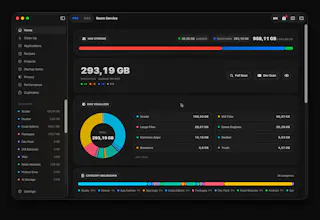

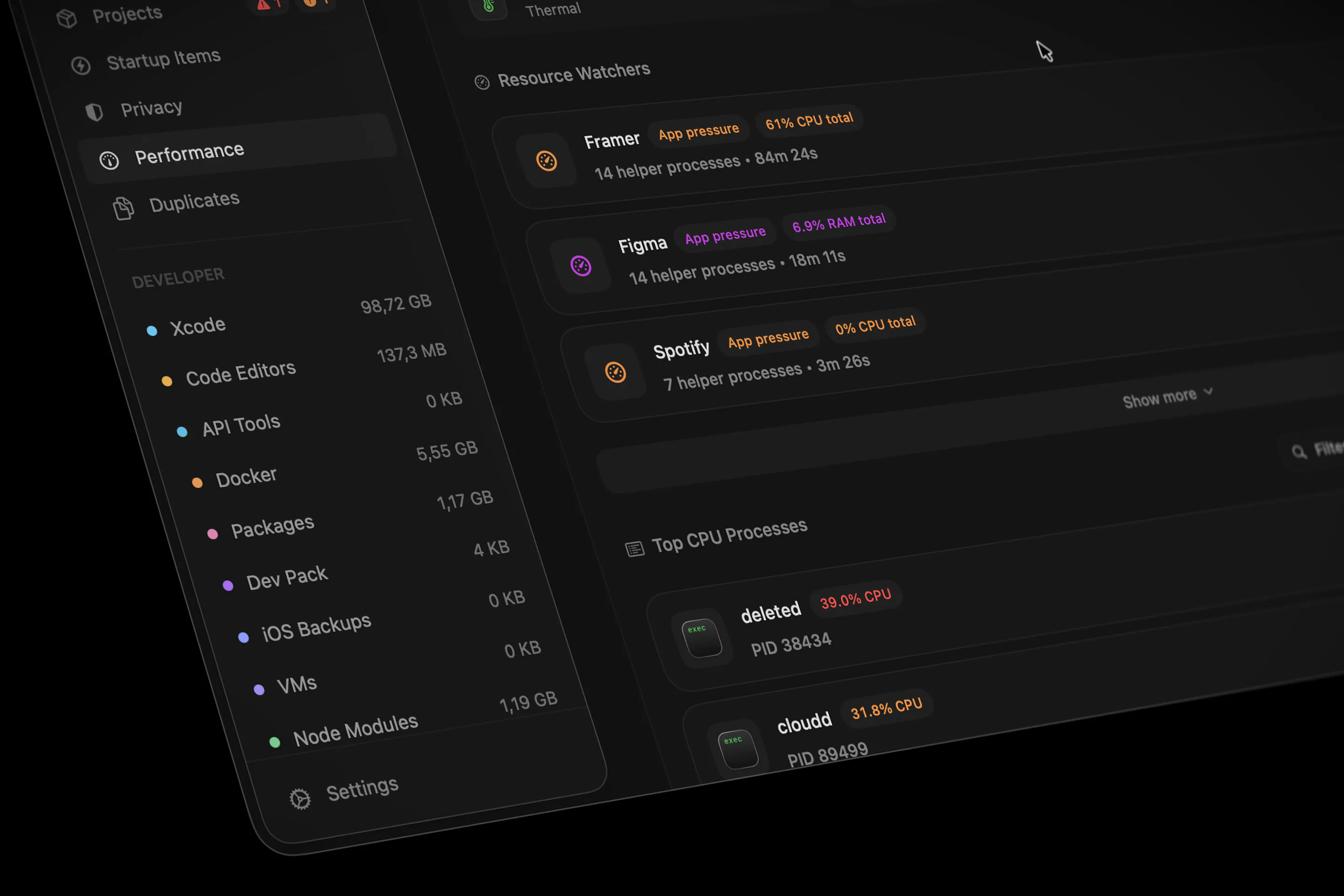
Room Service helps developers understand what is actually filling their Mac, then clean it with more confidence. From Xcode build data and package caches to Docker, generated folders, app leftovers, duplicates, and privacy traces, it turns scattered disk clutter into a workflow you can inspect, review, and act on without losing control.
No reviews yetBe the first to leave a review for Room Service
Yeah sorry not a fan of the illusion of a free tool and then when you want to actually use it you have are hit with a paywall... it should be UPFRONT/ transparent.
I wasted my time after getting all excited about a potentially cool new tool.
This gets a down vote in my book just because of that - even if the tool seems qualitative.
@exlemor Thanks, really appreciate you taking the time to share this. And sorry it felt misleading, that’s definitely not the experience I want to create. The idea was to keep all scans fully free so you can see everything before deciding, but I understand how the paywall at the action step can feel frustrating. Based on feedback like yours, I’ve just added a clearer section on the landing page to make this more upfront and avoid confusion. Thanks again for calling it out 🙏
@exlemor Also, I’ll be improving this inside the app as well. In the next update, I’ll make the free vs paid distinction much clearer UX-wise so it’s more upfront and less frustrating.
Report
Does it detect Xcode derived data automatically or do you need to point it to specific folders? Congrats on the launch!
It detects Xcode derived data automatically, no need to point it to specific folders. Right now there’s a general scheduled scan in place, but category-specific alerts like that are a great idea. I’ll look into adding more granular, category-based alerts in upcoming updates.
Most Mac cleaners just nuke browser caches, so seeing one that specifically targets abandoned node_modules and Xcode derived data is refreshing. Setting up automated weekly sweeps of dormant Docker images would be a killer use case for this. That alone would save me from having to do a manual disk space panic cleanup every few months.
@y_taka Thanks, really appreciate this. Glad it actually makes sense in real use. And yeah, the automated Docker cleanup idea is spot on. I’ll definitely try to add something like that soon. Thanks for calling it out 🙏
Report
Most Mac cleaners are blunt instruments. They promise speed, skip the explanation, and leave you second guessing what just got deleted. Room Service takes the opposite approach, and for developers, that distinction matters a lot.
What stands out is the framing shift. This isn't cleanup as a chore; it's cleanup as a workflow. The visibility layer turns clutter into something you can actually understand and act on, which quietly repositions this from a utility to a developer productivity tool.
That's also the stronger narrative angle. Part performance monitor, part digital housekeeper is closer to how a developer thinks about their environment than Mac cleaner. Leading with that framing could sharpen how this lands for the audience already predisposed to care most.
I'm curious whether you're thinking about scaling this toward teams managing dev environments or keeping the focus on individual machines for now.
@copywizard Appreciate this, really well put. The “cleanup as workflow” angle is exactly where I’m heading.
For now I’m focused on getting the single-machine experience right, but I can definitely see this expanding into team environments over time.
Report
@ardacankrko Getting the single machine layer right is where trust is either built or lost, so the focus makes sense.
What's quietly interesting is that you're already building something that could compound well beyond cleanup. A system of record for what dev environments accumulate over time is a different asset than a utility. Once that data starts stacking, the leap to teams isn't just about syncing machines; it's about standardizing hygiene across workflows, languages, and stacks.
That's the shift from cleanup tool to developer environment infrastructure. And that's a much stickier category to own.
Are you already seeing patterns across users, things like what React or Docker setups tend to bloat with over time? Surfacing that as shared intelligence would be a natural next layer and a compelling reason for teams to stay well beyond the first clean.
Would love to hear your feedback if you end up trying it 🙏
Report
I like that this seems to focus more on understanding what is happening on the system rather than just offering a one-click cleanup. In my experience, the problem is rarely just “free up space,” it is figuring out what can be safely removed without breaking something later.
@josh_joy1 That’s exactly the problem I kept running into. It’s rarely just about freeing up space, it’s figuring out what’s actually safe to remove without breaking something later. That’s what pushed me to focus more on visibility and control first, cleanup second. Really appreciate you calling that out.




Yeah sorry not a fan of the illusion of a free tool and then when you want to actually use it you have are hit with a paywall... it should be UPFRONT/ transparent.
I wasted my time after getting all excited about a potentially cool new tool.
This gets a down vote in my book just because of that - even if the tool seems qualitative.
Room Service
@exlemor Thanks, really appreciate you taking the time to share this. And sorry it felt misleading, that’s definitely not the experience I want to create. The idea was to keep all scans fully free so you can see everything before deciding, but I understand how the paywall at the action step can feel frustrating. Based on feedback like yours, I’ve just added a clearer section on the landing page to make this more upfront and avoid confusion. Thanks again for calling it out 🙏
Room Service
@exlemor Also, I’ll be improving this inside the app as well. In the next update, I’ll make the free vs paid distinction much clearer UX-wise so it’s more upfront and less frustrating.
Does it detect Xcode derived data automatically or do you need to point it to specific folders? Congrats on the launch!
Room Service
Thanks, @borrellr_ appreciate it.
It detects Xcode derived data automatically, no need to point it to specific folders. Right now there’s a general scheduled scan in place, but category-specific alerts like that are a great idea. I’ll look into adding more granular, category-based alerts in upcoming updates.
Okan
Most Mac cleaners just nuke browser caches, so seeing one that specifically targets abandoned node_modules and Xcode derived data is refreshing. Setting up automated weekly sweeps of dormant Docker images would be a killer use case for this. That alone would save me from having to do a manual disk space panic cleanup every few months.
Room Service
@y_taka Thanks, really appreciate this. Glad it actually makes sense in real use. And yeah, the automated Docker cleanup idea is spot on. I’ll definitely try to add something like that soon. Thanks for calling it out 🙏
Most Mac cleaners are blunt instruments. They promise speed, skip the explanation, and leave you second guessing what just got deleted. Room Service takes the opposite approach, and for developers, that distinction matters a lot.
What stands out is the framing shift. This isn't cleanup as a chore; it's cleanup as a workflow. The visibility layer turns clutter into something you can actually understand and act on, which quietly repositions this from a utility to a developer productivity tool.
That's also the stronger narrative angle. Part performance monitor, part digital housekeeper is closer to how a developer thinks about their environment than Mac cleaner. Leading with that framing could sharpen how this lands for the audience already predisposed to care most.
I'm curious whether you're thinking about scaling this toward teams managing dev environments or keeping the focus on individual machines for now.
Room Service
@copywizard Appreciate this, really well put. The “cleanup as workflow” angle is exactly where I’m heading.
For now I’m focused on getting the single-machine experience right, but I can definitely see this expanding into team environments over time.
@ardacankrko Getting the single machine layer right is where trust is either built or lost, so the focus makes sense.
What's quietly interesting is that you're already building something that could compound well beyond cleanup. A system of record for what dev environments accumulate over time is a different asset than a utility. Once that data starts stacking, the leap to teams isn't just about syncing machines; it's about standardizing hygiene across workflows, languages, and stacks.
That's the shift from cleanup tool to developer environment infrastructure. And that's a much stickier category to own.
Are you already seeing patterns across users, things like what React or Docker setups tend to bloat with over time? Surfacing that as shared intelligence would be a natural next layer and a compelling reason for teams to stay well beyond the first clean.
Room Service
Hey everyone, as a small thank you for the Product Hunt launch, I set up a 50% discount for the community here: https://ardacankirko.gumroad.com/l/zfsjob/ymsfqth
Would love to hear your feedback if you end up trying it 🙏
I like that this seems to focus more on understanding what is happening on the system rather than just offering a one-click cleanup. In my experience, the problem is rarely just “free up space,” it is figuring out what can be safely removed without breaking something later.
Room Service
@josh_joy1 That’s exactly the problem I kept running into. It’s rarely just about freeing up space, it’s figuring out what’s actually safe to remove without breaking something later. That’s what pushed me to focus more on visibility and control first, cleanup second. Really appreciate you calling that out.