Sentient Companion – Adaptive Learning Partner
Concept:
An AI that learns with you, not just answers you. It tracks your progress across different topics like coding, writing, or trading and builds a memory of your learning style, mistakes, and goals.
Instead of repeating explanations, it reminds you of what you already know, tests you gently, and adapts its tone or teaching pace depending on how you respond.
1.Why it fits Sentient AGI:
Sentient’s multi-agent reasoning can simulate a team of tutors, one explaining, one correcting, one testing.
It aligns with Sentient’s social reasoning research where agents cooperate to teach.
Could plug into the Builder Program, letting educators or developers create custom learning agents.
2.Core Features:
Personalized skill tracking
Team tutor system (explanation, quiz, feedback)
Offline and web integration
Open-source learning models that evolve with community input
3.Example Use Case:
A crypto trader uses Sentient Companion to practice market reasoning:
“Simulate a 3-day BTC swing trade and quiz me on risk logic.”
The AI team debates, challenges your logic, and teaches through conversation.



 ChatGPT free
ROMA
Scrumball
@vivek_kolli The open-source approach for intelligence workflows is ambitious. How do you maintain data quality and reliability when pulling from 100+ different partners? That many sources could either be incredibly comprehensive or create a lot of noise.
What kind of complex workflows are you condensing into the Spaces? Are we talking multi-step research processes, or something more like automated analysis pipelines?
Also curious about the business model - how does open-sourcing everything work financially when you're coordinating that many data partnerships?
ROMA
@alex_chu821 Some great questions, thanks for sending!
Data reliability across partners:
We've vetted all of the partners that joined GRID and ensured they are high-quality so as not to compromise on our answer quality. For our answers, we don't continuously tap all 100 partners for their data/information, our eng team has worked hard in creating niche, vertical agents, that know which sources to tap based on the query.
Spaces and workflows:
More of your first idea (multi-step research processes), but they can be extended to something like your second idea (automated analysis pipelines). The internet was great at connecting us to limitless information, but we're still stuck with manually sorting through it. Spaces solves that problem, by coordinating across many data sources, agents, and models to give you a comprehensive answer in one-shot.
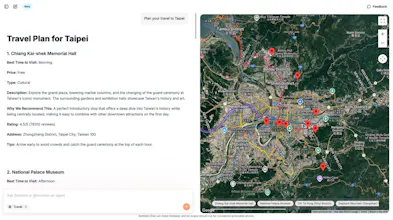
Here's one example of how many of us use the internet when planning a trip to Barcelona. We start by Googling “flights to Barcelona” and scanning Google Flights for prices. Then we adjust departure and arrival destinations to see which combination works best, and experiment with different dates to find the most affordable options. Once flights are sorted, we open another tab and search “hotels in Barcelona under $400/night,” either using a travel planning site or scrolling through offers and links until something feels right. From there, another tab goes to restaurant research, Reddit threads, Yelp reviews, local guides etc, to figure out which spots are worth trying. Finally, we open yet another tab to search for the best tourist activities in the city, piecing together an itinerary from multiple sources.
As you can see, this is quite a complex workflow and is just scratching the surface of all the manual research I have to do across various data sources and the various actions I have to take (optimizing dates/locations for travel, finding food/lodging to my preferences, combining all of it into 1 comprehensive itinerary, etc.).
Sentient Chat's travel space is a proof of concept for what a clean/polished workflow could look like to plan for any trip (with beautiful/interactive world map UI in a side pane) to help users through this. It’ll check across various data sources and perform various tasks to analyze, optimize and compile data. Instead of sifting through all this information manually, you can get it all done through Sentient Chat where it reasons and combines across our stack/tools and other tools provided by our partners.
This is just one example of a Space, and we hope many people will build some insane workflows due to the open-source nature of the platform. Also, feel free to sign up and try out the platform today (it should let you in, but dm me if you need a code or anything).
Business model:
Currently, we're very focused on building product and infrastructure so everyone can come build on our performant work. We'll have some sort of subscription for GRID (where Sentient Chat access is included and additional features will be available to the highest plans).
Scrumball
@vivek_kolli The vertical agent approach for intelligent source selection sounds solid. Coordinating that many data partners while maintaining quality control is no small feat.
Definitely going to sign up and test the platform. The automated research workflow concept could be a game-changer if it delivers on the promise of replacing those manual multi-tab research sessions.
@vivek_kolli @alex_chu821 Great Things are happening !
@vivek_kolli @alex_chu821 Bullish Sentient_chat , the best agent AI
@vivek_kolli Bullish agent AI
the best agent AI
@vivek_kolli Sentient the best agent AI
That’s huge! An open-source AGI powered by GRID with 100+ partners already integrated? The scale and transparency here could set a new standard for AI development.
Excited to see how Sentient Chat evolves.
best project if they can let me in without code ! i cant understand why for test we must search for code and feed influencers ! bagging to get code?
Upvote done Sentient our Grid ecosystem strong and largest intelligence network.
does the project manage the risk of fragmentation caused by multiple versions or forks, and what measures are in place to maintain standardization and ensure users can choose the most stable and appropriate software iteration?
Sentient is unique and easy to use. Its GRID chat answers are fast and the sources are accurate plus smooth UI
Just tried Sentient Chat, wild how it pulls from such a massive network. The whole "Spaces" side-pane UI is super slick too. Really curious to see how the open-source rollout plays out.