Been burned by exactly the problem this solves - manually testing voice models against a handful of sample clips every time a new one drops, then forgetting to re-test six months later when something better shipped. Having routing decided against real public benchmarks instead of vendor marketing numbers is the actual value here, not just "one API for everything."
What needs improvement
Would like to see the benchmark methodology published somewhere permanent rather than just referenced in a launch post - if the whole pitch is "trust our ranking, not vendor marketing," the scoring process itself needs to be as transparent and auditable as the results.
vs Alternatives
Looked at ElevenLabs and Deepgram directly but those are single vendors, not routers - I'd still have to run my own comparison across them for each language. Speko's pitch of ranking by actual public benchmark per language is a different category of tool, not a competitor to either.
Hi Product Hunt! I'm Bek, founder of Speko.
Before this I was cofounded/CTO at a startup building voice AI apps. I left after Series A to work on the pain we lived with every week: we had to support 10+ languages, and I wished there was some kind of gateway that could route to the right voice tech based on the use case and language. Back then our process was a Google Sheet with 15 audio links we sent to people who speak those languages to score. If a new model was good, you swap. Every week something new comes out, even in English, and testing it is so much R&D cost that most teams end up running outdated models - swapping always looks like an R&D project. So early this year we started Speko.
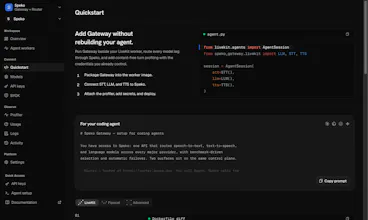
What it is: a router for voice models. You come with your use case and language, and we route to the best speech-to-text, LLM, and text-to-speech for it - measured on our public benchmarks, not vendor marketing. You should be running the best voice stack at any given moment. We don't train or sell models ourselves, and that is precisely how we keep the rankings impartial.
How the approach evolved: we launched on Hacker News recently and the discussion sharpened how we explain this. "Router" hides three questions: what gets picked (a model, a provider, or the whole stack), where it lives (an external hop or inside your session), and when it decides (session start or mid-call). A voice agent is a live duplex session, not a batch request - that is why this is its own product. And we are proxy-less: routing is decided before the session starts, then audio flows directly to the provider - no extra hop in the audio path.
I’ve already discussed this direction with Bek, and we even hosted a deep-dive online meetup together about the development of voice AI.
That’s why it’s especially interesting to see how the idea behind Speko is now evolving into a real product. Choosing the right voice stack is becoming increasingly complex as new models and providers keep emerging.
I really like Speko’s approach: independent benchmarks, routing based on the specific use case and language, and no bias toward their own models.
Very interesting product and direction. Good luck to Bek and the Speko team!
@umedrahimoff Thank you a lot Umed aka, enjoyed the interview!
Report
Congratulations on the launch @abdikbek! All of us needed a voice AI OpenRouter for sure. Wondering how often you would refresh this list of APIs or include more providers.
Report
What are the advantages compared to Google’s open-source libraries and other alternatives? Also, what about less commonly supported languages like Swedish or Danish?
P.S. I just saw a post here about a kids’ app. You should consider partnering with them - they have voice recognition for children and convert speech to text.
Report
Looks good, but would be nice if the site provided also actual voice samples of each model, e.g. just same text with type of voice prompt benchmarked accross different models.




@abdikbek Very interesting product. All the best!
I’ve already discussed this direction with Bek, and we even hosted a deep-dive online meetup together about the development of voice AI.
That’s why it’s especially interesting to see how the idea behind Speko is now evolving into a real product. Choosing the right voice stack is becoming increasingly complex as new models and providers keep emerging.
I really like Speko’s approach: independent benchmarks, routing based on the specific use case and language, and no bias toward their own models.
Very interesting product and direction. Good luck to Bek and the Speko team!
@umedrahimoff Thank you a lot Umed aka, enjoyed the interview!
Congratulations on the launch @abdikbek! All of us needed a voice AI OpenRouter for sure. Wondering how often you would refresh this list of APIs or include more providers.
What are the advantages compared to Google’s open-source libraries and other alternatives? Also, what about less commonly supported languages like Swedish or Danish?
P.S. I just saw a post here about a kids’ app. You should consider partnering with them - they have voice recognition for children and convert speech to text.
Looks good, but would be nice if the site provided also actual voice samples of each model, e.g. just same text with type of voice prompt benchmarked accross different models.
Love your product, guys. We are using it at SUN
openrouter for voice is such a usefull idea 🎙️ which stt is winning rn?