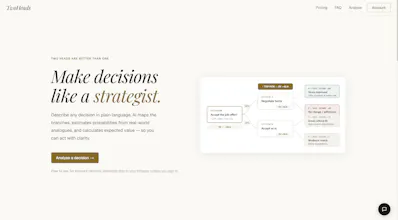
Describe a decision in plain language: a job offer, a startup bet, a big purchase, a negotiation. TwoHeads maps out your real options as a decision tree, estimates the probability of each outcome with a cited real-world analogue, and calculates the expected value of each path. Then you argue with it: every probability has a slider, so you can override the AI's assumptions with your own and watch the expected value recalculate live.
No reviews yetBe the first to leave a review for TwoHeads
Maker
📌
Hey everyone!
I built this because major decisions are always easier with concrete numbers. TwoHeads lets you describe the decision, and it extracts the branches and probabilities for you, with a cited analogue for every number so you can see *why* it thinks 60% and not 80%.
Every probability is a slider. The AI's estimate is a starting point; if you know your situation better than a base rate does (you do), drag it to what you actually believe and the expected value updates live.
It's free to use, no account needed, 1 analysis/day. Would love feedback on: (1) where the AI's probability estimates feel off-base; (2) what decision types it handles badly. I'm in the comments all day.
Report
Does the AI cite sources for the probability analogues it picks, and can I swap in my own reference points if I disagree with the cases it draws from?
Report
Maker
@pekkoalifapm Hey! It doesn't cite the sources/allow you to swap them yet, but I'll look into adding this ASAP. It does however allow you to override the AI's probability assumptions with your own. Have you used TwoHeads to analyse a decision yet?
Report
How does it actually source those cited real-world analogues, and is the citation depth solid enough that I'd trust the probabilities, or am I going to spend half my time fact-checking the tree?
Report
The slider for overriding probabilities is genius, made me realize I'd been anchoring way too hard on the AI's defaults. Tried it on a job offer last night and it actually changed which option I was leaning toward once I adjusted the equity upside estimate to something I actually believed.
Report
Love how every probability comes with a slider you can override. That turns the whole thing from a black box into an actual conversation with your own assumptions, which is exactly how decisions should get stress tested.
Report
the live recalculation when you drag a probability slider is so satisfying, makes the math feel like something you can actually argue with instead of just read
Does the AI cite sources for the probability analogues it picks, and can I swap in my own reference points if I disagree with the cases it draws from?
@pekkoalifapm Hey! It doesn't cite the sources/allow you to swap them yet, but I'll look into adding this ASAP. It does however allow you to override the AI's probability assumptions with your own. Have you used TwoHeads to analyse a decision yet?
How does it actually source those cited real-world analogues, and is the citation depth solid enough that I'd trust the probabilities, or am I going to spend half my time fact-checking the tree?
The slider for overriding probabilities is genius, made me realize I'd been anchoring way too hard on the AI's defaults. Tried it on a job offer last night and it actually changed which option I was leaning toward once I adjusted the equity upside estimate to something I actually believed.
Love how every probability comes with a slider you can override. That turns the whole thing from a black box into an actual conversation with your own assumptions, which is exactly how decisions should get stress tested.
the live recalculation when you drag a probability slider is so satisfying, makes the math feel like something you can actually argue with instead of just read