Launching today

ZooWork
The AI agent delivery platform for FDEs and domain experts
316 followers
The AI agent delivery platform for FDEs and domain experts
316 followers
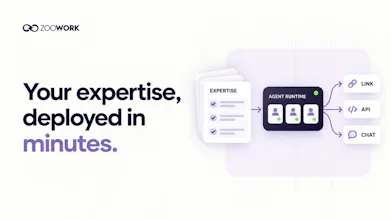
ZooWork lets you build, deploy, and deliver AI agents to teams or clients — experts start in the Builder UI, developers ship with the Managed Agent API. Turn your expertise into AI solutions built for real business operations.


Free Options
Launch Team / Built With


I love the product concept.
Imagine a founder could build an agent that drafts investor updates from approved company notes, then share it with teammates for review, that will be very helpful.
@justin2025 The approved notes are what make this work, since an update is only as good as what the founder has already signed off on. You'd load those notes into the Agent's knowledge base, write the update format and tone into its job description, and set it to run on a monthly schedule. The draft then goes to your teammates through a share link or Slack, and they review it before anything reaches investors. The knowledge base is free on ZooWork for a limited time, so it's a good moment to try it with last month's notes and see whether the draft sticks to them.
How experts decide what parts of their workflow should become automated versus stay human driven?
@nolanpierce03 We think expert knowledge is the most important ingredient in FDE delivery and enterprise agent adoption. Experts know what good work looks like, which exceptions matter, and when a person needs to step in. Start by automating repeatable steps around that knowledge, then test a small workflow and refine the boundaries.
@ninghu The proposal Deck agent sounds useful. Can users build their own custom agents without coding?
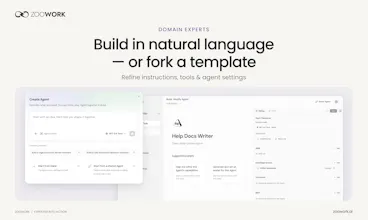
@ninghu @rohit62661 You can. In ZooWork's Agent Builder, you describe how the work should be done in plain language, and the Agent is built from that conversation, no code needed. Building it isn't really the key part, though. What matters is that you can share it with your team or other users, so they get to use it too, not just you. You could try it with your own proposal workflow and share it with one teammate.
@ninghu @david_srp Got it.
No code setup and easy team sharing sound really useful
@rohit62661 Thanks, Rohit! That's the part we care about most: making an Agent useful to the rest of your team too.
How do you agent performance over time?
@advin_jadis Looking at the final output only tells you part of the story. With our Managed Agent API, you can access the trajectory of each Agent run, inspect how it approached the task, and use that to refine the next version. We’re also rolling out an evaluation mode to make that iteration more automated. I’d start with one real task through the API and look through its trajectory to see where you’d make the first improvement.
Hi Product Hunt! 👋
I'm Ning, founder & CEO of ZooWork. Some of you may remember us as ZooClaw from our launch here in April.
Since then, we've heard one thing over and over, and felt it ourselves: there are countless tools for building AI agents, but almost nothing for delivering them. Everyone has an agent that works beautifully on their laptop. Almost no one can hand it to a client, a team, or a paying user as a reliable service.
That gap changed what we build, and our name along with it. ZooWork is our answer: an agent delivery platform for forward-deployed engineers, developers, and domain experts, with the whole path from build to production in one place.
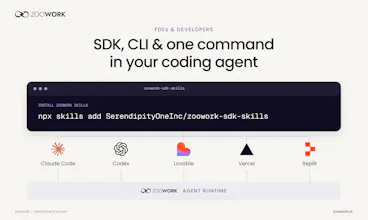
Build: Describe what you want in the no-code Builder, or stay in the coding agent you already use (Claude Code, Codex, and more) and ship through our Managed Agent API. Setup is one line:
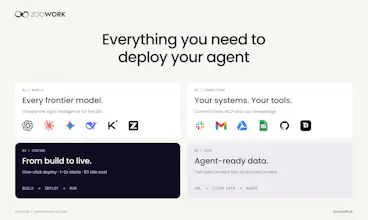
Deploy: One click to the cloud, from a single agent to a multi-agent pipeline. Agents cold-start in 1–2 seconds, and you pay nothing while they're idle.
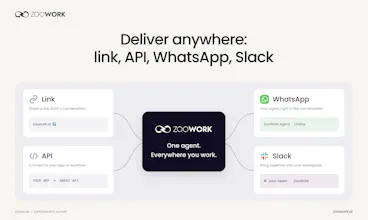
Deliver: Reach users where they already are: a shareable link, an API, or directly in WhatsApp, Slack, and more.
Under the hood, we handle the hardest part: the runtime. Every agent runs in its own managed, isolated sandbox, so what you ship keeps working without you babysitting servers. You own the interface, the customers, and the business. We run the agents.
A few of my favorite agents running on ZooWork today:
A proposal deck studio: drop in your notes, get back a client-ready deck. Built by a consultant, not an engineer.
A personal stylist: describe the occasion, get a complete look and the reasoning behind it.
A home layout designer: snap a photo of your room, get a new layout with an interior designer's eye.
If you've ever built an agent that died on your laptop because there was no good way to share it, I'd love to hear the story. And tell us which coding agent or channel you want next. Your answers go straight into our roadmap.
Thanks for being here on launch day! 🙏
@ninghu glad to see it plays nice with Claude Code and Codex straight out of the box. congrats
@ninghu @priya_kushwaha1 Thanks, Priya! 🙌 We wanted people to keep building with the tools they already love. Give it a spin with an agent you’ve built in Claude Code or Codex—once you can hand someone a working service instead of setup instructions, it’s hard to go back.
What does the handoff process look like when an expert delivers an agent to a business team?
@mikkellarsen Most of the handoff is the expert writing down how the work should be done. In the Agent Builder, they write the Skills and the Agent's job description: its role, the SOP it follows, and what a finished deliverable looks like. Then they connect it to Slack or another IM channel, and the business team uses it right where they already talk. Where does your business team work today, and what kind of Agent would they use there?
Zero idle cost is the detail that makes a weekend agent project feel less wasteful. I'd still check the running costs, but I don't want to pay simply because an experiment exists.
@felix_wang5 That's exactly the cost we didn't want experiments to carry. On the Managed Agent API, the sandbox is billed only for the time it actually runs, plus model tokens, and Agents start in a second or two when called, so a weekend project sitting idle between runs costs nothing. Run it a few times over a weekend and check the usage afterwards to see what a real week costs.