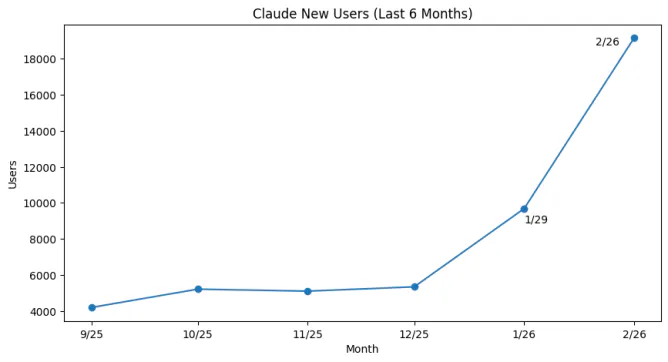
Claude's paid subscriptions have more than doubled this year. New users hit record numbers between January and February. Previous users came back in record numbers too.
Every day, after launching, makers are contacted on LinkedIn and X by people offering to sell votes. As the Product Hunt team, we are very much aware of this and really hate it. We have systems in place to neutralize this type of gaming. Every vote counts for a different number of points on Product Hunt. A couple examples:
An account with a recently created gmail address and no history of quality contributions on Product Hunt: this vote will count for 0 points. Yes, this might be a well intentioned user, but we take a conservative approach to protect the community. If the account has a company email or applies for verification on Product Hunt, that's a different story.
An account with a company email address linked to a legitimate LinkedIn account with a history of meaningful contributions on Product Hunt: this vote carries significant weight.
A couple questions for the community:
Are there specific accounts on Product Hunt that you suspect participate in vote selling? You can reply here or email report@producthunt.co
What would you want to see us do differently here?
But companies are still opening internships, which suggests something deeper than just skill-building still matters (like understanding systems, workflows, and how companies actually operate the management part).
I've been noticing something lately. We went from using AI as a tool to letting AI become the default for almost everything: writing, deciding, planning, even reflecting.
Need to write an email? AI. Need to make a decision? Ask AI. Need to understand how you feel about something? Believe it or not, AI.
The problem isn't the technology. The problem is that we're quietly outsourcing the one thing that makes us valuable: our ability to think for ourselves.
Curious what the community is running for authentication/authorization in their apps (e.g. Auth0, Supabase Auth, Clerk, Firebase Auth, Cognito, etc.)
A few things I'd love to hear your take on:
What provider are you using and what's your primary stack? (e.g. Next.js + Clerk, Go + Auth0, etc.)
What's the one thing that surprised you , good or bad ?
Would you make the same call today? Especially curious if you've hit scaling pain.
For context: I'm building a B2C application with my own database layer, and currently in the process of evaluating which authentication provider best fits the architecture. Trying to understand how others are handling the auth <> database relationship and what influenced your final decision.
Working towards launching my app. It's too early for meaningful data, growth trends, or any real signal on what's working, and I'm okay with that.
What I've noticed though is that the internet is full of milestone posts. First 100 users, $10k MRR, viral launches. And when you're pre-data, it's easy to accidentally use someone else's month 18 as your week 1 benchmark.
I'm not losing sleep over it, but it did get me thinking about how founders define meaningful progress before the numbers are there to tell the story.
My current approach is staying focused on qualitative signals are the right people finding it, are early users actually engaging, are conversations happening. But I'm curious what others have done:
Early-stage founders often try to improve their product as much as possible and tend to take almost any feedback into account.
Sometimes they end up adding every feature users (even non-paying ones) ask for, even when those features are unnecessary. The product then becomes more complicated and harder to use.
And I m not even talking about the stage when the product is already established. At that point, there are more users, and their expectations start to differ.
Today, I read a TechCrunch article about what investors are no longer looking for in SaaS, or rather, what to avoid if you don't want to lose their interest.
The red flags were:
Too easy to replicate light AI wrappers, generic horizontal tools, basic CRM clones, generic productivity or project management tools.
No real depth products where differentiation is mostly UI and automation, anything without proprietary data, surface-level analytics.
Becoming obsolete workflow automation tools that coordinate human work (agents are taking over), integrations as a moat (MCP is making connectors a commodity), and "workflow stickiness" products trying to keep humans inside their software.
Saw Aravind's post yesterday about Perplexity's new computer.
Got me thinking: we launched Happycapy - the 1st agent-native computer here on Feb 11 (beta was Jan 27). Grateful @rajiv_ayyangar and the PH community witnessed it from the start.
TL;DR: Anthropic refused to sign a contract with the Pentagon that would have allowed the U.S. military to use all of its models without restrictions. Anthropic insisted on an exception, and brace yourself, that its models cannot be used: 1) for mass surveillance of citizens, 2) for autonomous killing. Now the administration is threatening that if the founder of Anthropic doesn't change his mind by a certain date, they will come after him.
Google, OpenAI, and Musk (Grok) have all signed the contract.
Following Sam Altman's announcement over the past few hours, people have been speaking out massively about cancelling their OpenAI subscriptions and subscribing to Claude.
When mass layoffs started in tech, many people suggested that:
The layoffs were happening because, during COVID, companies hired too many people for online and remote roles.
That AI was attacking jobs.
And I still keep seeing statements from creators of various AI tools saying: No, AI won t replace you. Employees will just have time for more meaningful tasks in a company.
I'm a freelance consultant. Tried Folk, Attio, HubSpot free, Google Sheets. Never stuck with any of them. The problem wasn't the features, it was that I never went back to the tool.
So I built a CRM inside my AI assistant (Claude + MCP server + Supabase). Six contact lists, email drafting, a Chrome extension that scrapes LinkedIn profiles at $0.001 each. Total cost: $10.
The whole thing lives where I already work. That's why I actually use it.
Today, I m doing a slightly more relaxed and bizarre corner.
The internet is full of things that are either amusing or scary, but mostly things that capture something outside the norm (and over time, even these weird things tend to become normalised).
At the beginning of the year, 2 co-founders reached out to me because they wanted to scale their personal LinkedIn profiles. The reason: In a few months, they re planning to raise funding and believe their personal brand could help.
A few days ago, another founder contacted me with a similar intention, although he s not planning to raise funding. For him, LinkedIn has become the platform that generates the most leads. He doesn t particularly enjoy the network itself, but he still wants to keep building it.
I m increasingly noticing a trend: people use AI for (almost everything), especially for writing texts. it is nothing new, but it started to be annoying (?)
The problem is that AI often: fully or largely replicates existing text without adding anything new adds completely pointless things, like a two-line comment followed by writes extremely long comments that no one will actually read