The Roundup
Everything you missed this past week on Product Hunt: Top products, spicy community discourse, key trends on the site, and long-form pieces we’ve recently published.

Every year, Wikipedia runs an annual fundraising campaign imploring you to ensure the future of free information. Despite the urgency, Wikipedia is actually doing pretty well, but regardless a product that suggests it could help fund the internet's favorite free encyclopedia piqued our interest.
Yep is a new search engine built by the team at Ahrefs, a company that helps you improve your search engine ranking with a toolkit of products and resources. Ahref tools are powered by big data, collected by its very own crawler.
“We crawl the entire web 24/7 (much like search engines do) storing petabytes of information about live websites — how they link to each other and what keywords they rank for…” explains the website In fact, Ahref processes so much data, they spun up their own data centers too.
So what’s a company to do with all that information and infrastructure. Why not start a search engine? One that doesn’t rely on Google or Bing APIs, as many do.
Amazingly, Ahrefs is able to do so with $60M of its own money after bootstrapping and re-investing its revenue. That’s a ton of money but Ukrainian founder, Dmytro Gerasymenko, is betting big on the same “content creators [that] made Google rich.”
More than three years ago, Gerasymenko introduced his new search engine concept, noting in a blog that Google “convinced us to write, produce and publish content on its behalf without paying a dime.” He questioned why Google never took up YouTube’s revenue share model after acquiring the company back in 2006.
Look at featured snippets on Google. Though they provide easy (sometimes incorrect) answers for search users, they take away traffic — and therefore revenue — from the creators and small businesses who are pulling together all that information.
So Yep's biggest differentiator is that it will share 90% of its ad revenue with content creators. The logistics of how this works aren't clear yet, but we’re looking forward to a bootstrapped startup throwing its hat in the search ring.


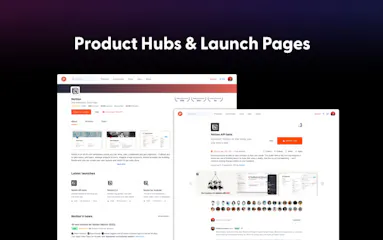
What happens when hundreds of thousands of products are launched or hunted over the span of eight years on Product Hunt? Well, for one thing, a standout community of ideators and makers is born.
Also, discovering new products gets a little hard to navigate.
We’ve watched products go from MVPs, hackathon submissions, and side projects to businesses, unicorns, and bootstrapped success stories since Product Hunt launched in 2013. We all love following along, but have had a hard time doing so.
“Just look at Framer — the team has dropped over thirty launches in less than a decade! ...We knew we needed to make some changes…“ shared Product Hunt CEO, Ashley Higgins.
So we did, and last week we got to be a little bit meta as we launched Product Hubs on Product Hunt.
We rolled up all the information that’s needed to learn about a product’s journey, from launches to reviews, into one hub. Now you can follow products and receive updates whenever your favorite launches something new. This feature was created for product stans and makers who build in public.
“Product Hunt shouldn’t just be where you launch your product, but where you can build a community,” shared Product Hunt PM, Michael Silber.
Product Hubs are a big change to how the platform is structured. “We had to restart it several times before reaching these results” noted Head of Design Julie Chabin, and “Migrating a lot of data related to the post to the product without breaking the models and bringing the site down was a significant challenge,” shared Engineering Lead Vlad Vladimirov.
We’re just getting started though and Product Hunt makers would love to get your feedback.



Scroll through LinkedIn for a couple of minutes and you’re bound to find one of those crazy corporate anecdotes and a bunch of variations of the “I’m pleased to announce…” post. While the platform is still one of the most efficient ways to find opportunities, some of you feel it’s “lost its purpose” and “has become more of a social network than being a top-notch professional network.”
That’s one of the areas Peerlist is hoping to improve. The community-led professional network has work profiles at its core, which are aimed at designers, developers, indie hackers, and creators. This means it enables you to showcase your work directly from Github, Dribbble, Substack, Medium, DEV, Hashnode, YouTube, and Product Hunt. You can also add custom projects and credentials.
As far as the social element goes, Peerlist helps you discover people based on the skills and work they are doing. You can keep your network organized by adding connections to custom lists. This kind of organization also extends to the feed, where you can contextualize your posts as opportunities, books, URLs, and events.
Social apps are notoriously difficult to build and grow. Peerlist’s focus on the utility of building a profile to showcase your experience is an interesting growth strategy. We’ve seen this in past successful companies – think filters on Instagram and video creation on TikTok.
Other similar platforms include Golden Kitty Award winner, Contra, which gives freelancers flexible, commission-free opportunities, and Showwcase, a professional network built for people who code. Polywork (backed by Youtube founders, among many others) is another popular LinkedIn alternative.



Deciding what to eat can be easy, but it can also be really tough. Some of us spend what feels like hours scrolling through food delivery apps and restaurant reviews, some look inside the fridge for inspiration, while others have their life together and meal prep. And let’s not forget about the meal-kit delivery services fans.
If you’re looking to cut down on costs, get inspiration, and enjoy more wholesome home-cooked meals, that’s where an app like Manna Cooking comes in handy.
The app takes users through the meal lifecycle: from search and discovery to shopping, cooking, and sharing. You can swipe on recipes that you’re interested in making, save them for later, or swap out certain ingredients to fit your eating requirements – think gluten-free, vegetarian, or lactose intolerant. This takes away some of the work that goes into finding the ingredients of that delicious-looking meal you saw on Pinterest or Instagram.
One of the problems that prompted the makers to start working on Manna is shopping for ingredients. According to a recent consumer survey, 80% of American shoppers use recipes as their starting point for online grocery shopping. Often that means searching for each and every ingredient and manually adding it to your cart. The app bypasses this by automatically adding ingredients in the right quantities of selected recipes to your Amazon Fresh cart. The team is also working on adding new vendors.
The food-tech space seemed to be quiet for a while, but some interesting products are launching nonetheless. Take yhangry, for instance, which launched a couple of months ago as a marketplace where you can book a private chef for your dinner party for $40pp. Instacart also recently confidentially filed for an IPO, despite seeing declining sales compared to the pandemic growth it experienced.
One disclaimer: swiping through the app might make you hungry. If you’re willing to take a chance, let the makers know which recipe you’re trying out tonight.


It sounds sexy, showering together, but is it?
Whether you're getting frisky in there or not, some couples see showering together as a way to nurture and strengthen their relationship. The problem is that most showers are built to support a one-person activity. That single stream of water leaves coupled cleaners with one person in the warmth and one in waiting.
The problem caught the attention of two engineers, Brett Skaloud and Jeff Feiereisen, who met while working at Amazon. Skaloud has over 15 years of experience designing products from the ground up, including Amazon Scout and Amazon Go. He teamed up with Feiereisen, who has worked as an engineering lead at Microsoft and Amazon (where he launched Amazon Go with Skaloud) to make Boona, a tandem shower.
The makers worked on numerous iterations of their product over the last year before launching it on Kickstarter. Now Boona has over 2,900 backers kicking in over $650,000 — over 65x their original goal, with a week to go.
So how does Boona work? It’s an after-market solution, meaning it was created to work easily within the setup you already have, making it an option for renters and homeowners. It fits like a tension curtain rod at the top of your shower, with two opposite-facing shower heads on either side connected by an insulted hose. There are three pressure settings and a valve allows you to adjust the flow of water between the showerheads.
And who said you can’t shower solo and enjoy two streams all on your own? No one.
Get more details on how Boona works.



It’s rough out there. While scrolling Twitter last week, you may have seen some founders announce they’re laying off parts of their teams. Significant cuts have been happening since the beginning of the year and we’ve already seen at least 22 companies join the list in Q2 alone.
If you’re curious to dig deeper into the data, one maker created a database tracking tech startup layoffs since COVID-19. Layoffs.fyi gets all of the information from public reports. It even shows a list of folks looking for new opportunities with contact information.
But why is this happening now, you might ask. One reason is that fundraising has slowed down. While global VC funding in 2021 was on a high, recent reports show that Q1 funding fell for the first time in a year. That, paired with bloated valuations, start-ups struggling to find ways to increase revenue or become profitable, and a looming bear market, might be bringing us closer to seeing the bubble burst.
We like to look at the positive, though. There are plenty of companies out there looking to hire. Fortunately, we continue seeing makers find smart, creative ways to gather opportunities and help those wanting to make a career change.
Take Honter, for instance. The app launched recently with an interesting discovery mechanism. “We found a good use for the matching system Tinder uses. We believe we can connect faster and better creative freelancers with potential new clients,” the maker shares.
Another tool worth mentioning is Himalayas, a remote job board that allows you to search 2,000+ open roles at 1,700+ remote companies. You can filter by time zone, visa, skills, company, salary, and tech stack. Alternatively, if switching to a career in Web3 sounds exciting to you, we recently wrote about it here.
Yours truly has some open positions, too.


Zenly is not a new app. We first saw its launch back in 2016, a year before getting acquired by Snapchat for a whopping $213M. Despite being an inspiration for Snap’s map feature, Snap decided to continue running Zenly as a separate product.
Recently the team launched Zenly 5.0 and earned Product of the Day. If you need some context as to what Zenly is – it’s a social maps app that marks all the places you and your friends have been. The app lets you see where your friends are, using always-on GPS, so no need for check-ins. You can then message them from the app to make plans and hang out.
The Paris-based team has been heads down working on its biggest redesign to date for its now 35 million monthly active users. One of Zenly’s makers shares “you’ll see new features like public profiles and auto check-ins for places (this is our antidote to curated posts on other social platforms). You’ll also find your footprints (your virtual scratch map) that show all the areas you’ve uncovered and haven’t yet been on your map.”
Looking at the versions side-by-side, the update feels a lot more grown-up, elegant, and aligned with today’s design trends. The initial playful, colorful, emoji-filled appearance has been replaced by a dark mode mixed with trendy gradients. As expected with major redesigns (remember Snapchat’s 2018 update?), reviews have been mixed, although most of its supporters seem to be excited about the new features.
If you haven’t heard much about the app, that’s not surprising if you’re in the US. Since its inception, Zenly has been mostly focused on growing in Europe and Southeast Asia, and it’s growing in popularity in Brazil and India.
We recently saw Snapchat's Q1 results show that the photo-sharing app is growing faster than its rivals Meta and Twitter. Snap’s CEO, Evan Spiegel, is taking over from Zenly’s founder soon, and it will be interesting to see where he takes the social app.
The social space is getting a lot of buzz right now, but it’s notoriously difficult for newcomers to break through. We’re excited to see new and old players build and innovate. What are your thoughts on Zenly’s take on social? Let the team know in the comments.


You may have heard tales of start-ups being sold on eBay (see: Justin Kan’s first start-up, Kiko), but a big part of the coverage in today’s tech news tends to be focused on large acquisitions. The world of M&A goes beyond tech giants acquiring smaller companies though.
EarlyAcquire launched last week as a marketplace for buying and selling side projects. What makes this different is that the team aims “to provide the best curated deals under $10k before anyone else can get them on other networks,” as well as allow anonymous acquisitions. Once you submit your project, the EarlyAcquire team reviews and publishes it for others to see. When someone is interested in buying, you can start negotiating using its internal messaging system.
EarlyAcquire is not the first of its kind. MicroAcquire made a splash when it launched a couple of years ago, with almost 7,000 of you upvoting it. The product has seen 500+ acquisitions since its debut and over $300M in closed deals. Yesterday, MicroAquire’s founder announced the first $10M deal. Some called it a MassiveAcquire.
Golden Kitty Award winner, Tiny Acquisitions, also recently launched its second iteration. While the platform started with the premise of strictly allowing deals under $5k, it recently announced it’s expanding to accommodate listings of projects up to $100k.
If you’re a micro-SaaS founder and considering making an exit one day but need a little help growing, SaaSmate.co launched a few days ago to help makers find product partnerships, reduce customer acquisition costs, and mutually expand customer bases.


gm, friends.
On Thursday, we announced the launch of our Web3 feed – a place where you can discover the latest Web3 projects and learn the ins and outs of this new era of the Internet.
Nearly 6,000 Web3 projects have launched on Product Hunt, 35,000 of you are already following the crypto topic, and Web3-related keyword searches make up over 32% of the top 8 most searched terms — we took the hint.
The idea for the feed came about during one of our annual internal hackathons, when Web3 engineer, Tim Carambat, proposed building a central hub for Web3 enthusiasts that not only allows them to discover new projects but also gives makers a way to reach new audiences.
In its current format, the feed allows you to browse through projects, filtering by the category they fit in – DAO, DApp, DeFi, or by the blockchain they’ve been built on. We designed the feed while keeping in mind the particularities of Web3 projects. The embedded Twitter follower count may, for instance, help you better understand the hype and community behind a launch.
The Web3 space can be confusing and it’s hard to know where to start. We get that and we’re with you. That’s why we’ve also partnered with experts, like David Phelps and Linda Xie, to help shed some light on Web3 concepts. Whether you still don't understand NFTs or you’re ready to dive into more advanced topics, we’ve curated a collection of resources ranging from understanding the uses cases of NFTs to deeper dives into the economics of them.
We’ve still got a lot planned and we hope this initiative encourages more of you to launch. We’d love to hear your thoughts, so make sure to drop us your feedback!


This is your daily reminder that you don't need all those tabs open.
Last week we saw a new player join the save-for-later race in an attempt to make collecting knowledge easier. Meet Heyday. What seems different about the tool is that you don’t actually do any of the saving yourself. Instead, the browser extension automatically collects web pages you visit and pulls in content from your apps.
Maker Sam DeBrule shares that he started working on Heyday as “today's tools require behavior change and constant input. That’s okay for productivity junkies but the rest of us are stuck with 100 open tabs.” He believes that “knowledge management tools should be easy/fast to set up, layer on top of existing workflows, and require little manual input,” carrying on to explain that staying organized should be made as easy as “Honey makes it to save money or Grammarly makes it to write well.”
Heyday remembers what content you visit, including websites or tweets, and uses artificial intelligence to resurface these whenever you’re reading something in the same area of knowledge. One user referred to it as “your own personal Google search engine for anything you’ve looked at, read, or thought ‘I should make a note of this.’”
The save-for-later, bookmarking space is a compelling, yet crowded one. We’ve written about using AI to resurface content in the past so it’s interesting to see makers working to minimize the time we spend learning and getting used to a new tool.
What do you use to make sense of all the information you come across? Let us know.


