The Roundup
Everything you missed this past week on Product Hunt: Top products, spicy community discourse, key trends on the site, and long-form pieces we’ve recently published.

Employers are still struggling to fill jobs and retain employees and it looks like some of those just entering the workforce are ditching suits for the metaverse.
There are at least a couple reasons why people are interested in switching to a career in Web3. One is that Web3 provides younger candidates the opportunity to become an expert without the need for decades of experience. Another? It pays WELL. “Regardless if you like it or not, Web3 is easily 2x to 5x what Silicon Valley pays,” NomadList founder shared after coming across a $750k/year job posting.
Last week we saw the launch of Hustleverse, a community that wants to help engineers, designers, marketers, PMs, and community managers in Web2 onboard and transition their careers to Web3. “We’ll host events with Web3 founders and builders to teach community members about Web3 tools and career opportunities. We’ll also facilitate high-level peer networking to help members build their network,” maker and Creative Director at early-stage VC Hustle Fund, Hung Pham, shares.
If you’re still on the fence about this Web3 thing, you can also window shop. Web3 Jobs has 15,256 jobs and 2,231 projects listed that you can browse. You can also sign up to receive a daily or weekly round-up of new jobs added. You know, just in case.
Hunted takes a slightly different approach. It connects you with Web3 startups that can commit to your desired salary. You get to stay anonymous until you interview and earn NFTs along the way.


What’s better: getting in 10,000 steps a day or switching to a Mediterranean diet? Well, it depends. Being able to tell what’s making you feel great (or not) is hard and varies by person.
Enter Cor.
We first heard about it six years ago when founder Bob Messerschmidt launched a crowdfunding campaign. As the former Director of Platform Architecture for Apple's Optics and Spectroscopy team, Messerschmidt had worked on bringing Apple Watch health sensors to market. After a long hiatus of heads-down building, Messerschmidt is back.
Cor is an at-home infrared spectrometer that uses your blood to provide insights into how lifestyle tweaks affect your health.
Infrared spectrometers use specific wavelengths of light to identify and quantity molecular changes. The spectrometer is the size of a WiFi router and comes with analytics tracking tens of millions of data points. You’ll have to prick your finger and gather a small sample of blood every week, but according to the team, you’ll be able to discover what food and fitness practices have the highest impact on you.
This might feel familiar to one infamous Silicon Valley scandal many of us are watching unfold in a dramatized TV series right now. In contrast to Theranos’ culture of secrecy, Cor shares its plans publicly, explaining that insights and profits from their early adopters help scale data and bring the product to the average consumer. Messerschmidt has also been clear about what data Cor can and can’t provide. In an interview with Forbes, he compared the device to current wearables – you can think of Cor as being “1,000x more sensitive than Apple Watch.”
Still, if you’re squeamish at the sight of blood, but like the idea of taking more control over your health, Mage recently launched to help you own your medical records, kind of “like a passport for going into medical facilities.” You can share your health record with a hospital but only for the duration of the visit.


“Tesla is not cool enough anymore,” wrote Jasmine Sungu with the launch of Olympian Motors.
Sungu started the new electric vehicle company with co-founder Eren Canarslan upon realizing there is a demand for alternative EV designs and experiences. Sungu had previously worked at IBM and EY as a managing consultant in the automotive and mobility industry. Canarslan's career started at Ford as an R&D engineer and, prior to Olympian, the founder had been working on automotive, mobility, and augmented reality at Qualcomm Strategy & Ventures.
The founding team set out to create an experience-first consumer segment in the auto industry, prioritizing aesthetics over horsepower, user experience over torque, and simplicity. In practice, that looks like a "radically minimalistic" cockpit experience, swapping out tons of button and switches for an augmented reality HUD (heads up display) with voice-assistant and head/eye-tracking applications.
Olympian says it has the first fully fabless production model in the US, meaning the company designs its cars and microchips, but contracts out production rather than owning a factory. According to Canarslan, the model keeps Olympian asset-light, enabling it to have a product-development cycle that’s 300% faster than the U.S. average. The team is currently building prototypes for its Olympian O1 (Sedan) and a Model K1 (SUV) with the first shipment scheduled for November 2022.
Whether you agree with Sungu or not about Tesla’s coolness, it will be nice to have new options, faster. Elon Musk also said that Tesla won’t be rolling out any new models in 2022 because of the global chip shortage. Its most recent consumer EV launch was the Cybertruck in 2019, and production won’t start on those until 2023.
Still, think Tesla is pretty damn cool? Check out this new Cyberbackpack while you wait. Otherwise...


Sorry Dunkin’ but America’s not runnin’ on your coffee. It’s running on XaaS.
Same with the rest of the world. The global anything and Everything as a Service market is expected to grow from $419.02 billion in 2021 to $2,384.12 billion by 2028, according to Fortune Business Insights.
XaaS refers to the subscription-based business model of offering all sorts of products and tech over the internet, but we probably don’t have to tell you that. Harvard Business Review notes that over 84% of global smartphone users already know what it is. The pandemic increased our love of XaaS and there’s plenty to love as it speeds up progress on anything from sustainability to AI.
As techie nerds, we’re always eager to see which services startups are tackling now, and we thought you would be too. Here are 10 unique problems being tackled by XaaS:
- Snippyly and Liveblocks help devs build real-time multiplayer experiences into their software
- Identance, Persona, and Passbase simplify the complicated process of identity verification
- Terra connects users' wearables and sensor data to apps with an API or widget
- Convoy built an open-source webhooks service to combat fragmented implementations
- Duffel Payments helps travel companies sell flights from their products
- Nyckel and anon let companies integrate machine learning without ML experts
- Climatiq makes it easy for companies to calculate their carbon emissions
- Subspace introduced low-latency, real-time internet for verticals (like gaming) that need fast speeds
- Angle Audio helps makers add audio rooms into their product with ease
- Asserto lets devs add authorization capabilities in a fraction of the time it would take to build it by hand



What happens when a brain researcher who specializes in the rehabilitation of athletes makes an app? A lot of celebrity endorsements will follow.
At least that’s the case for Nuro by Nurosene. If you have already heard of the app, founded in 2019 by neurologist Daniel Gallucci, it may be because of headlines around Michael Phelps (Olympic swimmer) and Richard Sherman (NFL star) joining the advisory council or Joe Jonas investing in the app. There’s are other big names associated as well but what they all have in common is the impetus to speak out about mental health.
Nuro provides a science-based, self-guided platform for better brain health. “Our app was designed by a team of neurological experts that have been using these methods in clinic with elite athletes for decades,” explained Nurosene Product Manager, Jamie Hackett, with last week's launch.
According to the company’s investor information page, Nurosene agreed to acquire NetraMark, a Canadian AI and ML startup that provides learning solutions to biotech companies. The goal is to digitize the experience of seeing a functional neurologist.
One of the most interesting features is a Virtual Neural Scan described as a non-invasive, personalized tool to strengthen your brain basics. It starts with a series of tasks to assess four neural networks (a collection of synapses that fire across the human brain and create meaning) — cognitive flexibility, working memory, long-term memory, and adaptability.
“...[T]he brain is a self-organized series of neurological networks… Your score is a PROXY for what we think certain networks of the brain may be doing, what they may excel at, or not. This is very much ACTIVE data as you progress…” the site explains.
The assessment of these four neural networks serves as the basis for personalizing your experience. The result is Daily Brain Flow exercises, designed to stimulate and optimize the dynamic nature of your brain and improve your mental performance.
Though we may not know what it’s like to compete in the Olympics, we’ve all been through something in the last few years. Would you try Nuro to boost your mental health? Why or why not?


Like many of you, our minds and hearts continue to be with the people of Ukraine. Product Hunt is a global community connected through our love of products and technology.
We know that our thoughts can feel trivial during this time — particularly if you’re separated by miles and borders — and that finding a way to help is difficult. In times of crisis, we are always inspired by makers who lead not only with their thoughts but with actions, too. Makers around the world have been rallying to create and share resources for how we can help.
We've compiled a few of them here:
Help Ukraine Win: A collection of resources and info on how foreigners can help
Help Ukraine: Another detailed resource for how those outside Ukraine can help
Help Ukraine | Crowdsourced List: A list of resources to help Ukraine with crowdsourced info
We Stand With Ukraine Website Badge: A simple website badge to show support for Ukraine
Pro Ukraine Website Banner: A website banner that directs Russian users to Help Ukraine Win — for Russian civilians who want to support Ukraine
These resources provide various ways to help, from suggestions on where to donate (if you are able) to petitions that you can sign and more to support Ukraine.


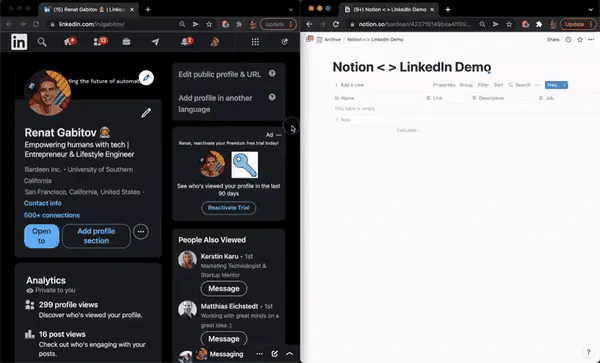
What’s up with the browser extension with 1,500+ upvotes that had people saying this last week:
“Trust me on this...Bardeen is the #nocode tool of the year 💥.”
Bardeen is an automation tool to replace your repetitive tasks in just a click. These days, a lot of startups like Bardeen are working on solutions for context switching and SaaS sprawl. One way companies tackle the problem is through internal hubs. Another is search. There’s automation, too.
Robotic process automation goes further. RPA uses AI to program software to do basic, repetitive tasks across applications. While a tool like Zapier lets you connect apps to automate your workflows, Bardeen is working to use RPA. RPA for personal use is still very new. As Matt Turck, Managing Partner at FirstMark Capital and Bardeen investor, put it:
“Over the last few years, enterprises have poured billions of dollars into Robotic Processing Automation (RPA) to automate their backend systems. But, if you look at what we all do at work every day, we’re all badly in need of our own RPA. We spend so much time and mental energy on simple tasks that could be automated.”
With Bardeen, users can deploy an automation workflow, right in their browser with a click. Two hundred “playbooks” give users pre-built automation, or they can create their own (similar to Zapier). Machine learning helps users identify which tasks can be automated and recommends playbooks. Founder Pascal Weinberger also shared with one commenter that Bardeen runs “entirely on the edge (so in your browser). That comes with all sorts of privacy, security, and cost advantages...”
Thursday's launch was Bardeen’s public debut from stealth and came with an announcement of its $3.5M seed fundraise. Weinberger and co-founder Artem Harutyunyan are accomplished engineers. In a limited snapshot: Harutyunyan spent 8 years as lead developer at CERN (European Organization for Nuclear Research), and Weinberger worked at Google Brain on various ML projects and led the AI team at Europe’s first moonshot factory.
Harutyunyan shared on the launch page:
“I started moonlighting on.. a slack bot that would… take away most mind-numbing and repetitive tasks… A while after, I talked to Pascal. I was really surprised when he literally pitched me my own idea! 🤯… Fast forward a few months and a bunch of us quit our jobs and we're working on Bardeen with some old friends.”
Sounds fun!



We know how this community loves an open-source alternative. Medusa’s launch may strike a chord with those who run or support a business on Shopify, as it did for this commenter:
“This looks great, I'm a huge fan of Shopify and ran a store for nearly 8 years. I agree that I've written some horrible code to get Shopify to do what I want…” - Simon Barker
Maker Sebastian Rindom explained that he and his cofounders were motivated to create Medusa, a headless commerce platform, after often finding themselves hacking together solutions that left them “cringing while writing the code.”
If you’re feeling bad for Shopify, we’ll take a moment to remind you that they’re doing well. Shopify enables 1.75 million businesses to sell to their customers in 175 countries worldwide. The tech giant also consistently explores new partnerships and features to support sellers, making it a favorite tool for businesses and makers.
While Medusa’s solution offers out-of-the-box building blocks for your store along with plug-n-play integrations, similar to Shopify, the startup promises more customization that developers can leverage (“when you need to you can take full control over any part of Medusa and make it your own.”)
Anyone can checkout Medusa’s code (as open-source goes) and at least a couple of makers already took a peek under the hood and are feeling good:
“I'm really impressed by the architecture and code quality,” Cristian Toba commented.
Head to the link below to check out Medusa and leave feedback for the team.
Or, if you clicked on this email hoping to see a lot more open-source, we direct you now to Open Source Alternatives, a resource to find open-source tools by topic, from newsletters to observability platforms.



It’s been a while since we’ve seen this much discourse on Tech Twitter. Calendly took the spotlight recently as the most discussed product. It felt somewhat reminiscent of the 2015 “The Dress” viral phenomenon (is it blue or gold?!) dividing the Internet, except this time, the debate was focused on the question of "is sending a calendar link rude?"
The discussion stems from a post by former Facebook VP, Sam Lessin, arguing that Calendly is “The Most Raw / Naked Display of Social Capital Dynamics in Business.” The Twitter crowd can’t really agree on a consensus either: some shared a satirical response, while others offered up alternative products.
The Calendly team has been addressing concerns like these through a Calendly Etiquette series they started last November.
Still, if you side with Lessin or are just looking for an alternative calendar experience, here are others to check out:
Cal.com is an open-source Calendly alternative that you can self-host and integrate into your business. It's also launching Cal.com for web3 today. 👀
SavvyCal overlays your calendar and your recipient’s calendar, giving them the choice of how long the meeting should run.
Coffee Chats helps you build a no-code website that is connected to your Google Calendar. Think Carrd meets Calendly.
Zcal offers a free Calendly alternative that allows you to customize your booking page.
Hera Calendar was built with remote teams in mind, allowing you to schedule meetings and share availability across all accounts and timezones.
Woven Calendar
leverages group polling to find the best time for larger teams to meet.
Speaking of The Golden Kitty Awards, what did you think?!
We’d love to hear your feedback so we can make next year’s ceremony even better. Please take a moment to fill out this survey and be entered to win one of two $100 Amazon Gift Cards we’re giving away.



The 7th annual Golden Kitty Awards are over. We kicked off this year's celebration when you submitted over 13,800 nominations to tell us what products were your favorites from 2021. You're clearly bullish on web3. It was the category with the most nominations at 11,497, followed by Productivity and Mobile Apps.
From the list of semi-finalists, you chose the products you wanted to see win an iconic Golden Kitty Award. Tens of thousands of votes later, we made it to the ceremony.
We had a blast on Thursday — we’re still talking about the winners, magician, and Sahil Bloom’s outfit. You can watch what you missed or relive the highlights here. You’ll find a list of all finalists there too, so make sure to browse through all of the products your peers love.
Thank you to everyone who attended — you made it a truly special event. Without further ado, here the winners are…
🗣 Audio & Voice Tool of the Year: Podcastle
📱 Mobile App of the Year: Obsidian for Mobile
🙅♀️ No Code Tool of the Year: Flutterflow
👩💻 Productivity Tool of the Year: Cron
⛱ Work from Anywhere Tool of the Year: Sessions
🙀 WTF?! Product of the Year: The Table™️
🤖 AI & Machine Learning Product of the Year: Uizard
💸 Fintech Product of the Year:
Carta Launch
🛠 Hardware Product of the Year: Opal C1
🔐 Privacy Tool of the Year: Drata
🥕 SaaS Product of the Year: Lucky Carrot
⛓ Web3 Product of the Year: ConstitutionDAO
👥 Community & Social Tool of the Year: Canva Video Suite
👪 Children & Family Product of the Year: Brickit
✍️ Creator Tool of the Year: Contra
💻 Developer Tool of the Year: DhiWise
🛍 eCommerce Tool of the Year: Mode Magic 2.0
📚 Education Product of the Year: Odyssey
🏋️♂️ Health & Fitness Product of the Year: Loóna
🎥Product Video Demo of the Year: tl;dv
Watch all finalist videos here.
👀 Side Project of the Year: Workspaces Newsletter
⚤ Diversity & Inclusion Product of the Year: leap.club
🌳 Social Impact Product of the Year: Crewdle
🎨 Design Tool of the Year: Clover
🌟 Maker of the Year: Savio Martin
🙋♂️ Best Community Member: KP
🏆 Product of the Year: Softr 2.0
Finally, thank you to our sponsor, Flatfile — make sure to check out the onboarding platform for importing customer data in as little as 60 seconds.
Let’s take 2022 to the moon!


