

Which jobs do you think will disappear and which will be created? (in the online space)

I keep hearing and reading about how programmers are at risk; basically, everything that can be replaced by AI is at risk.
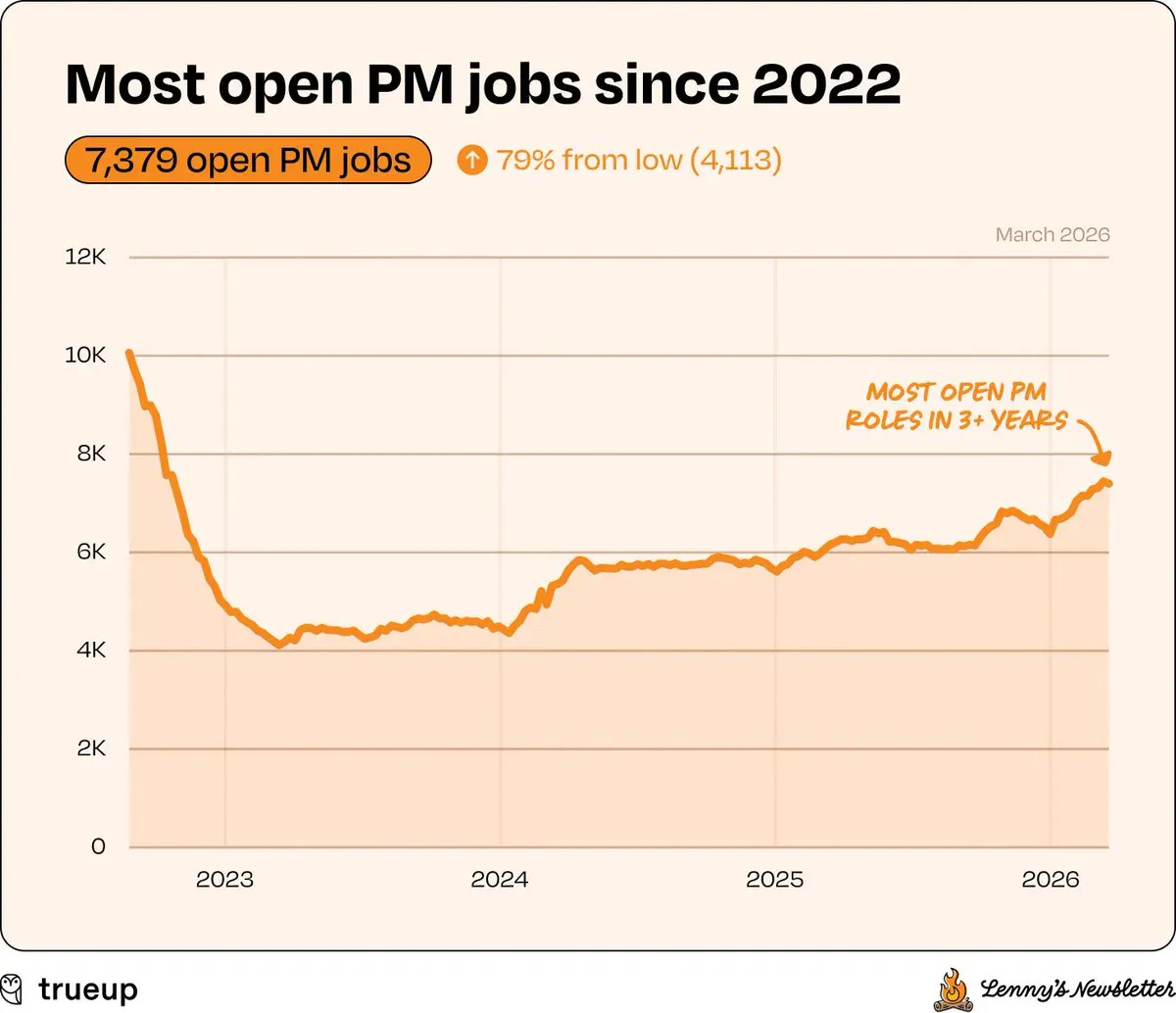
Yesterday, Lenny Rachitsky shared a post that PM openings are at the highest levels since 2022.
At the same time, I read how big giants (Meta, Amazon, etc.) are laying off engineers because of AI, and then I read about how they had to hire back again because something managed by AI went wrong.
So which positions are really disappearing online, and which are emerging?
I assume that security-related positions will emerge more.
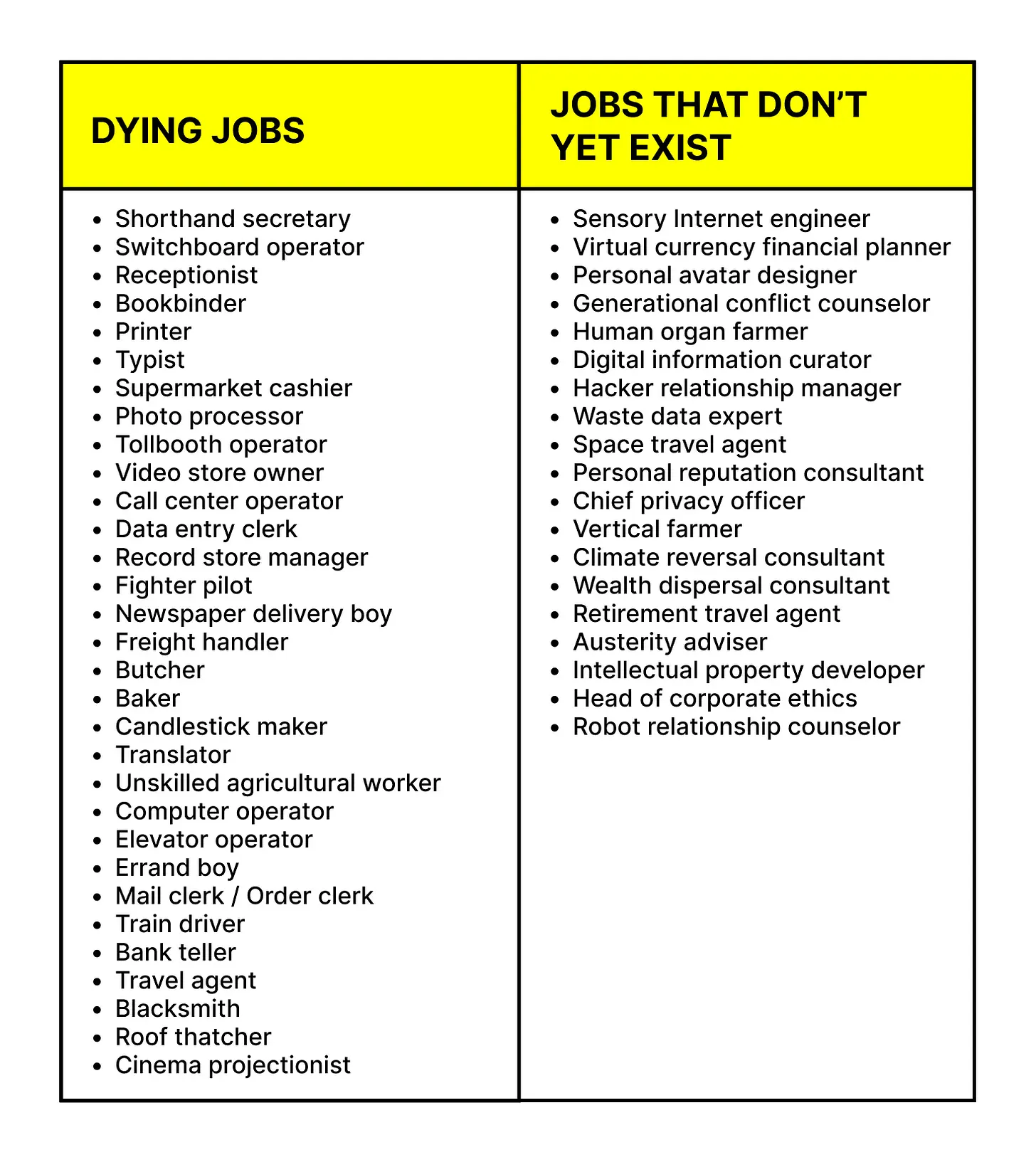
BTW... adding also an assumption made in 2012 by one author who predicted dying vs emerging jobs. – image from the book The Future: 50 Ideas You Really Need To Know
321 views
Replies
I often joke that during the COVID times, we had more patients and few doctors. The same situation is now with too few growth marketers for the flood of new products online.
Everyone is busy building, but there just aren’t enough people focused on high-quality marketing and distribution.
That’s why I believe growth marketing and growth marketers are the next big leverage point. Back in 2019, I launched my book “The Growth Hacking Book,” where I championed the idea of growth hacking and growth hackers.
Today, I think its more important than ever... we really need creative minds who can drive smarter distribution, not just more people building the next product.
@rohanrecommends That reminds me of @sandradjajic
@busmark_w_nika Thanks for sharing. Glad to know our peers in the industry echo the same thought.
I am 100% in agreement with you @sandradjajic! :)
@rohanrecommends my company has made me growth maketer for the Hire ID, I was hesitant at first but now it feels like right step. I am learning new stuff everyday
I think the jobs are not disappearing but they are merging. What's more likely is that what used to need a team of a few people to achieve some goal will now be done by just one person, with a new title that has broader coverage thanks to applications of AI. Openings may seem to shrink for a while because one person can now cover what several used to. But that's happened before, webmasters turned into full stack developers and eventually there were more of those jobs than the original ones ever were. The same cycle might be playing out here. And the re-hiring stories at places like Meta and Amazon kind of prove it. Someone still has to manage the specialized AI instances and be responsible for what they break, which turns out to be its own job. Security is just the most obvious version of that, but it should apply across the board.
@akandere That sounds more like a generalist approach. I was always told off that I want to know / to do many things – that I am spreading myself too thin. Now, what they perceived as weakness, it is my superpower lol.
@busmark_w_nika That is the case with me as well. Having spent time in many fields almost always helps solve problems in one with a wider perspective.
All these professions have “gone extinct” at least for now, as long as the internet exists; without it, they would instantly become super popular.
It’s fine when AI replaces what a person can do themselves, understands the process, and then delegates it to AI.
But I disagree about bakers. Part of the process has long been automated, but I doubt a robot could independently create something that would truly delight a person. You have to put your heart and soul into truly delicious food.
@maria_anosova The baker point is a good one. There’s a category of work where the human presence IS the product — the craftsmanship, the intent, the imperfection. A sourdough from a neighborhood bakery isn’t competing on efficiency. It’s competing on the story behind it, the hands that made it, the fact that someone cared.
I think that category is actually growing as AI expands. The more automated the world becomes, the more people will pay a premium for things that are demonstrably human-made.
The threat to bakers isn’t AI , it’s the industrial bread that was already there.
@maria_anosova maybe baking will be a part of some "art" that only a few people will be doing, just wait for some robot from China that will automate more things :DDD
30 years in software development. I've watched this exact conversation happen with every wave, outsourcing was going to kill programming, then low-code, then no-code.
What I actually see happening: the floor is rising and the ceiling is rising faster. Junior roles that were mostly boilerplate and glue code are genuinely at risk. But senior engineers who can reason about systems, catch what AI gets confidently wrong, and make architectural decisions - their leverage just went up dramatically.
The emerging role nobody's naming clearly yet is something like "AI output auditor" , someone whose job is specifically to verify, test, and take accountability for what AI produces. We're seeing this already. Meta and Amazon rehiring after AI managed something badly is exactly that dynamic.
I'm building a consumer AI product right now and I spend as much time reviewing and correcting AI decisions as I do writing code. That's not going away, it's just becoming the job.
@henrikpedersen love this POV. youth has been wasted on entry-level roles, which have historically been more mindless, monotonous, and manual.
@anneliese Exactly, and the cruel irony is that those entry-level roles were also how people learned to reason about systems in the first place. We're removing the training ground at the same time we're raising the bar for entry.
@henrikpedersen yeah, but you need to know that skill anyway, otherwise you didn't know what went wrong and why. That's why I think people need to learn those basic (former/original) skills anyway.
@busmark_w_nika 100% agree. You can't audit what you don't understand. The people who will thrive as "AI output auditors" are the ones who learned the fundamentals the hard way - which is exactly why the junior role disappearing is a slow-moving problem. The pipeline of future seniors just got a lot murkier.
@henrikpedersen I am trying to learn, but still not satisfied with the process. But trying to ask Claude "why" "why not" "how to interpret things", and google between lines.
The "programmers are at risk" framing is too broad. What's actually happening is that the bar for what counts as useful programming work is shifting upward. Writing boilerplate code? Yeah, AI handles that now. But figuring out what to build, why, and how the pieces fit together - that's harder than ever to automate.
I'm a solo founder and AI has made me maybe 3x more productive on the coding side. But it didn't replace me, it just raised my output ceiling. The decisions, the debugging when things break in weird ways, the part where you talk to users and realize your assumptions were wrong - none of that got automated. If anything I need those skills more now because I'm shipping faster and getting feedback faster.
The jobs that disappear won't be entire roles, they'll be the repetitive slice of every role. The people who only did that slice are the ones in trouble. The meta hiring/firing/rehiring cycle you mentioned kind of proves it - companies overcorrected, realized AI can't actually own outcomes yet, and pulled people back.
My bet on what emerges: people who can sit between AI output and real business decisions. Not prompt engineers, that's already commoditized. More like people who can audit, verify, and course-correct AI-driven processes. Basically quality control for a world where the first draft is always automated but the first draft is often subtly wrong.
@abdullah_mohamed14 If you have big ambitions, you can achieve more things with AI, so it makes you more employable in the market. But imagine that 80% of people are not like that. That is a huge problem.
@busmark_w_nika
That's a fair point and I don't have a clean answer for it. Not everyone wants to learn new tools every six months, and "just adapt" is easy advice from the side that's already adapting.
But from what I've seen, most of that 80% aren't lacking ambition - they're lacking exposure. When I was doing agency work in Egypt nobody around me was using AI tools seriously. The moment someone showed me what was possible, things shifted fast.
The real risk isn't AI replacing people. It's the gap between those who get exposed early and those who don't.
All I can say is look at the McDonalds in CA that is fully automated with no human workers and then wonder, is there anything it won't be able to do?
@david_sherer I probably missed something with McDonalds :D what happened there? :D
@busmark_w_nika https://www.linkedin.com/posts/ivo-van-breukelen_texas-robotics-automation-activity-7417265919393181696-nznz/ Just an FYI, I have not verified the source
@david_sherer I would be curious how things go when there is some unsatisfied customer or so :D because in many cases, I would like to talk with management directly on the spot.
Anything repetitive, predictable, or easy to structure gets compressed quickly. What seems to stay is the part where context, judgment and deciding what actually matters is involved. That’s harder to replace because it’s not just about output.
@arun_tamang Soft skills can also hugely twist the game :)
@busmark_w_nika Yeah, especially when it comes to understanding what actually matters in a given situation. A lot of decisions aren’t obvious or structured, they depend on context, trade-offs, and timing. That’s where things get harder to replace.
Honestly I don’t think jobs are disappearing… it’s more like the boring parts inside jobs are getting wiped out.
Anything repetitive or easy to turn into a prompt (basic coding, SEO stuff, data entry, simple support) is definitely shrinking.
But the moment things need context, responsibility, or actual decisions… AI still struggles.
That’s why you see companies lay off engineers and then hire again right after. AI helps, but it breaks as soon as things get a bit messy.
Feels like the real shift is from “doers” to more like operators / people who actually understand what’s going on.
The ones doing well aren’t just coders or marketers anymore, it’s people who:
know how to use AI properly
understand the business/system behind it
can catch and fix the stuff AI messes up
Security is a big one too. More AI = more ways to mess things up, leak stuff, or get hacked. That’s only going to grow.
Also feels like more people will just build their own tools / SaaS instead of relying only on jobs. AI makes it way easier to build, but also easier to shoot yourself in the foot if you’re not careful.
So yeah… not disappearing, just changing fast.
If your whole job can be replaced by a prompt, that’s risky.
If you can use prompts to move faster and still think for yourself, you’re probably in a good spot.
@zack_zb anyway, I still think that some people will be redundant – those who will not be willing to collaborate with AI. It has always been like that. Regressive people are going out first from the workspace circle.
@busmark_w_nika Yeah, I agree!
People who refuse to adapt will always struggle, that’s nothing new.
But I think what’s different now is the speed and scope of the shift. It’s not just about adopting a new tool, it’s about changing how you think and work entirely.
Even people who do use AI can still become redundant if they rely on it blindly without understanding what’s going on underneath.
The edge now feels less about “using AI” and more about knowing when it’s wrong and what to do about it.
I agree with this a lot. It feels less like jobs are disappearing and more like the repetitive parts are getting replaced. The real shift seems to be toward people who can understand context, make decisions and fix what AI gets wrong. Feels like knowing how to use AI properly is becoming part of almost every role now.
@haiqa_irfan Only people with fast pace and who can orientate themselves quickly, will win the battle :)
Copywriting as a standalone profession is already fading. I see it firsthand at my day job. Our content budget dropped from $15,000 to $2,000. Same output, fraction of the cost, because AI handles what used to require a team of writers.
The one wildcard: Google could introduce AI-content filters at some point, which might flip the script and make human-written content valuable again.
What might survive is 'creative direction' - knowing what to say and to whom, even if AI does the actual writing. But that's a fundamentally different job than copywriting
@virtualviki Copywriting was the first, as soon as ChatGPT appeared at the beginning of 2024, I was told: Do more articles with the tool at the same price, or lower the price per article. So I knew that I was losing the client :D
@virtualviki yes, but you know how fast ChatGPT is and to what extent it creates things. It is hard to keep that pace :D