
 •
•1yr ago
Instagram's Edits vs. TikTok's CapCut?
The short video format originated primarily on TikTok as "TikToks." Of course, it was then picked up by Instagram ("Reels"), YouTube ("Shorts"), and later other platforms began to embrace this trend of short, vertical videos (LinkedIn, X).
For these purposes, TikTok created a mobile video editing app and later a desktop version, CapCut. (2019)
And guess what...
 •
•13d ago
Does launching on Product Hunt even matter if you don't have an audience?
I ve been watching a lot of recent launches, and honestly, the gap between solo indie hackers and backed startups with massive mailing lists is getting crazy.
When you launch with zero audience, even if your product solves a real problem, it feels like shouting into a void unless you constantly poke people in DMs to take a look. On the flip side, teams with existing distribution easily dominate the top spots within the first few hours.
For those of you who launched completely from scratch with no pre-existing email list or social following:
What actually worked for you to get those first 20 or 30 genuine conversations going? Did you focus heavily on Reddit, cold outreach, or just engaging here in the community weeks before launch day?
 •
•6d ago
What are the 5 parts of your workflow you automated this year?
I spent most of last year replacing my own team's manual work. The one that changed everything: a daily pipeline that generates the videos, converts them to GIF with FFmpeg, burns in the logo, watermark and caption, then publishes across 36 client channels. Nobody touches it now. It used to take three people a full morning.
The strange part is that I miss the morning. There was a rhythm to it.
What did you automate, and did you miss any of it?
 •
•2mo ago
Hot take: "reach" is a useless metric for creators. What actually tells you a post was worth it?

 •
•6mo ago
Do you click for the cool logo or the clever tagline?
We all spend hours obsessing over every pixel and word before a launch, but I m curious about what actually works on you as a user.
When you re scrolling through the top products of the day, what is the one thing that actually makes you stop and click?
The Icon/Logo: Does a sleek, high-quality aesthetic signal a better product to you?
The Tagline: Does a clever or "punchy" one-liner win you over?
The Upvote Count: Do you only click things that are already trending?
The Problem: Do you ignore the branding and only click if the name solves a pain point you have right now?
 •
•2mo ago
🤔 AI made building easier. It also made saying "no" much harder.
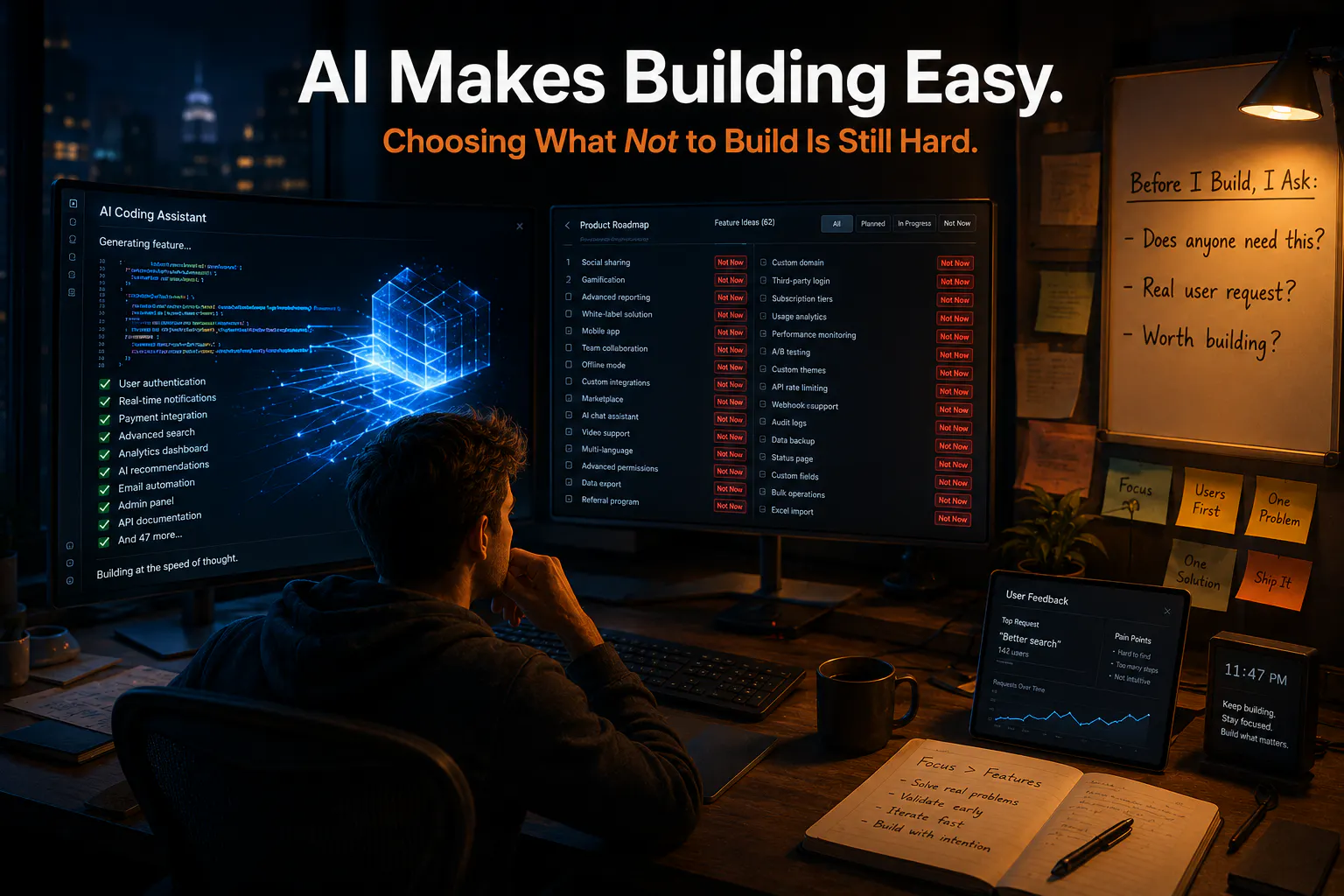
One thing I've noticed over the last year is that AI has changed the cost of experimentation.
•5mo ago
Where do you think the best conditions are for setting up a company?
For the past few months, there has been discussion in Europe about creating a concept like EU Inc. (the 28th regime) a single pan-European legal company structure with:
100% online incorporation
extremely fast setup (target: ~48 hours)
operation across the entire EU without needing to establish 27 separate companies
a digital-first corporate lifecycle
So far, within Europe, people most often set up companies in Estonia, mainly due to its low tax burden and fully digital infrastructure, as well as in countries like the Czech Republic, Slovakia, or Hungary.
 •
•3yr ago
Why did you become a founder?
 •
•6d ago
My migration tool asks before touching the database, and anything without a terminal answers yes
A two minute check for anyone who lets a script, a CI job or an agent run commands in their repository. List the commands that ask before they do something. Then find out what each one does when nobody is there to answer.
Mine is the schema migration generator. Its job sounds like writing a file: compare the models against the database and produce a migration for the difference. To compare honestly it needs the database up to date, so if any migration has not been applied yet, it asks whether to apply them now. The default is yes.
Nobody reads that as dangerous, because there is a question, and the question is the safety. There is a second safety underneath it: the console framework checks whether it is attached to a terminal, and if it is not, it marks the run non-interactive, and a non-interactive run refuses instead of applying anything.
I read the code this morning to find out why neither of those had ever stopped it. The terminal check only runs if the input object has a stream to test. The ordinary input, the one built from the command line arguments, has none. So the check is skipped, the run is treated as interactive, the question is asked, and reading the answer hits the end of an input that was never connected to anything. The library treats end of input as no answer, and no answer as the default. Yes.