
 •
•3mo ago
About That SpaceX "AI Device"
The Wall Street Journal reported this week that SpaceX has shown investors an early prototype for a handset-like device designed to reshape how humans interact with artificial intelligence. It s thinner than an iPhone, runs on SpaceX s own operating system, and uses chips from Qualcomm.
It s probably not a phone because Elon said he doesn t want to build one. But what it actually is is unclear. (That's if it exists at all; Elon Musk called the report "utterly false.")
 •
•5yr ago
If you guys are not using reddit for marketing you should! Here are some tips.
 •
•5mo ago
Is Claude/ChatGPT/Gemini hijacking the Product Hunt experience?
lately I open product hunt and the top 3 spots are just another feature drop from one of the big three, every single day :/
a small maker trying to get real feedback and traction doesn t stand a chance when they re going up against a billion-dollar company s changelog update.
don t get me wrong, these companies ship incredibly fast and usually groundbreaking stuff. We all know it, and honestly, it s fun to watch. (I upvote a lot of them myself too)
but to me, PH used to be about finding products I would never find otherwise. Chatting with makers, getting feedback on my own stuff. That was the whole point.
for the big three and other giants, we re all going to see it anyway. Every reel, every thread, every newsletter will cover it as soon as it's launched, whether or not it s featured on Product Hunt.
I am really curious about what you all do for these 2 things now
- how are you all still finding good indie stuff on here?
- and if you ve launched recently or are thinking about it: is it actually worth it anymore, or has it become a vanity checkbox?
feels like Product Hunt needs a separate board for corporate launches vs. new indie products. Or am I wrong?
 •
•2mo ago
Your LLM judge probably shares a base model with the thing it is judging. That is not a judge.
LLM as judge has quietly become the default way people check agent output, and almost nobody states which model is doing the judging. In most setups it is the same one that produced the answer, or a sibling from the same family. That arrangement fails in a specific and predictable way. The judge does not catch the hallucination because it finds the same thing plausible, for the same reasons, out of the same training. You have not added a check. You have asked the same mind twice and written down that it agreed with itself. Errors that are correlated between producer and judge are exactly the errors that survive, and they are also the ones you most need caught, because a plausible wrong answer is the only kind that ships. There is a second version of this that shows up inside agent loops. A builder agent grading its own work grades against its own model of what "done" means, which is the same model that generated the work, so it cannot see the gap by construction. And the moment your tester can read the builder's own claim of success, it anchors on it. Two things that seem to hold. Run the judge on a different model family than the producer, even when the judge is the weaker model, because independence beats capability for that job. And give the judge the artifact and the original spec only. No producer reasoning, no summary, no "I have verified this works". The reason people do not do this is cost and latency, and those are real. But a judge that agrees with the producer for free is not cheaper than no judge. It is more expensive, because it manufactures confidence you did not have before. What is your judge running on, and did you pick it on purpose?
 •
•5mo ago
I want to support dev tool launches for free (obviously)
Hey there,
I am Nikolas and with my 30+ team we like giving back to the community. So, while I cant support every project that launches every day (I can barely keep up so somedays I dont even log on PH), I do want to make an effort for dev tool projects, especially those helping with AI code assistants (and platforms that could help me evaluate their effectiveness), IDEs, productivity tools and more. I am also interested in SaaS products with an API or simply APIs, especially APIs that leverage AI and can help developers build better (and faster).
 •
•5mo ago
What’s the hardest part of designing for your current product?
Lately I ve been thinking about how different design challenges look depending on the product you re building.
In theory, design processes often look clean and structured. But in reality, every product comes with its own constraints unclear requirements, edge cases, technical limitations, or simply trying to balance user needs with business goals.
 •
•2mo ago
The first version of your product is probably solving the wrong problem.
I've been thinking about something that surprised me while building AI products.
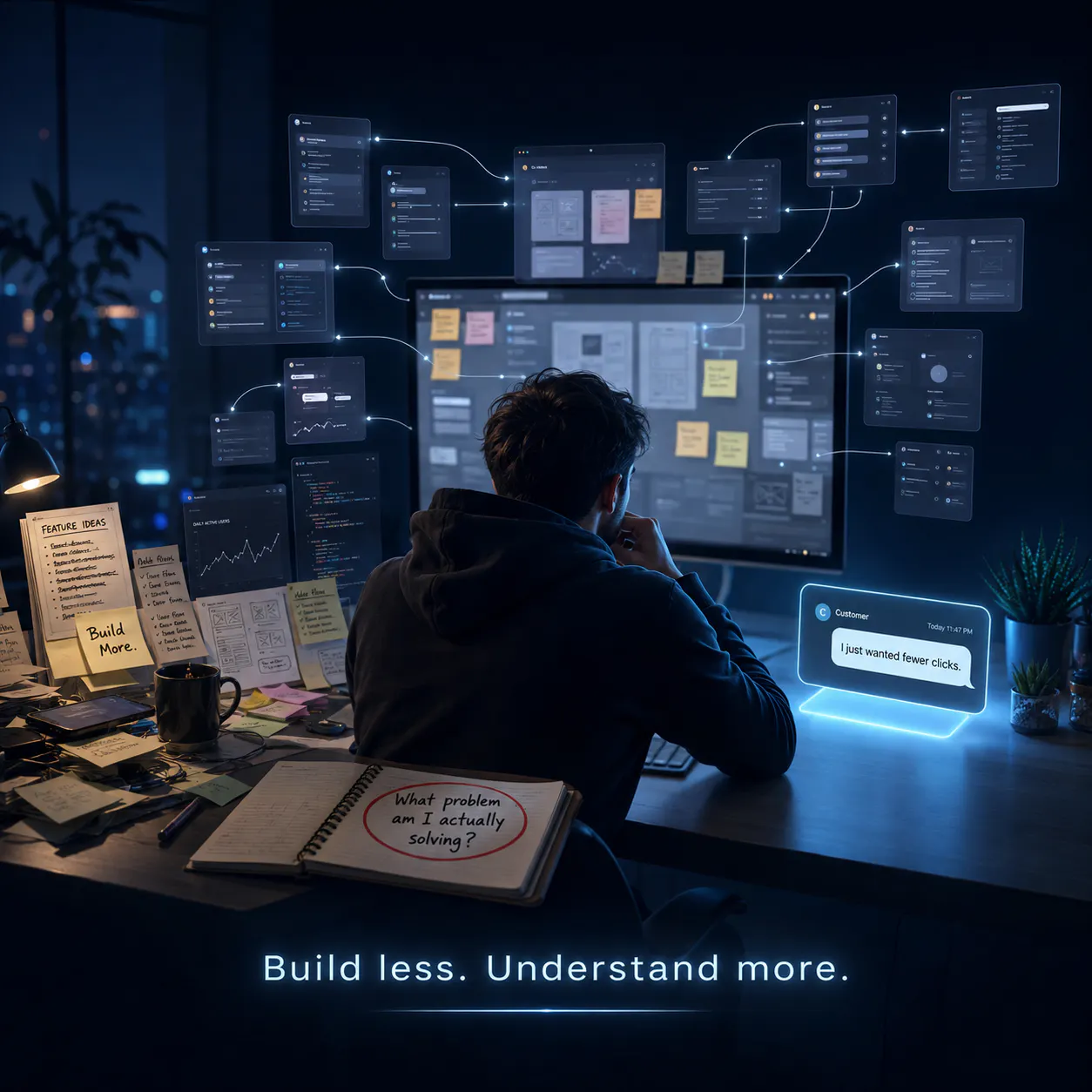
The first version of a product almost never fails because of poor engineering. It fails because it's answering the wrong question.
 •
•2mo ago
What was the biggest technical hurdle you faced when building your first SaaS?
I just pushed my first major SaaS project live, and the relief is real.
For me, the hardest part wasn't the UI it was getting the backend logic to seamlessly generate perfect PDF documents on the fly without lagging the browser.
For the experienced technical founders here: what was the one bug or architectural choice that kept you up at night when building your first app?
 •
•3yr ago
What are the most well-designed open-source products?
Happy Tuesday
What are the most well-designed open-source products from your point of view?
My favorites:
@Supabase
@Appwrite
@Cal.com
@Dub
@Documenso
@Hanko via @lxunos
Would love to have your suggestions
Thanks!
 •
•2mo ago
Is one time paywall dead?
I was thinking about old times where subscriptions were uncommon thing and mainly there was one time paywall. Users just don't mind paying few dollars for every app monthly, which in sum up can be equal to hundreds of dollars, or there isn't any solution for this at all? App developers are chasing money, they don't want to publish their work for just lame one time pay from one user. They want to get from user as much as it possible, logical way to that is by subscriptions. Also what about privacy, every app nowadays has to sell your data for additional money. There are no longer solutions connecting one time paywall with leaving data on Your device. My point is, does it make sense to create new apps more like everyday use so for some people It will be trip helper or sleep sounds so they can sleep better and for others it will be some advanced grocery list etc. with some cool features behind one time paywall and without selling data.