

5,000 customers, £20k spent: everything we did to market our AI startup (w/ free resources)

Hey all,
I wrote a forum post not long ago on marketing as one of the rising in importance hires for all startups. This is all the things we've done, with some results and free resources.
Keep reading if you're early stage, not a marketing background, or just looking for some inspiration and free help...
We get a lot of compliments on @Meet-Ting's marketing, mostly about the fun and creative stuff, but there's a whole bunch of more resourceful stuff we try that people don't see.
I'm getting asked more and more, especially by VCs (trying to work out if this question is reductive or fair these days...), about differentiation.
It's such a difficult question to answer honestly (stress, honestly) because how can anyone really differentiate when software generates itself?
Deep domain expertise is one good answer. Some categories are technical and complicated enough that you need someone who has really lived in that world.
But for this write up, let’s assume you’re not that person.
Then the other answers are usually product, distribution and marketing:
A product so good it speaks for itself.
Distribution so natural and low-cost the product starts lifting itself.
And then brand/marketing. The part where you somehow manage to squeeze into somebody’s goldfish brain for a brief second and make them care.
My background is in marketing and community roles locally, globally and by business unit at adidas, then TikTok platform and family of apps at ByteDance.
This article is my attempt at a practical guide through the lessons of building the startup I co-founded.
Main lesson is simple: operate by the “if we spend X, we get Y” philosophy.
The question becomes: how do we achieve the goal in the most cost-efficient way possible?
Meet-Ting: case study
So far we’ve generated 50k visits, with an average session time of 2 minutes 48 on our site, over 5,000 customers signed up, and we’ve spent around £20k on what I’d class as marketing-related costs.
That includes web development, subscriptions (LLM, CRM etc.), video and content development, and some small paid tests across community, newsletters, creators, social and search.
We’re a small team. Only one marketer, me. But really the whole team acts as one unit. They all review my posts, even this one.
The following is a semi-structured list of all the things we’ve done in the last seven months.
Not a perfect playbook. Just a bunch of tactics with some views.
1. Narrative and PR
I’m putting this first because I think story is the most contagious thing you can do for your product. It gives people an easy way to talk about you.
That matters for press, for community, for social, for creators. For everything, really.
Our first story was: what if that meeting never happened?
We took famous moments from history and imagined a version where, instead of the meeting happening, someone sent a Calendly link and the whole thing died there.
The Beatles never got together. Larry and Sergey lost touch. That kind of thing.
People loved it because it landed straight in the imagination.
Then we told a different story: a more emotionally intelligent assistant. One that leans into the messiness of human meeting culture rather than pretending people are neat little calendar blocks.
That felt important at the time because there was already a growing anti-AI slop feeling online.
We showed a version of AI that works in the messy human gaps.
Then, most recently, bonus points if you upvoted us here on PH too, we told the story of our availability agent. Something that learns how you make decisions, then helps do it for you: https://youtu.be/MbrWxYrlXF4
It’s all the same product. Just told in ways that capture more imagination each time.
2. Personal network
At the start, you are the product. Your network is the distribution.
And your first users are probably much closer than you think.
Friends, old colleagues, people you used to work with, people who want to help, people who are curious, probably your mum too.
Also pro tip - milk the moment when you announce the new role or company on LinkedIn.
The platform gives you a lot of algorithmic juice around that moment, so if you’re strategic you can get a lot of visibility from it.
Early on, this stuff matters, those sparse likes and comments give you some social signal.
3. LinkedIn
We’re a meeting software tool, so we’ve pushed hard on LinkedIn. It makes sense for our category.
I’ve found personal channels almost always outperform the brand account, so we’ve leaned much more on mine than anything else.
People want people. True for most platforms.
I’ve also been testing recently to post a hot take on a big AI news story. I posted about ChatGPT ads and Google allowing agents to checkout for you just as the news hit the wire, and rode the wave of the platform ‘recommended posts’.
It’s got nothing to do with Meet-Ting yes, but it brings new people into me, and then I will eventually post about Ting, so it all adds value in the end.
Look at the impressions:

4. Free AI newsletters
We had to build the site from scratch, so we had zero authority. That meant backlink hunting.
It’s highly manual, just working through lists of AI newsletters and smaller publications where we could get featured, linked, or mentioned.
There’s a community-generated list here which helped us: https://docs.google.com/spreadsheets/d/1MZca01TpCmuVrFmWeaBxl7fVesFY_87k-DVRAFgteYc/edit?gid=0#gid=0
This sort of work helps with discovery, helps with credibility, and helps create more pathways back to you.
5. AI-generated content
Important mention: you still need taste.
But AI-generated content lets small teams punch above their weight and make things that would have been much harder before.
We made a homage to the classic tech keynote before we launched and it helped us create something much bigger-feeling than a small team would usually be able to pull off:
That’s where AI is brilliant. It gets me so excited about the future of content.
6. Newsletters
We also worked with some of the AI-focused newsletters to create content that raised awareness of the product.
These were great for getting instant testers.
Less great for retention, because some of those people were more AI tourists than true ICP.
But at that stage, we wanted people to come in, test the onboarding flows, and give us signal.
I also found it personally enlightening to see how amazing writers told our story.
I sent this article to all our investors: https://aiadopters.club/p/the-real-reason-people-hate-your
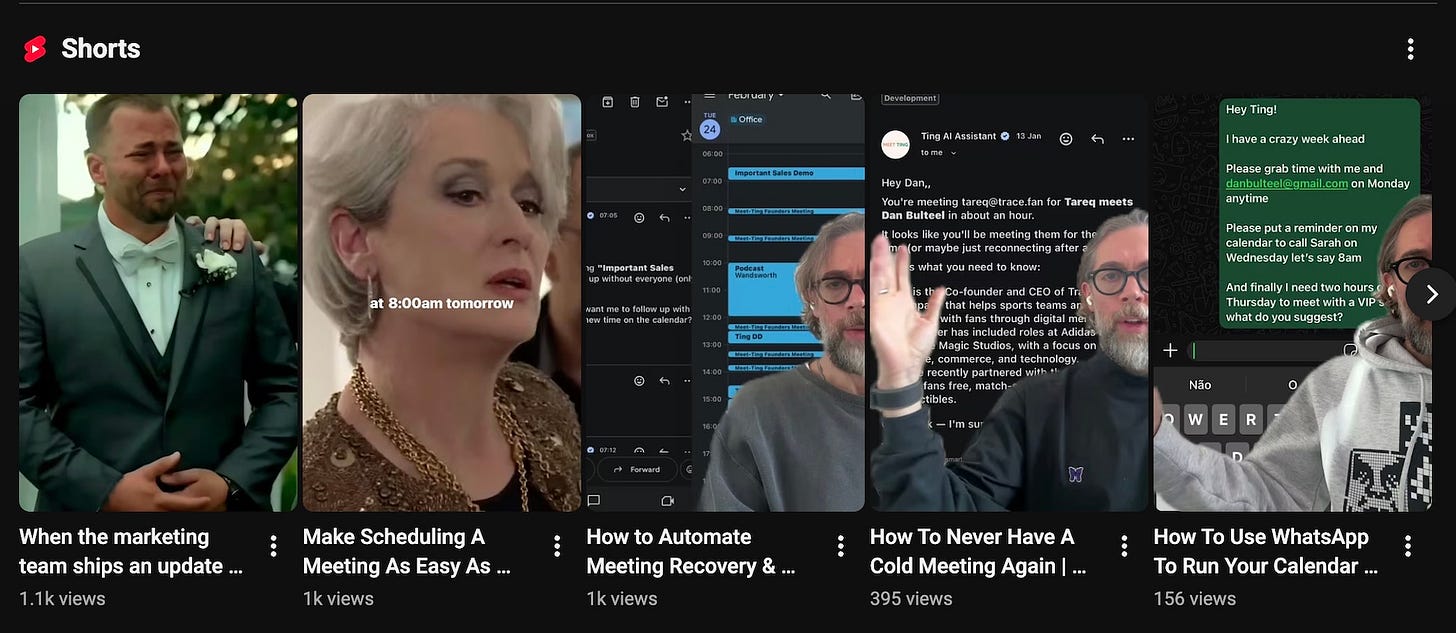
7. Short video
We’re in an amazing window where you can still publish to Reels, TikTok and YouTube Shorts and get a lot of organic reach.
So my general view is: throw it up!
At worst you get 200 views of your product. At best, sky is the limit.
I wrote this guide to short video a few years ago, but the lessons are still true: https://www.linkedin.com/pulse/create-viral-short-videos-cheat-codes-daniel-bulteel
8. Content marketing
We worked hard to define stunt-y ideas that could give us media efficiency because we didn’t have the dollars to spend in a bigger way.
Everything about Ting is supposed to feel fun and relatable.
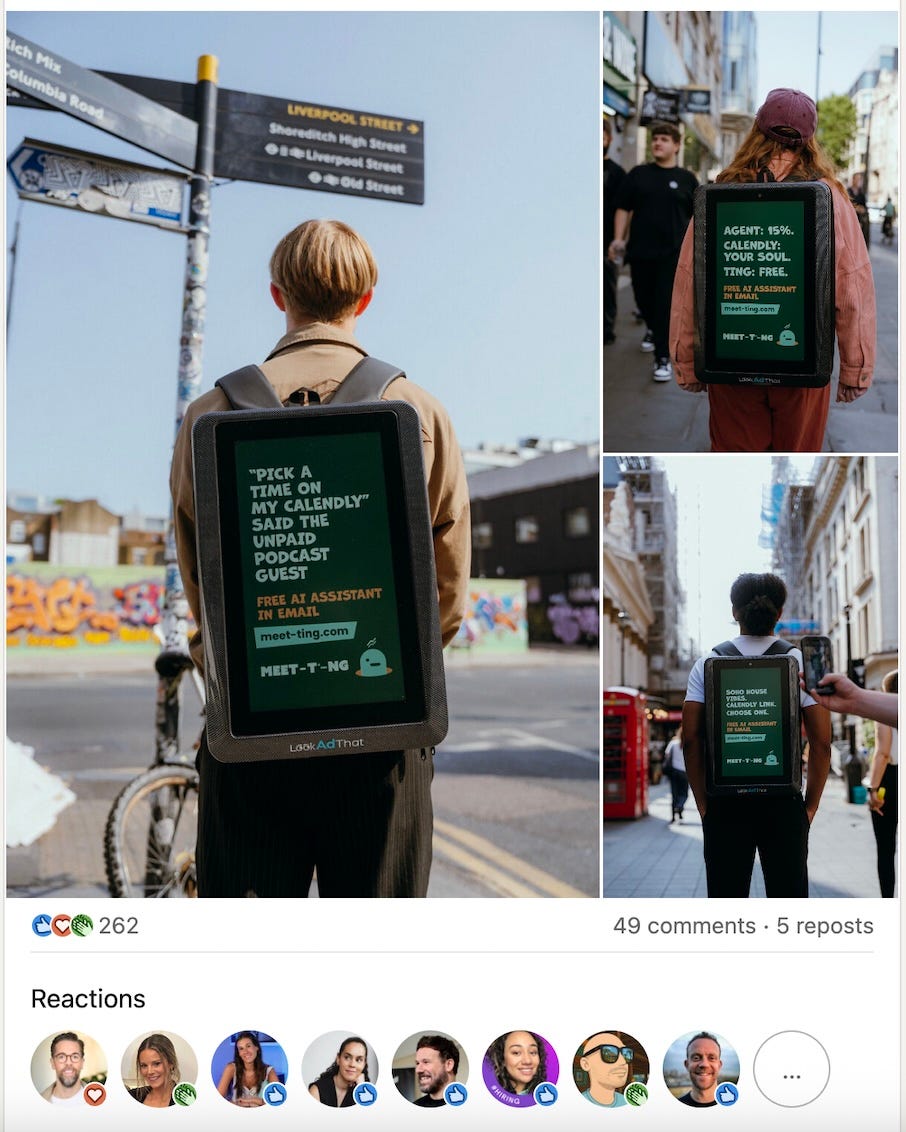
We did a stunt with LookAdThat, cost around £2k, sending people wearing billboards across London.
But it was never really about the offline. It was about the online.
The point was to create something people would film, share, repost and talk about.
That’s where the ROI came from:
9. Founding creators
We identified a small group of incredible creators to work with early.
Not a massive scaled creator program. Not loads of volume. Yet.
Just a smart group of people we trusted, who felt close to our audience and could help us build social proof from day one.
That gave us ongoing support, trust by association, and proximity to the types of users we thought were most likely to care.
I think this is a really underrated one. Think about creators as business partners not just rented space.
Thank you Sophie, Elisabetta, Elf and Amelia if you’re reading this.
10. Instagram carousels
Instagram is a communal platform. Sharing matters a lot. And carousels show up in feed multiple times, which is (obviously) helpful.
We’ve recycled these for memes, testimonials, creator content, press mentions, user feedback, all sorts.
Not everything needs to be some massive original campaign.
Sometimes it’s just packaging proof in a format people already like consuming and sharing: https://www.instagram.com/p/DRw1a-DCOGa/
11. Analytics
As a one-person team trying to keep an eye on the funnel and all the different channels, I need a simple way to watch what’s happening.
Social followers. Website traffic. Traffic quality. Where we’re getting mentioned. Where we’re not getting mentioned. Whether answer engines are picking us up.
I use Dojo AI to pull a lot of that together into a simple chat-style interface I can query.
You need to know what is working.
12. AEO
AEO, or answer engine visibility, is really more of a by-product of everything else.
I don’t think of it as some totally separate magic channel.
It’s what starts happening when you do a lot of other things well.
You rank well. You have enough blog content for machines to understand you. You make the site easy to read. You show up on places like Product Hunt and Medium.
You create enough signals around the brand that answer engines have something to pull from.
We also added a button on our site that generates a ChatGPT query to encourage more people to ask about Meet-Ting directly.
Final thought
The main thing is that there isn’t one tactic that suddenly solves startup marketing forever, especially early on.
It’s usually a stack of small things, done with high focus, and minimal cost.
Hope this helps and thanks for reading!
Dan
Replies
Valuable insights Dan, thanks. Will use some of your tips for my upcoming launch. If you had to do it again, is there something you would NOT do?
@ismaelyws We worked with a small AEO agency at the very start thinking it would be an edge and it was an area we didn't know - true waste of time, needed to study ourselves, meant less focus and additional stress for me, but upon reflection why was it ever a good idea to not become more of an expert there! Probably wasted £1k over a few months
Many thanks for sharing these insights and resources. I know zilch about marketing and am slowly learning how to get my startup in front of potential users. I appreciate the easier to follow/understand toolbox here. Now back to work!
@merideth_thompson I didn't mention too much about Reddit in this post, but was also a good source of new users for us, mainly part of our Product Hunt launch day recruitment. These subreddits might be helpful: r/Entrepreneur, r/productivity, r/business, r/smallbusiness, r/startups, r/EntrepreneurRideAlong, r/AlphaandBetaUsers - give me a shout if you need anything!
Re PR - did you use a PR agency or do the cold contacts to journos or writers yourselves?
@couldashouldawoulda I used to work in PR as my first job so I have some background. I did what I did in my first ever PR job. I made a list of all the journalists writing in my space (just go through Google News, search by your keywords, look for articles in the space, look who wrote it, Google their email or look at the bio on their site) then I sent a "Hey I'm Dan, this is what I'm building + I'd love to meet for virtual coffee/lunch if you're in London" as a first email, then when we had comms moments I'd send an update to them hoping the first email even if they didn't respond was friendly enough to strike up a relationship. I have Google Alerts setup on "ai scheduling" and "meeting scheduling" so constantly recording new journalists and titles that cover our space. I also signed up to HARO so pitch when I can. Busywork but really important for better AEO and getting a Wikipedia one day!
@dbul Love this. In the process of doing this myself.
Super useful tips, have bookmarked your post so that I can re-visit whenever I need some marketing inspo
Thanks for sharing @dbul !
@theanimeshs Also here if you ever want to ping and chat, happy to help sir.
@dbul sure thing, appreciate it sir
This is awesome and love that you had PR at the top.
AI imagery is a killer shout out and something that some SMBs find hard to nail.
But there are tools out there that provide curated image sets with no prompting required (examples below) - so no excuses!
@couldashouldawoulda Did you make those images with a product you built? Very cool!
the buried lede in this whole post is the newsletter retention problem. you got testers but they were "AI tourists" - thats the core issue with like 80% of startup marketing channels right now. everyone is optimizing for top of funnel numbers that look great in investor updates but the actual users who stick around almost always come from the boring stuff like personal network and linkedin. ive seen the same pattern building content pipelines, the flashy distribution gets attention but the people who actually care find you through weirdly specific channels you didnt plan for
@umairnadeem Top comment. 100% this ^^^. Some of our most retentive users say a piece of content, reminded them of an app called X AI that folded (not the Elon one), and came along trying to find what they used to have.