

The Tool Replacing SketchUp for Architects: How 2D-to-3D AI Is Reshaping Architectural Workflows
SketchUp has been the workhorse of architectural visualization for 25 years. It's fast, intuitive, and ubiquitous. But it's about to be disrupted, not replaced, but supplemented, by a new category of tools: AI-native 2D-to-3D platforms that make SketchUp look slow.
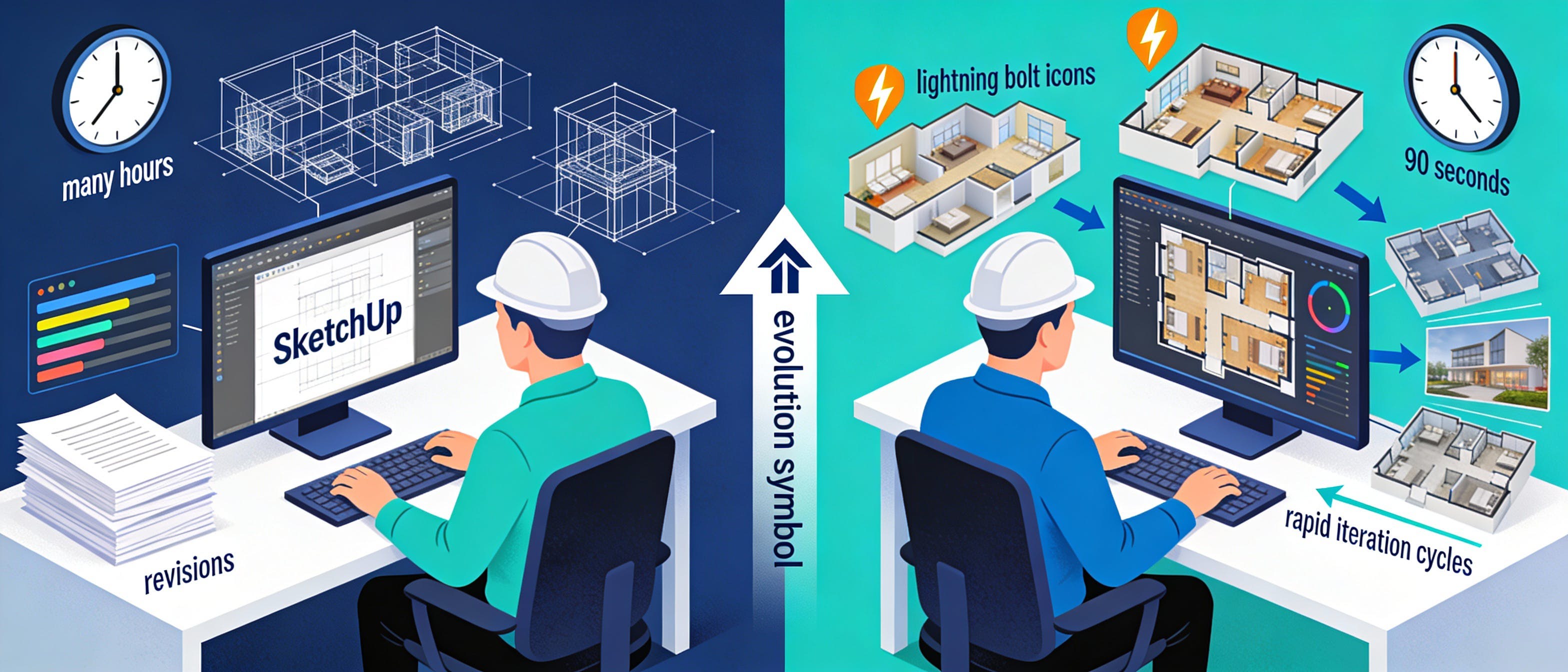
Here's the numbers: A typical architectural project involves 30-40 hours of SketchUp work - modeling, texturing, lighting, rendering. The results are good. But the time investment is significant.
Now, that same project takes 30-40 minutes with AI 2D-to-3D. The computer reads your 2D floor plan, understands the architecture, generates photorealistic 3D scenes with materials, lighting, and furniture - all automatically.
Why this matters
· 97% time reduction: 40 hours vs. 40 minutes per iteration. That's not incremental, that's transformational.
· Design exploration at scale: Instead of picking one design direction and hoping it's right, architects can explore 10+ variations and make informed decisions.
· Faster client communication: Clients don't have to imagine space from a 2D plan. They see it photorealistic. Feedback is faster. Approvals accelerate.
· Cost compression: What used to require a specialist ($150-200/hour, 40 hours = $6,000-8,000) now costs a few hundred dollarsand takes an afternoon.
The workflow shift
Old:
· 2D plan
· SketchUp modeling (hours)
· Manual materials & lighting
· Overnight rendering
· Client feedback
· Repeat
New:
· 2D plan
· AI platform (like Foursite by VirtualSpaces)
· Choose style
· AI generates photorealistic 3D in 90 seconds
· Client feedback
· Regenerate in seconds
The adoption curve is already steep
Early adopter architects are integrating AI 2D-to-3D into their workflows - not replacing SketchUp entirely, but using it as their primary tool for rapid visualization and client communication. SketchUp remains for technical drawing and detailed coordination. AI handles the fast visualization. Market leaders (Autodesk, Zillow) have already recognized this. They're investing aggressively in instant visualization. The question for architects isn't whether to adopt this technology.
It's how quickly you can integrate it before your competitors do.
Read more in the VirtualSpaces Blog here.
Replies
Be the first to reply
Have a question or a thought to share? Add a comment above to start the conversation.