Client emails you a new blog post. You open Framer, find the CMS item, paste, publish. Repeat next week, forever.
The usual fix is inviting them into Framer. Now you're paying for a seat and teaching a non-technical person a CMS they'll touch twice a month.
KnotCMS syncs Notion to your Framer CMS instead. Client edits in Notion, changes land in Framer as drafts, you publish when ready. Or turn on auto-publish. Setup is about 5 minutes and your client never needs a Framer account.
Free for 1 project and 50 items. $9 per project per month after that.
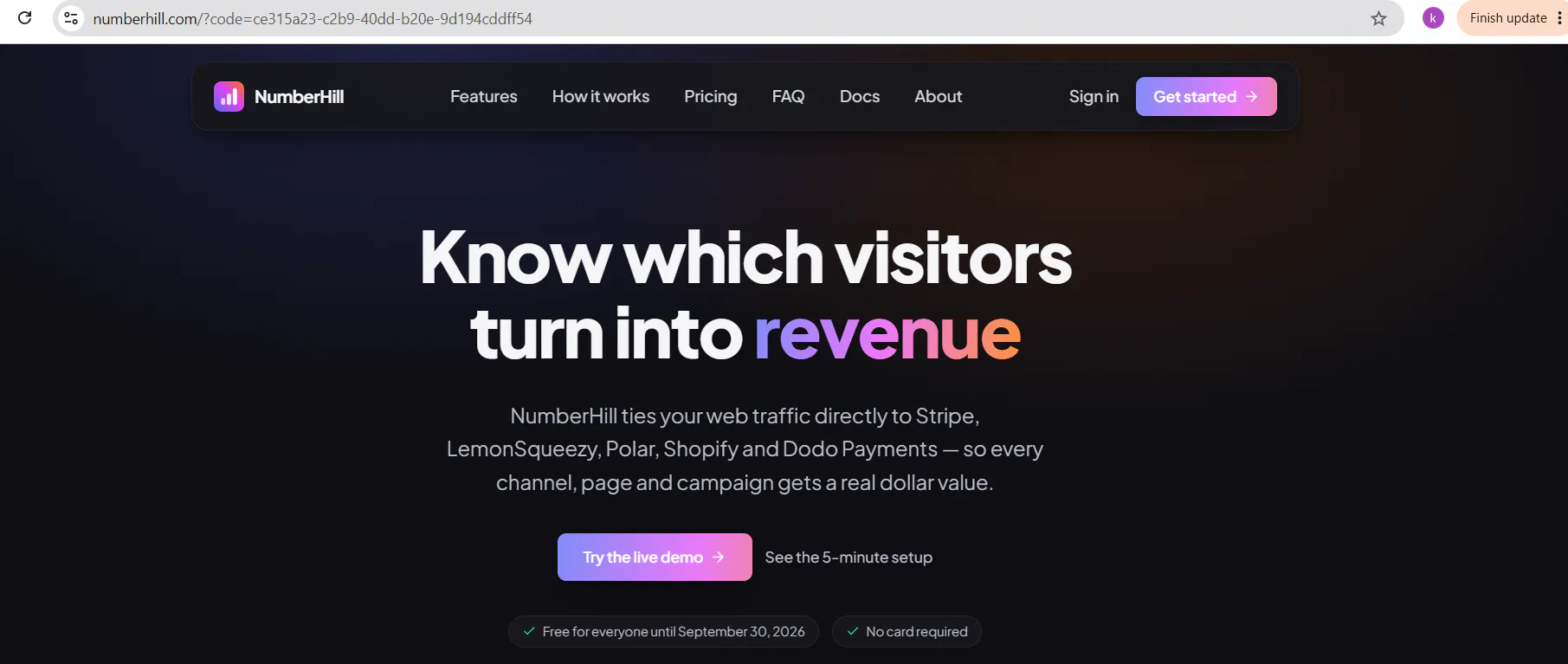
After failing in multiple startups and product, I am building Numberhill.com and It is showing great trascation, in just 1 week our visitors has reached more than 2k. NumerHill Analytics helps to See exactly which marketing channels bring paying customers. NumberHill connects your web analytics to Stripe, LemonSqueezy, Polar, Shopify and Dodo Payments. then, The whole journey of when your customers first see your brand to when they never return or paid for your service can be tracked.
Vision Transformers waste 90% of their compute recalculating stationary asphalt. NeuroFlow tracks semantic surprise in embedding space, physically eliminating background tokens before the encoder.
Result: 55.8x wall-clock speedup for ViTs on high-res video (1792p) with 97% fidelity. No fine-tuning required.
NeuroFlow is a dynamic routing framework for Vision Transformer video inference. It exploits temporal redundancy by tracking per-patch embedding-distance threshold via an Exponential Moving Average (EMA) of patch-level embeddings, effectively answering the architectural mismatch between O(N2) self-attention and highly redundant natural video streams.
Honest question for anyone building: is your own company a customer of your product?
In April I made that rule for us. I build a social media scheduler, and until then our own accounts were run the way everyone's are: five composer tabs, the same caption pasted five times, LinkedIn posted "when I remembered". Since mid-April every weekday post on our LinkedIn, X, Bluesky, and Threads has gone out through the product itself, and I haven't opened a composer since.
Two things surprised me.
First, dogfooding turned out to be our best QA. When a platform changes its API, our own morning post breaks before any customer's does. We've caught real publish bugs hours before a support ticket could have existed.
Hey everyone I built ScanCook after realizing I spend more time deciding what to cook than actually cooking. You just scan your food and get recipes + calories instantly. Goal: less food waste, faster decisions, healthier eating. Would love your honest feedback what s missing?
Most learning platforms give everyone the same course, the same sequence, and the same pace whether you're preparing for a government exam, building a new career skill, or trying to close a knowledge gap.
We're building AtoZAIx, a personalized AI-powered learning ecosystem that takes a different approach: instead of making everyone follow the same learning path, we want learning to adapt to where you are and where you're trying to go.
AtoZAIx is being built to help learners:
Identify what they actually need to learn
Find knowledge gaps before they become bigger problems
Build learning paths customized to their level and goals
Practice and assess their progress
Prepare for government exams and career-focused skills
After a year of building, breaking, rebuilding, and questioning almost everything, PravRaha is finally live.
Now comes the part I ve been looking forward to: getting it in front of people who have no attachment to the code, the decisions, or the countless iterations behind it.
I built Smart Journey to solve a frustration I constantly ran into while trip planning: endlessly switching between itinerary generators and manually mapping out stops in Google Maps.
When we started building our AI visibility product, we thought more features would make it more valuable.
The product could track a brand's citations across popular AI models, with multiple models from each AI provider. We also had website analysis, brand sentiment analysis, competitor insights, action plans, and more.
We even built it as a self-hosted product. Customers could deploy it on Railway, use their own AI API keys, own their data, and have control over their monthly AI costs.