
 •
•4mo ago
Built a tool that replaces to-do lists with clock vizualization
Recently a lot of obligations in my life started to pile up. I felt like time flies and that I never have time to finish anything.
Normal to-do lists didn't work for me because I don't feel where my time goes. That's why I built Arcadia - a tool that visualises your daily tasks on a 24-hour clock.
You simply add a task and it appears on your clock. You can even edit tasks, go into Focus mode or take a look at your insights.
For those who are curious, it's available here: https://app-arcadia.vercel.app
 •
•29d ago
We kept losing candidate context every time they moved to the next hiring stage, so we fixed it
I spent a lot of time on the hiring/HR side, and I kept running into the same wall. A candidate would clear the interview, then someone has to manually re-enter their info into the HRIS. Then performance reviews live in a totally separate spreadsheet. Then when someone gets flagged for a project, nobody remembers what was discussed in their last review. Every stage resets the context.
So I started wondering: why does the "employee lifecycle" get treated like five disconnected tools instead of one continuous thread?
That's what led to Pilatus. It's an agentic system where a dedicated agent handles each stage sourcing, screening, interviews, offers, onboarding, HRIS, performance and an orchestrator keeps them all synced so nothing gets lost in the handoff. Nothing runs fully on autopilot though; there are human approval gates at the points where judgment actually matters, so it's not just agents making calls in the dark.
We've been testing it with a few teams and the biggest relief people mention isn't speed, it's just... not having to re-explain context five times to five systems.
 •
•29d ago
Layer for robotics dataset quality and intelligent data curation
Hello Guys,
I built Calibra a layer for robotics dataset quality and intelligent data curation
We are exploring how teams can automatically audit data quality, detect problematic demonstrations.Therefore you can build smaller and high-quality training sets before spending GPU time. So you can reduce your training costs up to %70.
 •
•30d ago
What does your coding agent still not know about your codebase?
My agent could read any file I handed it and had no idea what else existed in the repo.
Ask it to change a function and it cannot tell you what calls that function, who wrote it, or that the same change was tried and reverted in March. So I became the index. I grepped, I pasted, I explained, and then I did it again the next session, because nothing I told it yesterday survived.
I built Oynix to stop doing that. One command indexes your codebase on your machine, and the agent queries it directly over MCP. What does this symbol do. What calls it. Who owns it. What breaks if I change it. What did the last session already try. It can also write down what it just did, so the next session, or a different agent
entirely, reads that back instead of starting from nothing.
 •
•6mo ago
I built FounderScope — a lightweight real-time founder movement dashboard.
Hey PH community
As someone building in the Indian startup ecosystem (Hyderabad), I kept missing key founder signals. One founder raises in Mumbai, another visits my city, someone starts hiring talent or drops a podcast and I only find out days later.
That frustration led me to ship FounderScope in just a few days using Lovable + Supabase.
It aggregates founder activity across the internet social posts, podcasts, launches, events, hiring signals, and even city-visit alerts into one clean, actionable dashboard.
 •
•29d ago
I built a livestreaming app that couldn’t livestream.
1/ Before AI, I used to hire developers on Upwork to build app ideas.
Every small change meant:
explaining it again
getting a new estimate
waiting 2 weeks
paying another invoice
You could burn months and tens of thousands of dollars just to learn the idea sucked.
 •
•29d ago
What if you could talk to someone without having to reveal who you are?
 •
•29d ago
hey guys i am 16 and i am building WhisperMe is a voice-first social network
WhisperMe is a voice-first social network where people discover each other through what they say, not who they are. You can share thoughts, stories, and experiences through your voice anonymously or openly and find people who resonate with them.
Most social platforms are built around identity, photos, followers, and performance. WhisperMe is built around something simpler: your voice and what you want to express.
You can share a short voice post anonymously or publicly, listen to other people s stories and thoughts, and respond through your own voice. Instead of following people because of who they are, you discover people because of what they re saying and how it resonates with you.
The idea is that sometimes you don't want to make a post on Instagram, write a tweet, or enter a group chat. You just have a thought, a story, an achievement, a problem, a weird experience, or something you ve never been able to say anywhere else.
 •
•29d ago
I kept getting “great idea” from AI, so I built something that argues back
I kept running into the same problem while using AI to think through startup ideas.
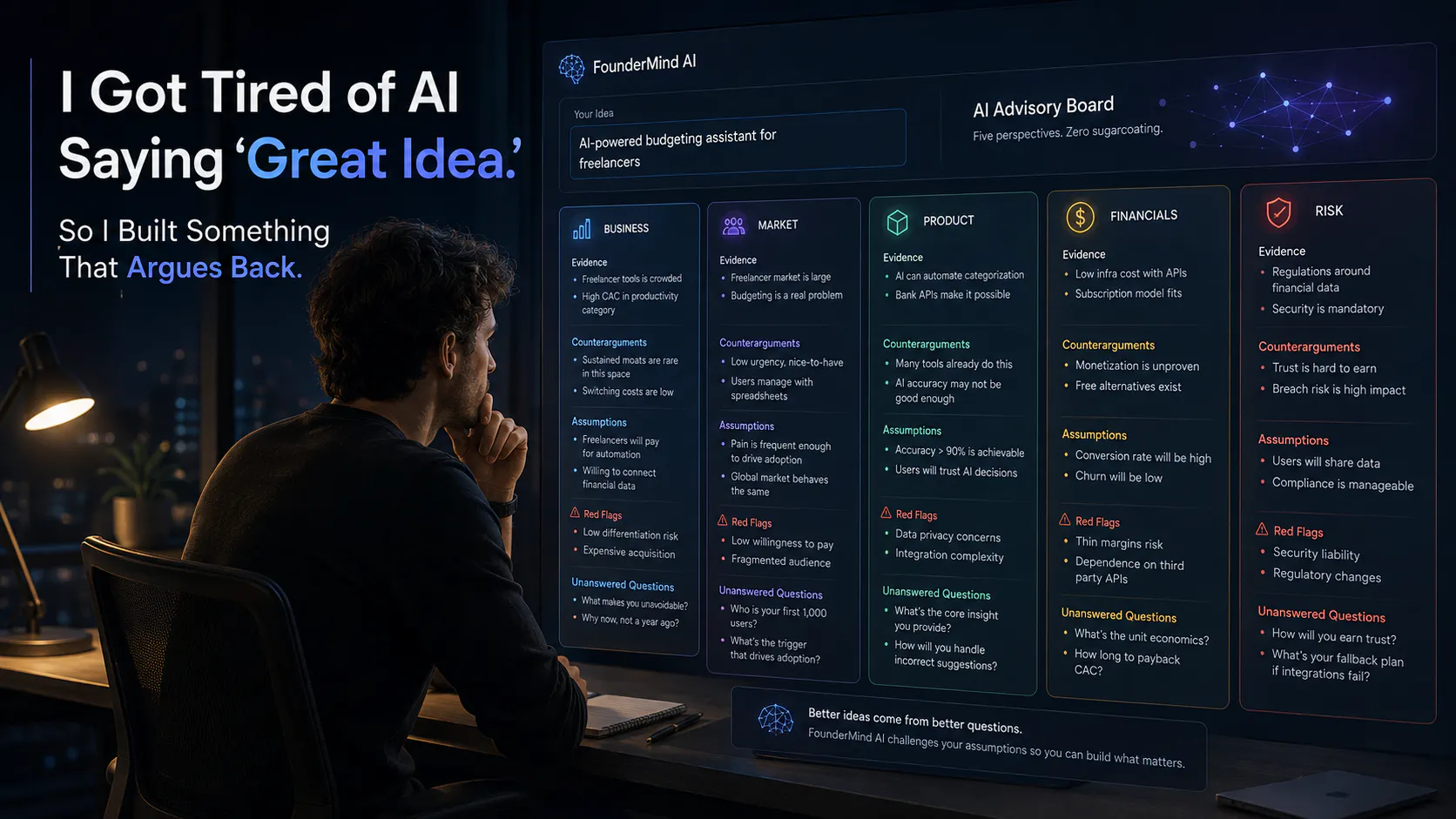
I'd describe an idea.
 •
•29d ago
I built an AI to make email management less tedious
Hey Product Hunt!
I started building Modulo AI after seeing how much time my mother spends handling emails at work.