

Writers Shouldn’t Have to Prove They’re Human
How writers can use AI without giving up authorship, and why keeping a record of the process may matter more than trying to “sound human.”
I came across a question recently that would have sounded completely bizarre a few years ago. A writer asked whether recent AI allegations had changed the way other writers work. Were they saving more versions of their drafts? Switching software so they could show how a piece developed? Avoiding em dashes because apparently punctuation that has existed for hundreds of years is now evidence of ChatGPT? The writer works by hand and had started organizing their notebooks in case they ever needed to prove the work was theirs.
That last part stuck with me. Writers have always developed habits that become part of their voice, including certain rhythms, sentence structures, punctuation, and strange little constructions that might not survive a copywriting course. Those things used to feel like fingerprints. Now some writers are changing the way they naturally write because machines learned to imitate human writing, and the humans are afraid that sounding like themselves will make them look like machines.
I hate the idea of somebody deleting an em dash they genuinely wanted because they’re imagining a stranger on the internet squinting at it suspiciously. Once that fear gets into the writing process, where does it stop? Do you make the prose clumsier on purpose? Leave in a typo every few pages so everyone knows a carbon-based life form was involved?
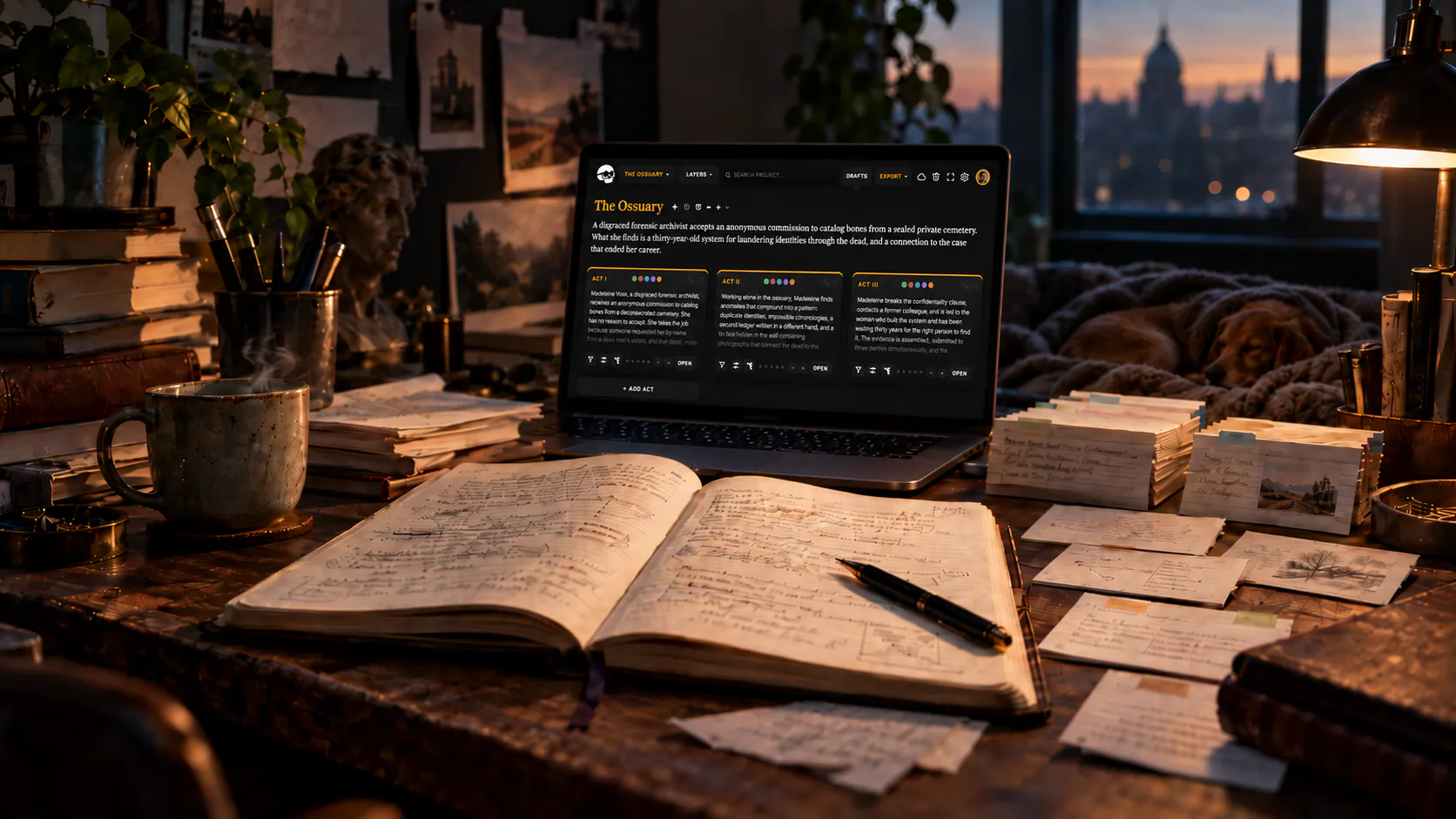
This question lands directly in the middle of how I built Skeleton Draft. The app grew out of the writing process I had been developing for myself for about 25 years. It lets writers move through acts, chapters, scenes, beats, and drafts in the same project, but the part relevant here is the boundary I put around AI.
The AI’s job is deliberately small. It can condense something you already wrote into a logline, clean up spelling and punctuation without rewriting your voice, or convert your prose into screenplay format while staying faithful to the source. It can help organize, summarize, clean up, and translate between formats. It does not decide what happens next, develop your characters, write your dialogue, or hover over every sentence offering to improve things nobody asked it to improve.
I’m interested in AI when it removes tedious interruptions and helps a writer keep moving. I’m much less interested in software that quietly crosses from assisting the process into creating the work.
The part that has become more important than I expected is everything Skeleton Draft keeps behind the writing. It preserves extensive version history for cards and drafts, and it records every AI action the writer chooses to run. The project history shows the rough material, the changes, the earlier versions, when an AI function was used, and what that function produced.
From that history, the app can export an authorship document comparing user-authored material with AI-assisted material and showing the chronological development of the work. I started calling it an authorship ledger, which sounds ridiculously serious for something that may contain three weeks of trying to decide whether a character walks into a bar before or after lunch, but that is essentially what it is.
What I like about that approach is that it moves the conversation away from guessing. If somebody thinks a paragraph “sounds AI,” they can have whatever theory they want about punctuation or sentence length. The record still shows how the work came into existence. You can see the cards, the scenes, the drafts, the revisions, and any AI-assisted action along the way. There is no need to examine the finished prose like blood spatter and try to reconstruct the crime.
AI is completely optional in Skeleton Draft. Writers can turn it off and use the same structure, drafting tools, version history, backups, and authorship record manually. I think that matters because nobody should have to surrender part of the creative process just to use modern writing software.
Skeleton Draft launched here on Product Hunt on Monday, and this question has been on my mind while thinking about what creative software should be responsible for. I do not want writers carrying around stacks of evidence to prove they are sufficiently human. But if AI is going to be part of creative tools, should those tools preserve a clear record of what the human wrote versus what the AI did?
Replies