


I got tired of my AI agents "losing the plot," so I gave them a brain

Hey Product Hunt!
I’m the creator of YourMemory. I've spent the last few years as an engineer at Gartner and MongoDB, and the biggest frustration I’ve found with AI agents is Context Rot. After about a week of working on the same project, my agents would start "forgetting" decisions we made on day one.
RAG usually treats memory like a permanent filing cabinet, but eventually, the cabinet gets so stuffed with junk that the agent’s reasoning falls off a cliff.
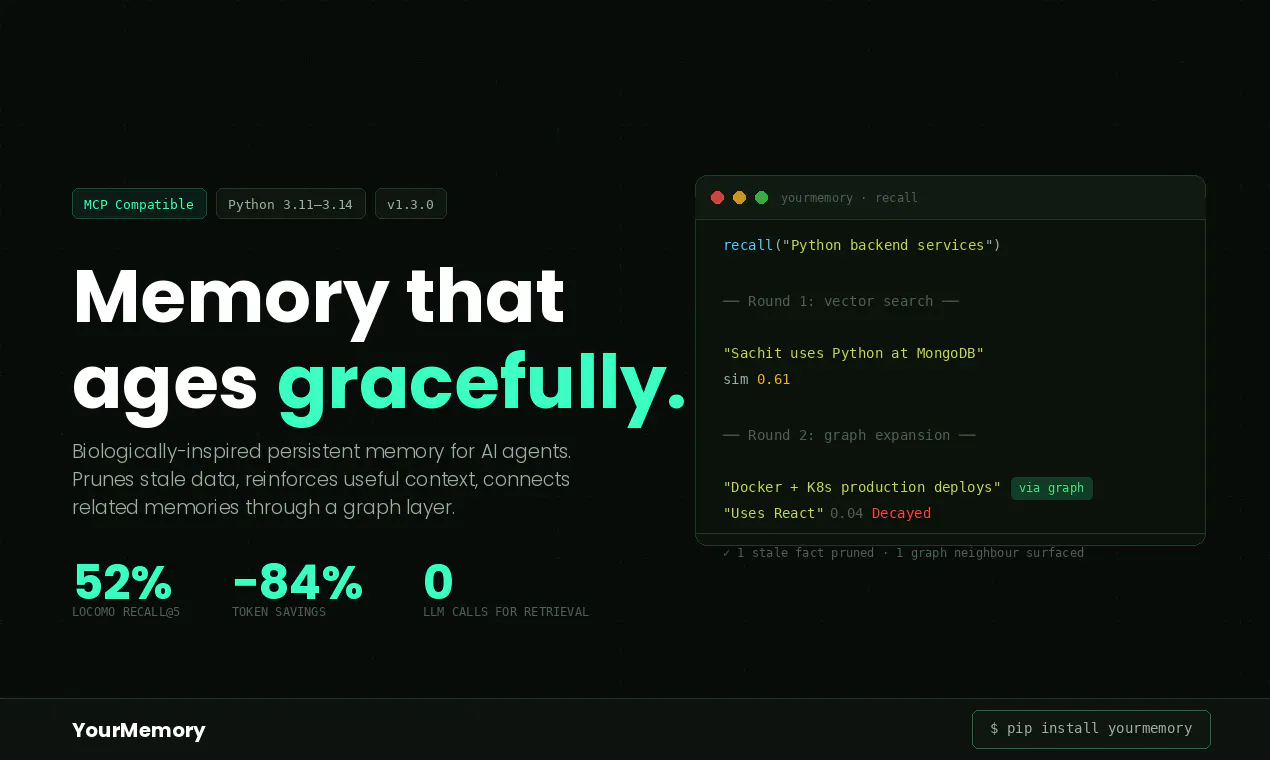
I decided to try a biological approach: YourMemory is an MCP server that uses the Ebbinghaus forgetting curve to manage context. It reinforces what matters and prunes the noise, just like we do.
The highlights:
It actually works: 52% Recall@5 on benchmarks (nearly double a standard setup).
It’s cheap: Stops the "context bloat" that drains your token budget.
It’s private: Everything stays on your machine via DuckDB.
I’m really curious to hear how you guys are handling long-term memory for your agents, or if you’ve just been hitting the "New Chat" button to escape the bloat. I'll be here all day to chat!
WebSite: https://yourmemoryai.vercel.app/
Replies
WUPHF by Nex.ai
The biological decay framing is interesting. I am curious how you calibrate the decay rate across different use cases. A long refactor probably needs a slower decay than a quick debugging session. Does the graph engine infer that from access patterns, or is it something the user tunes directly?
YourMemory
@najmuzzaman So this configuration is user driven, user can have a set of rules based on which they can assign importance to their memory for example a successful strategy can have a higher importance score than the failing one and so on. This ensures memory which are important to you decays slowly !