


My calendar tracked my meetings. Nothing tracked the other 6 hours. So I built something that does.
I have been a software engineer for 25 years and an engineering manager for 6. I know how to build things. What I could never figure out was how to remember everything I built, reviewed, commented on, or responded to on any given day.
My calendar tracked meetings fine. Everything else just disappeared. PR reviews, Jira comments, ad hoc requests from leadership, performance review prep, one-off conversations that turned into two hours of unplanned architecture discussions. By Friday I could barely reconstruct Tuesday. I eventually started keeping a running Google doc of everything I touched each day, including meetings. It was exactly as tedious as it sounds.
I researched tools that solved this and could not find one I was willing to actually use. Everything was either a time tracker that required me to manually start and stop timers, a task manager that needed manual input, a meeting tool that only cared about my calendar, or some "monitoring" agent I had to install on my PC that tracked everything I did. That last category was not going to happen.
So I spent the last couple months building something myself. Here is what I shipped:
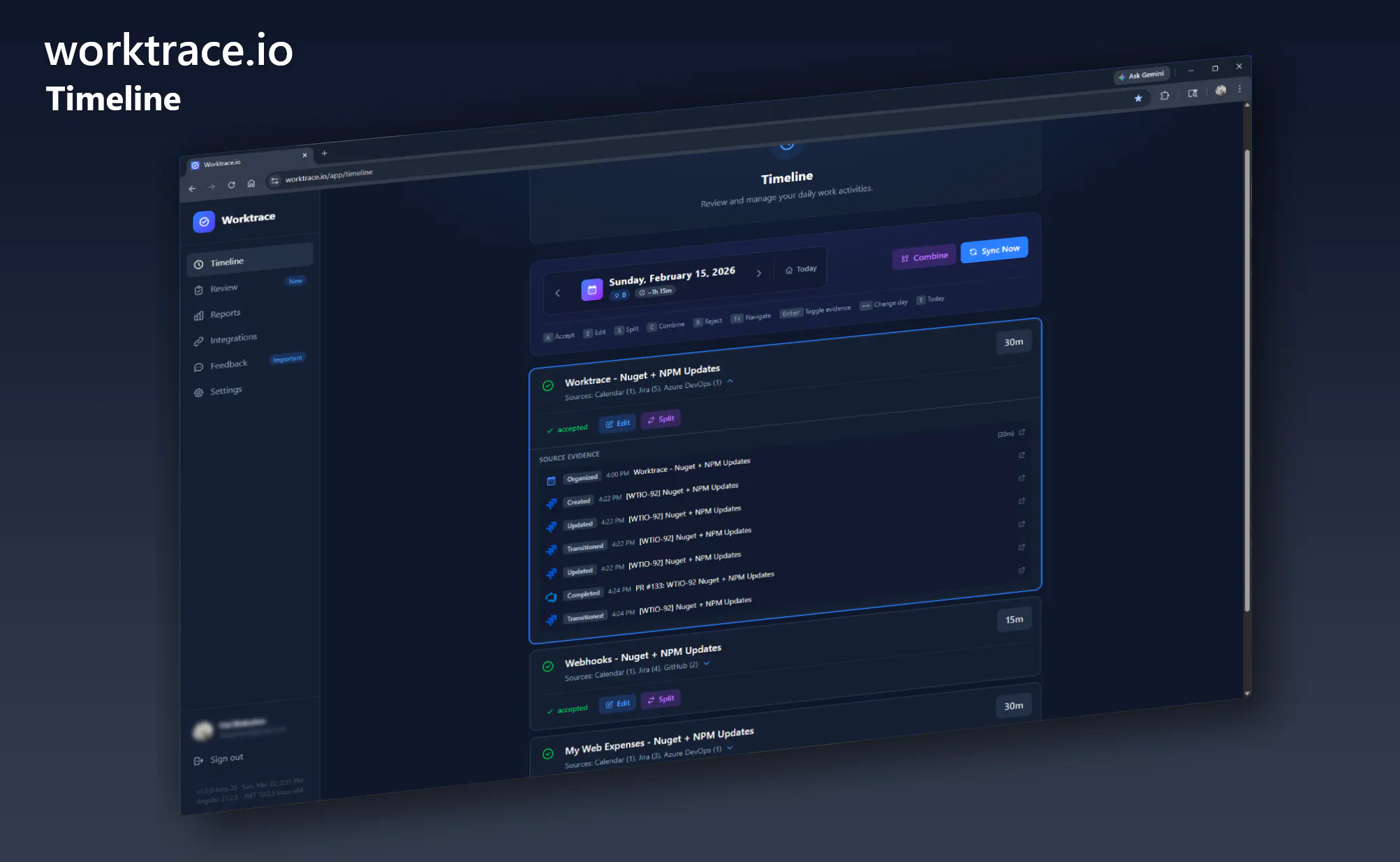
It connects to the tools you already use, GitHub, Jira, Google Calendar, Google Drive, Microsoft Calendar, OneDrive, Azure DevOps, and Bitbucket, and passively observes activity metadata to build a chronological daily work log. No timers. No manual entry. No surveillance. No agents running on your machine. At the end of the day you review what it surfaced, confirm what counts, and move on.
The important part is that it reads metadata only. Never your code, never PR diffs, never document bodies, never calendar event descriptions. Event titles, timestamps, status transitions, file names. That is it.
The technical side, for those curious: it is a .NET 10 clean architecture API with Angular frontend, integrates with eight providers via OAuth, runs a deterministic inference engine to group activity into meaningful work entries, and learns from your accept/reject/edit decisions over time to get better at clustering. No LLMs in the inference pipeline. All explainable, rules-based logic.
I built it entirely for myself. I use it almost every day. But I genuinely do not know if the problem I had is widespread or if I am just uniquely disorganized.
What I am trying to learn from this forum:
Does this resonate with you? Is reconstructing your workday something you actually struggle with? Contractors and freelancers especially, I am curious how you currently handle this for client billing or status updates.
Are there tools out there that actually already solve this that I missed? I looked hard and came up empty, but I am very aware I could have missed something.
What has your experience been sharing something you built for a personal pain point? Did you find the problem was more universal than you expected, or more niche?
I called it Worktrace. worktrace.io if you want to poke around (all free). Happy to answer questions about how it works, how I built it, or what I got wrong.
Replies
Fascinating build, Hal! Love how you tackled remembering all those non-meeting work moments...I've been there with trying to retain massive knowledge for Jeopardy, so built The Sponge (AI-powered flashcard app that turns webpages into study material with spaced repetition). I'll check out worktrace.io.
If you're up for it, I'm launching on PH soon...would appreciate a follow (See "PRODUCT HUNT LAUNCH" Link in my profile).
@rianbrob thanks for the comment and am very much looking forward to any thoughts or questions you have on worktrace.io.
Love the name "The Sponge"! I took a look at your app website and for me right off the bat it's not 100% clear exactly how your solution works E2E. Maybe it's just me but from what I can tell you install a Chrome extension that parses web pages of your choice and intuitively creates meaningful flashcards using AI for you to review which sounds like you confirm the card is accurate after AI generates it. The part I'm missing is the actual science-backed learning. Would I just come back to your app at my leisure and review random flashcards?
Time permitting I'll create an account and probably answer all my own questions.
@halhunt Cards roll into your queue exactly when they are "ready for review" based on how well you know them. There are basic email notifications to keep you on track, but you can also jump into the app at your leisure to tackle cards at any time (still in a priority order)
@rianbrob thanks for the clarification.