

The Compound Effect of Energy Tracking: How AI Learns What You Can't See
The Compound Effect of Energy Tracking: How AI Learns What You Can't See
Most people start tracking their energy out of frustration. Something feels off — you're tired all the time, certain days wipe you out for no obvious reason, and you can't figure out why last Tuesday felt great but Wednesday was unbearable. So you start logging. And the first few days are interesting, maybe even a bit eye-opening. But the real magic of energy tracking isn't what happens in week one. It's what happens when you keep going.
Six dimensions of wellness, not just one number
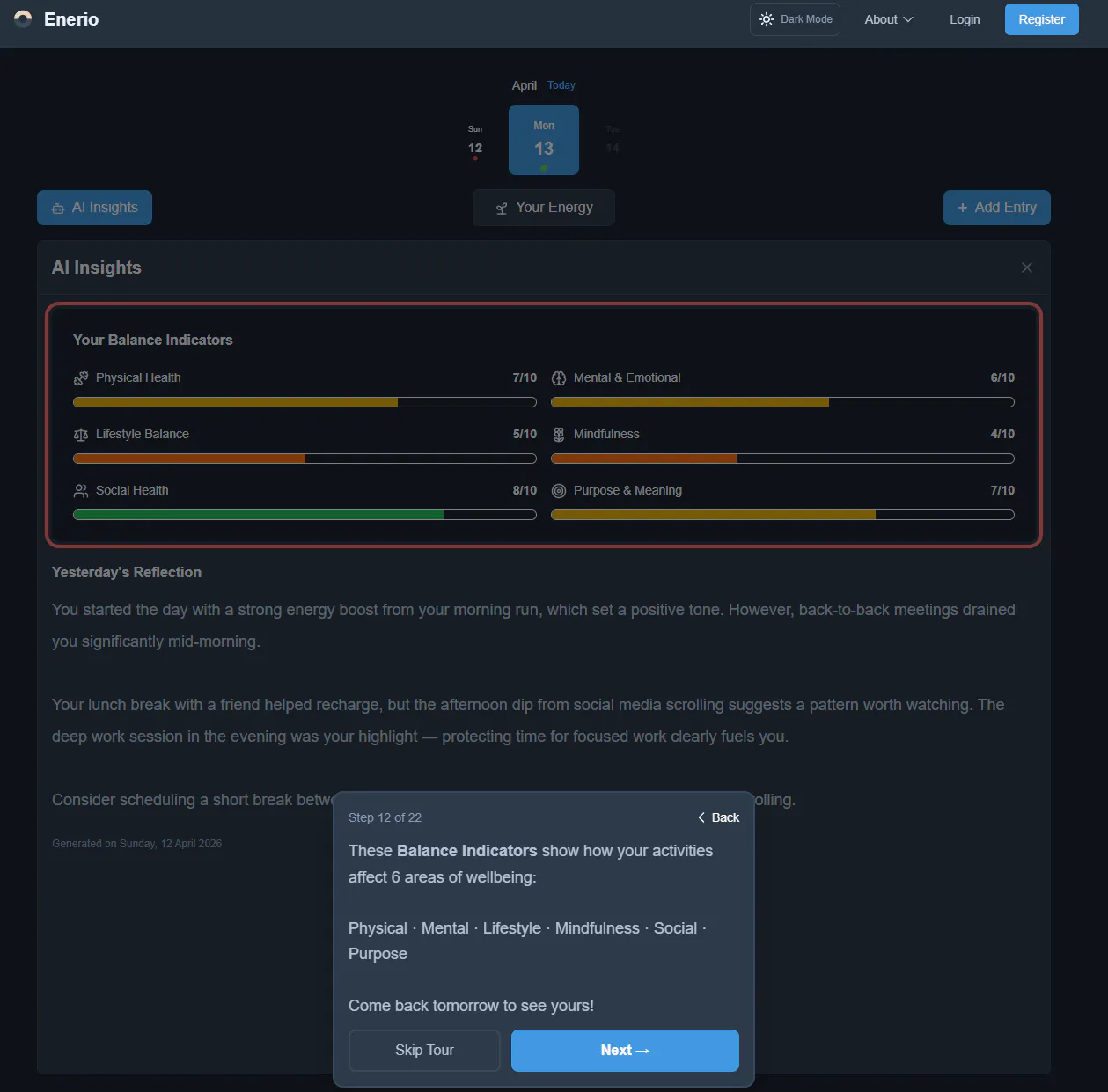
Energy isn't one-dimensional. You can be physically rested but emotionally drained. You can feel socially connected but completely disconnected from any sense of purpose. Enerio tracks your wellness across six indicators — physical health, mental and emotional wellbeing, lifestyle balance, mindfulness, social health, and purpose and meaning — and scores each one based on what you've actually logged.
Over time, you build a multi-dimensional picture of your wellbeing. You might discover that your social health is consistently strong but your mindfulness scores are low because you never take a moment to slow down. Or that your sense of purpose spikes when you work on creative projects but flatlines during weeks dominated by admin. These aren't insights you'd get from a mood tracker that asks "how are you feeling today?" on a scale of one to five.
Your brain is biased. AI isn't.
Here's the uncomfortable truth about self-awareness: you're not great at it. Nobody is. Your brain filters, rationalises, and forgets. You remember the big drains — the argument, the awful meeting — but you forget the dozen small ones that quietly chipped away at you all week. You overestimate how much that one gym session recharged you because it felt good in the moment, while ignoring the three nights of bad sleep that cancelled it out.
This is where AI changes the game. Enerio's AI doesn't just summarise your day — it cross-references your entries across days and weeks, looking for patterns you're too close to see. It notices that your energy consistently dips on days when you skip lunch. It picks up that socialising charges you on weekends but drains you midweek. It spots that your highest-energy days all have one thing in common — and it might not be what you'd expect.
The longer you track, the smarter these insights get. A daily reflection after three entries is a polite observation. A weekly report after fifty entries is a genuine breakdown of how your life is structured and what it's costing you.
The patterns that matter are the ones that repeat
One bad day isn't a pattern. One draining meeting isn't a problem. But when the same drainer shows up five times in two weeks with an intensity of 4 out of 5, that's not a coincidence anymore — that's a leak in your energy budget.
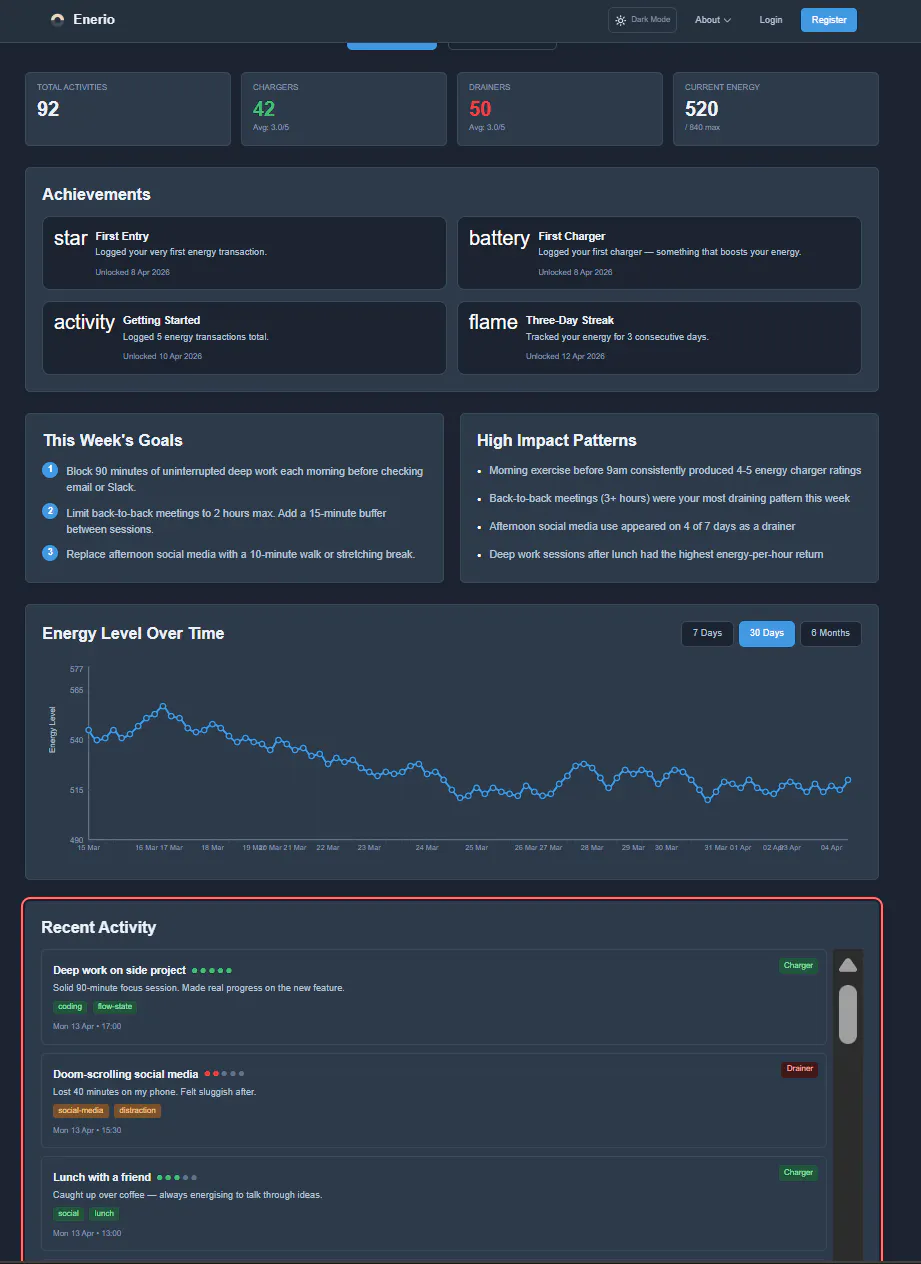
Enerio identifies high-impact patterns by looking at what consistently charges or drains you at the highest intensity. It asks the questions you wouldn't think to ask: is the same activity energising in one context but draining in another? Are there people, times of day, or environments that keep appearing on one side of the ledger? What underlying needs are your chargers fulfilling, and what would happen if you lost them?
These cross-pattern insights are where long-term tracking gets genuinely powerful. You stop reacting to individual bad days and start understanding the system that produces them.
Day one is a guess. Day thirty is a mirror.
When you first start logging your chargers and drainers, you're working with instinct. You know the gym felt good. You know that meeting drained you. That's useful, but it's surface level — you already knew that stuff before you opened the app.
The value compounds over time. After a week, you start noticing things you wouldn't have caught otherwise. Maybe you assumed your commute was neutral, but you've logged it as a drainer four days in a row. Maybe you thought cooking was a chore, but it keeps showing up as a charger when you actually pay attention. Your perception of your own life starts to shift — not because anything changed, but because you're finally measuring it.
After a month, the picture gets sharper. You can see which days of the week consistently drain you. You can spot that your energy crashes every time you skip morning exercise, or that back-to-back calls after 3pm leave you hollow for the rest of the evening. These aren't things you'd ever notice in real time. They only emerge from the data.
Small adjustments, compounded
The point of all this isn't to overhaul your life. It's to make small, informed adjustments that compound over time. Enerio generates weekly goals based on your data — not generic wellness advice, but specific suggestions tied to your actual patterns. Reduce that recurring drainer by one instance this week. Protect the charger that keeps showing up on your best days. Try moving that energy-killing task to a different time slot.
None of these are dramatic. All of them are grounded in what your data actually shows. And when you stack small improvements week after week, the compound effect is real. A month in, your ratio of chargers to drainers shifts. Two months in, you start making decisions differently because you already know what the data will say. Three months in, you're not just tracking energy anymore — you're managing it.
The best time to start was last month. The second best is now.
Energy tracking isn't a quick fix. It's a practice — and like any practice, it rewards consistency. The people who get the most out of Enerio aren't the ones who log obsessively for three days and stop. They're the ones who spend ten seconds a few times a day, every day, and let the AI do the heavy lifting over time.
Your energy has a pattern. You just can't see it yet. But give it a few weeks, and you will.
Replies