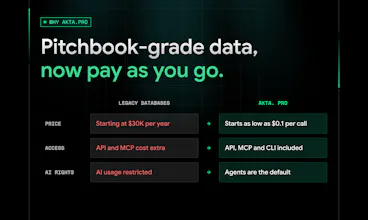
Private company data with 4x the depth and 2x the coverage of PitchBook, plus 100+ event signals and news across companies, industries, and topics. Source and diligence deals or make outreach lists and trigger outbound. Built for financial services and GTM teams, pay-as-you-go.
@aria_turner Completely agree, and it's the right test. Coverage is the easy axis to compete on; what kills daily use is noise — an analyst who gets 200 items a day stops opening it by week two. So we optimised for precision over volume and drop roughly 80% of what comes in before it ever reaches a response.
The event types such as funding, hiring, layoffs, partnerships etc. in the news signals endpoint can help make it actionable for teams using it daily.
@siddhant_masson Exactly, I think that’s where a lot of data products struggle. Having more information is easy, but turning it into signals teams can actually trust and act on daily is the harder part.
Report
How customizable are the event triggers? I’d love to define signals specific to a particular industry or workflow.
@subhash_kanagamani event triggers are customizable to the extent you can choose from 100+ categories (fundraising, hiring, layoffs, partnerships, office expansion etc.) of events for your company or industry/topic search. Further apply multiple filters like geo, sentiment, timeline etc. or entity filters like products, custom event, products etc.
Report
Would love to see webhooks for specific company events eventually. That could make the outbound automation possibilities huge. What do you think?
@himani_sah1 Agreed, and webhooks for signal alerts is coming soon!
In the meantime polling gets you most of the way there. You can hit the news API on whatever frequency and offset suits your workflow, and credits are only charged on news actually returned.
For outbound specifically, the 86-category event taxonomy is the part worth looking at. You can filter to the handful of event types that actually trigger a play, funding rounds, leadership changes, expansion signals, rather than filtering a general feed downstream.
What use-cases on outbound automation are you looking at?
Report
I’ve worked with company research tools before, and keeping data organized is usually the hardest part.
@grant_w1 Agreed, and it's most of the work. We do the organising upstream rather than at query time — resolution, dedup, categorisation happen before anything lands in a response, so what you get back is already settled. Less elegant than it sounds, but it's the only way the latency works.
Report
@siddhant_masson That makes a lot of sense. Handling the messy part before it reaches the user probably makes the API much more reliable.
The challenge seems less about collecting data and more about keeping the relationships between companies, events, and sources accurate over time.
@grant_w1 That's the part people underestimate, and private companies are the hardest version of it. Public companies have a ticker and a filing calendar, so identity and timing are both solved for you. Private companies have neither.
So the organizing problem comes first. Entity resolution is the foundation everything else sits on: resolve identity once, across 20M+ companies under one stable identifier, and every dataset after that inherits it.
The refresh design follows from the same idea. Once records are resolved to a stable entity, you can update fields at different rhythms and still have them land on the same profile, so a funding round from the news pipeline and a headcount trend from a completely different source both attach real-time to the same company without creating duplicate entries or needing manual interventions that a legacy database needed
Report
@saswat_nanda2 That’s a good point. Having a stable entity layer seems like it becomes the backbone for everything else, especially when different sources update at different speeds.
A lot of tools can collect more data, but keeping the same company context intact as that data changes is probably the harder problem.
Report
Congratulations on the launch @siddhant_masson! This is a smart angle - especially the combination of structured company data with event signals instead of forcing agents to stitch both together from separate sources. Curious - which use case are you seeing the strongest pull from right now?
@yogesh_builds Thanks Yogesh. Yes, overlaying signals on top of companies with proper entity resolution is something our team has really worked tirelessly over the last couple of years.
We see the strongest pull for the following use-cases (top 1 by segment)
1) For GTM teams - Find Companies by Signals e.g. Find by every US Series A-D software company that announced a partnership with AWS/Microsoft/Snowflake
2) For Investors - Find notable milestones for startup pipeline in CRM e.g., Notify me whenever any of the startups in my list have a) new product launch b) closed a big logo c) announced fundraising d) made a strategic hire e) hiring for 5 or more new jobs etc.
3) For Corporates - Competitive monitoring e.g., Track every product launch, partnership, expansion, negative press, c-suite hiring for my top 5 competitors
Love that you built this API-first for AI agents rather than dashboards, giving agents structured company signals to act on feels like the real unlock here.
@ilko_kacharov thanks Ilko. With API-first approach, you basically give the end user (whether developer or business) to customize their own way of digesting information. Interestingly, lot of business users are using MCP with Claude to create extremely versatile dashboards / mini-apps.
@ilko_kacharov Thanks, and that's the bet. We believe strongly that the future is headless - what matters then is whether the data arrives in a shape an agent can act on: resolve identity, deterministic schemas, signals structured. Build for that and the interface question mostly answers itself, since anyone can put whatever surface they want on top.
@istiakahmad Thanks, and that was the reasoning. Resolving at capture rather than at query time is what lets every endpoint stay sync.
That matters if you're reasoning inside an agent loop or building a platform where someone is waiting. A data call that returns a job ID and asks you to poll compounds across every step of a run. So every API is sync, no job submission, no polling. The resolution work is already done by the time you ask.




Having more coverage is great, but the real test is whether the data stays actionable for teams using it daily.
akta.pro
@aria_turner Completely agree, and it's the right test. Coverage is the easy axis to compete on; what kills daily use is noise — an analyst who gets 200 items a day stops opening it by week two. So we optimised for precision over volume and drop roughly 80% of what comes in before it ever reaches a response.
The event types such as funding, hiring, layoffs, partnerships etc. in the news signals endpoint can help make it actionable for teams using it daily.
Check out the benchmarks for signals precision and recall here: https://akta.pro/benchmarks/company-news-retrieval
@siddhant_masson Exactly, I think that’s where a lot of data products struggle. Having more information is easy, but turning it into signals teams can actually trust and act on daily is the harder part.
akta.pro
@subhash_kanagamani event triggers are customizable to the extent you can choose from 100+ categories (fundraising, hiring, layoffs, partnerships, office expansion etc.) of events for your company or industry/topic search. Further apply multiple filters like geo, sentiment, timeline etc. or entity filters like products, custom event, products etc.
Would love to see webhooks for specific company events eventually. That could make the outbound automation possibilities huge. What do you think?
akta.pro
@himani_sah1 Agreed, and webhooks for signal alerts is coming soon!
In the meantime polling gets you most of the way there. You can hit the news API on whatever frequency and offset suits your workflow, and credits are only charged on news actually returned.
For outbound specifically, the 86-category event taxonomy is the part worth looking at. You can filter to the handful of event types that actually trigger a play, funding rounds, leadership changes, expansion signals, rather than filtering a general feed downstream.
What use-cases on outbound automation are you looking at?
I’ve worked with company research tools before, and keeping data organized is usually the hardest part.
akta.pro
@grant_w1 Agreed, and it's most of the work. We do the organising upstream rather than at query time — resolution, dedup, categorisation happen before anything lands in a response, so what you get back is already settled. Less elegant than it sounds, but it's the only way the latency works.
@siddhant_masson That makes a lot of sense. Handling the messy part before it reaches the user probably makes the API much more reliable.
The challenge seems less about collecting data and more about keeping the relationships between companies, events, and sources accurate over time.
akta.pro
@grant_w1 That's the part people underestimate, and private companies are the hardest version of it. Public companies have a ticker and a filing calendar, so identity and timing are both solved for you. Private companies have neither.
So the organizing problem comes first. Entity resolution is the foundation everything else sits on: resolve identity once, across 20M+ companies under one stable identifier, and every dataset after that inherits it.
The refresh design follows from the same idea. Once records are resolved to a stable entity, you can update fields at different rhythms and still have them land on the same profile, so a funding round from the news pipeline and a headcount trend from a completely different source both attach real-time to the same company without creating duplicate entries or needing manual interventions that a legacy database needed
@saswat_nanda2 That’s a good point. Having a stable entity layer seems like it becomes the backbone for everything else, especially when different sources update at different speeds.
A lot of tools can collect more data, but keeping the same company context intact as that data changes is probably the harder problem.
Congratulations on the launch @siddhant_masson! This is a smart angle - especially the combination of structured company data with event signals instead of forcing agents to stitch both together from separate sources. Curious - which use case are you seeing the strongest pull from right now?
akta.pro
@yogesh_builds Thanks Yogesh. Yes, overlaying signals on top of companies with proper entity resolution is something our team has really worked tirelessly over the last couple of years.
We see the strongest pull for the following use-cases (top 1 by segment)
1) For GTM teams - Find Companies by Signals
e.g. Find by every US Series A-D software company that announced a partnership with AWS/Microsoft/Snowflake
2) For Investors - Find notable milestones for startup pipeline in CRM
e.g., Notify me whenever any of the startups in my list have a) new product launch b) closed a big logo c) announced fundraising d) made a strategic hire e) hiring for 5 or more new jobs etc.
3) For Corporates - Competitive monitoring
e.g., Track every product launch, partnership, expansion, negative press, c-suite hiring for my top 5 competitors
@siddhant_masson Great!!
Love that you built this API-first for AI agents rather than dashboards, giving agents structured company signals to act on feels like the real unlock here.
akta.pro
@ilko_kacharov thanks Ilko. With API-first approach, you basically give the end user (whether developer or business) to customize their own way of digesting information. Interestingly, lot of business users are using MCP with Claude to create extremely versatile dashboards / mini-apps.
akta.pro
@ilko_kacharov Thanks, and that's the bet. We believe strongly that the future is headless - what matters then is whether the data arrives in a shape an agent can act on: resolve identity, deterministic schemas, signals structured. Build for that and the interface question mostly answers itself, since anyone can put whatever surface they want on top.
Lancepilot
akta.pro
@istiakahmad Thanks, and that was the reasoning. Resolving at capture rather than at query time is what lets every endpoint stay sync.
That matters if you're reasoning inside an agent loop or building a platform where someone is waiting. A data call that returns a job ID and asks you to poll compounds across every step of a run. So every API is sync, no job submission, no polling. The resolution work is already done by the time you ask.