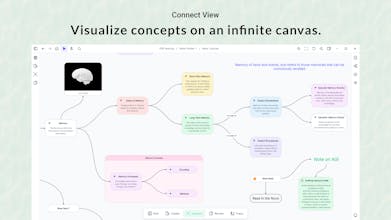
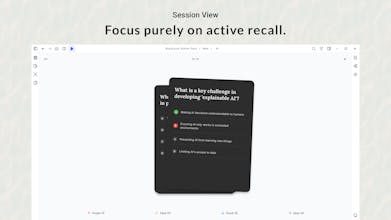
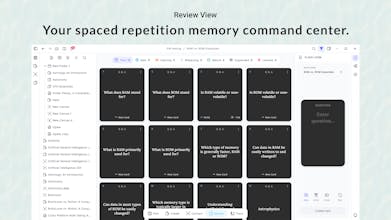
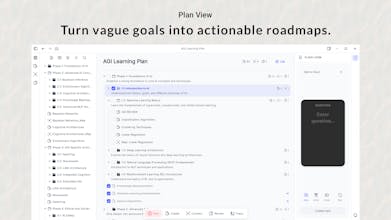
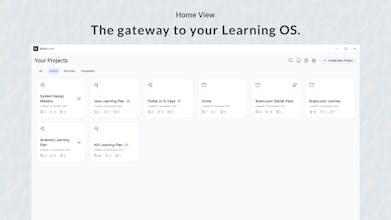
Stop switching between different apps just to study. BrainLoom is the local-first Learning OS that unifies your study workflow. Turn PDF highlights into Flashcards instantly and keep them linked to the source text for deep context. You can also structure ideas visually on an Infinite Canvas using "Smart Paste" without touching your mouse. Available for Windows v1.0 (Mac soon). To fund the expansion, grab a Lifetime License for $29 today (First 150 users only).
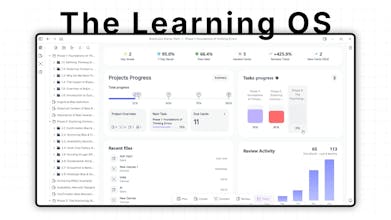
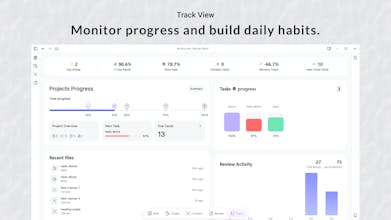
Since hitting #2 Product of the Day a few weeks ago, the feedback from medical students and developers using BrainLoom (our Local-First Learning OS) has been insane. But they all had one problem: They were flying blind. They didn't know if their study habits were actually working until exam day.
Today, I am dropping BrainLoom v1.0.6: The Analytics Engine.
When I launched BrainLoom (The Local-First Learning OS) two months ago, the goal was simple: Your second brain should live on your hard drive, not a server.
If you study anatomy, engineering, or complex flowcharts, you know the pain of traditional flashcard apps. Manually drawing 20 individual boxes over a diagram completely destroys your focus.
I wanted to fix that friction.
In our latest update (v1.0.4), I shipped the Image Occlusion Studio.
No reviews yetBe the first to leave a review for BrainLoom
MongoDB Atlas — Scale RAG and agentic workflows with MongoDB Atlas.
Scale RAG and agentic workflows with MongoDB Atlas.
Promoted
Really clever use of a unified learning OS turning PDFs into flashcards instantly solves a real chaos problem for students and researchers. Curious: are you seeing more value from flashcard generation or the deep context linking back to source text? That kind of behavior usually predicts whether people stick long‑term. �
@chimeremeze Super sharp question. The hook is the Generation, but the retention comes from Deep Context. Once users realize they can 'time travel' back to the source text with one click, they rarely go back to standard flashcards. So, for me "Deep context" is valuable.
Report
@ujjwalranga That tracks perfectly. Generation pulls people in, but “time-traveling” back to source is what builds trust and habit.
I’ve seen teams accidentally under-invest in that deep-linking layer, even though it’s the part that turns AI from a shortcut into a learning companion. Curious if you’re measuring things like back-to-source clicks or session depth as a proxy for real understanding
Report
Great use case for LLMs. Is there a limit on PDF size for local processing? Also, can the flashcards be exported to apps like Anki, or is the flow strictly internal? Love the local-first approach.
Important clarification: The core magic is actually manual. You can simply highlight text in the PDF and instantly convert that specific selection into a flashcard.
1. PDF Limits: Since I built this Local-First, the limit is mostly your computer's RAM. It handles standard textbooks (500+ pages) easily. 2. Export: Yes! I don't believe in data lock-in. You can export your decks as CSVs and import them directly into Anki if you ever decide to leave.
Report
This seems like a very carefully made and well-made product. But with so many strong features, no feature truely stands out. I had previously tried using Google's learn-your-way and notebook LM. The thing with these tools is that the learning curve is steep, and it takes time for it to fully seep into your routine.
@peterz_shu Totally agree—that initial learning curve matters a lot. I’m working on a Starter Pack that introduces the core features in a simple, guided way so users can start using the tool effectively much faster.
Report
The view source jump-back is huge. Flashcards without context always felt shallow this actually close that gap nicely.
@freya24 Exactly! Flashcards without context are just trivia. The 'Deep Context' link was the feature I built first because I got tired of forgetting why an answer was the answer.
Report
Founder's Club... My family uses ol'skool pen/paper notetaking, Anki, notebooklm learning, gemini, perplexity, pdfssss, transcripts, video, etc etc.... yeah, looking forward to see how this brings it all together and simplify into one place!
Report
Congratulations, I tried it out and the product is very good.
@rachelz1 Thanks, Rachel! The app interface (menus/buttons) is currently English-only for v1.0.You can write notes, create flashcards, and build mind maps in any language (Unicode support).
BrainLoom
@chimeremeze Super sharp question. The hook is the Generation, but the retention comes from Deep Context. Once users realize they can 'time travel' back to the source text with one click, they rarely go back to standard flashcards. So, for me "Deep context" is valuable.
Great use case for LLMs. Is there a limit on PDF size for local processing? Also, can the flashcards be exported to apps like Anki, or is the flow strictly internal? Love the local-first approach.
BrainLoom
@klara_minarikova Thanks, Klara!
Important clarification: The core magic is actually manual. You can simply highlight text in the PDF and instantly convert that specific selection into a flashcard.
1. PDF Limits: Since I built this Local-First, the limit is mostly your computer's RAM. It handles standard textbooks (500+ pages) easily.
2. Export: Yes! I don't believe in data lock-in. You can export your decks as CSVs and import them directly into Anki if you ever decide to leave.
This seems like a very carefully made and well-made product. But with so many strong features, no feature truely stands out. I had previously tried using Google's learn-your-way and notebook LM. The thing with these tools is that the learning curve is steep, and it takes time for it to fully seep into your routine.
BrainLoom
@peterz_shu Totally agree—that initial learning curve matters a lot. I’m working on a Starter Pack that introduces the core features in a simple, guided way so users can start using the tool effectively much faster.
The view source jump-back is huge. Flashcards without context always felt shallow this actually close that gap nicely.
BrainLoom
@freya24 Exactly! Flashcards without context are just trivia. The 'Deep Context' link was the feature I built first because I got tired of forgetting why an answer was the answer.
Founder's Club... My family uses ol'skool pen/paper notetaking, Anki, notebooklm learning, gemini, perplexity, pdfssss, transcripts, video, etc etc.... yeah, looking forward to see how this brings it all together and simplify into one place!
BrainLoom
@zeiki_yu Thank you so much! 🙌 That means the world to me.
I'm curious—since you tried it out, did you get a chance to test the 'View Source' button on a flashcard? That's the feature I'm most proud of.
BrainLoom
@rachelz1 Thanks, Rachel! The app interface (menus/buttons) is currently English-only for v1.0.You can write notes, create flashcards, and build mind maps in any language (Unicode support).