
Launched this week

BrandingStudio.ai
Agency-quality branding in 60 minutes, not 6 months
188 followers
Agency-quality branding in 60 minutes, not 6 months
188 followers
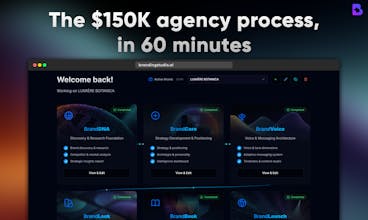
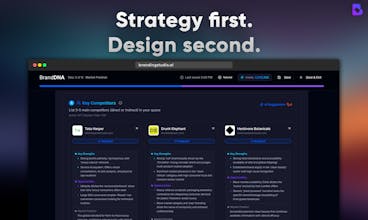
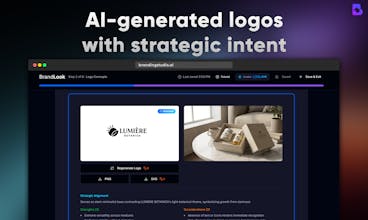
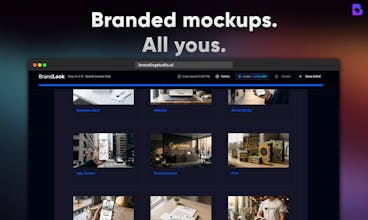
BrandingStudio.ai brings the $150K–$500K agency process to founders. 7 AI-powered modules build your entire brand from strategy and competitor analysis to logo, color system, typography, voice guidelines, and a 90-day launch plan. It analyzes 1,000+ data points about your business before generating a single pixel. Everything exports as SVG, PDF, and a shareable digital brand hub. Built by a brand consultant for Coca-Cola, HSBC, and Airbnb, who turned 20 years of methodology into AI.




How do the AI-powered modules handle potential inconsistencies or conflicts between the various branding components generated, such as logos, color schemes, and typography, to ensure a cohesive and effective brand identity?
BrandingStudio.ai
@zhukmax Thank you for asking this, Max. This is the core challenge we solve.
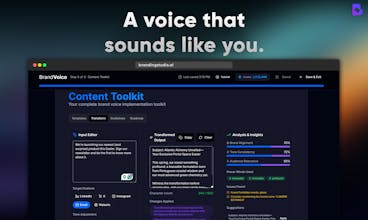
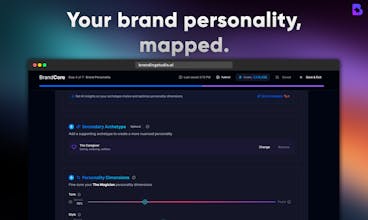
The AI doesn't generate components in isolation. It's a connected system. The 1,000+ data points from your BrandDNA and the strategic position from BrandCore become the creative brief for BrandLook. The logo, colors, and typography are generated from that strategy to express a single, unified idea.
It ensures the visual identity is a direct translation of the strategy, not a random assembly of parts.
BrandingStudio.ai
@joao_seabra First, hats off and congrats on this. Love BrandDNA and BrandCore pulling 1k+ data points; I was wondering tho, does it factor in AI search signals (e.g., competitor citation rates in ChatGPT/Perplexity, or semantic gaps in LLM responses)?
BrandingStudio.ai
@swati_paliwal Thank you, Swati. That's a great question.
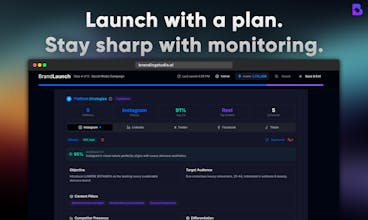
You're right to identify a new frontier in brand intelligence. Today, BrandRadar, our ongoing monitoring module, is built to track that shift. It monitors competitor activity across web changes, news, and sentiment, and specifically tracks their citation rates across major LLM platforms.
To answer directly, the initial BrandDNA and BrandCore modules focus on analyzing the current, established web landscape from search results to build your foundational strategy. BrandRadar then picks up the baton to monitor the evolving AI search layer, mixing LLM and traditional web signals. We believe this separation, foundation first, then live tracking, creates the most actionable pipeline.
I'd love for you to try the BrandDNA discovery, with the 75 free credits in the trial, and if you like it, use the PH 800 credits available until tomorrow on the first purchase, and see how the initial data stacks up.
Cue
20 years of agency branding experience packaged into AI modules is a strong foundation. Going beyond just logos into voice guidelines and launch plans is a nice touch. How long does a typical run-through take?
BrandingStudio.ai
@dparrelli Thank you, David. That's a great question, and you've hit on a key design principle.
It depends entirely on the user. A founder with a clear vision can complete the core strategy and identity in under an hour. Others use it as a strategic and creative partner, iterating on the AI's insights and suggestions, which can take a few hours of reflection.
The platform is built for both paces. You can move fast with confidence, or use it as a thinking partner to pressure-test your ideas (it's constantly auto-saving every user input, so you can exit and come back whenever you want). The 75 free credits are enough to explore that core workflow and find your own rhythm if you want to try it.
Curious about Brand Radar. How does it actually capture your competitor's data? And how does it choose the competitor? Congrats on the launch, @joao_seabra!
BrandingStudio.ai
@neilverma Thanks Neil, great question!
Competitor selection works two ways: you can add competitors manually, or our AI can suggest real competitors you might not even be aware of, based on your industry, positioning, and market. It draws on the brand profile you built in earlier modules, so suggestions are contextual rather than generic.
Data capture runs through web intelligence: we search for competitor news, website changes, and industry mentions using web search APIs, then layer AI analysis on top to classify what changed (visual, messaging, product, content), assess severity, and generate strategic recommendations specific to your brand's positioning.
It also calculates a Brand Health Score across 5 factors (competitor activity, content freshness, visual consistency, messaging coherence, and market presence) and detects industry trends relevant to your niche.
Everything runs automatically on a weekly cycle, so you get a living dashboard and a weekly email report if you choose to. Thanks for the kind words!
BrandingStudio.ai
@neilverma Neil, also, check this out - focused only in BrandRadar:
Pinnacle
BrandingStudio.ai
@joeharrison Thanks, Joe — and coming from the person behind responsivelogos.co.uk, that means a lot.
Your question hits the core of modern brand systems. Here's how we handle responsive scaling:
Logos: 11 variations per concept (color, monochrome, reverse, stacked, icon-only, etc).
Favicons: 22 files, from 16x16 to 512x512, with full light and dark mode sets.
Social Assets: Platform-optimized with research-based safe zones for each channel.
Typography: A modular, responsive scale (h1–h6) with proper hierarchies.
What we don't do yet is the true progressive, where the mark reduces in complexity at defined breakpoints; currently, BrandingStudio.ai ensures logos are legible at 16x16.
I'd genuinely love to hear your thoughts on what a "responsive-first" AI brand system could look like.
Pinnacle
BrandingStudio.ai
@joeharrison That's a genuinely exciting vision, Joe. A deterministic "Design Orchestrator" that collapses the variation matrix into a single adaptive asset, agree that's the future. I'm adding this to the roadmap conversation. Thank you.
Really interesting idea. Making a full branding process accessible to smaller teams sounds valuable, especially if strategy comes before the visuals. The 7-phase structure feels very close to how agencies actually work. How does it adapt the strategy if a startup has very limited data or market history?
BrandingStudio.ai
@vik_sh Thanks Viktor, you're right that the structure mirrors agency methodology intentionally. That's the background it was built on (Coca-Cola, HSBC, AT&T brand programs).
On your question about limited data, this is actually one of the most common scenarios we see, and the platform handles it very well in a few ways.
1. Website intelligence as a starting point. Even if a founder only has a landing page, BrandDNA analyzes it and extracts brand signals, tagline, tone, positioning cues, and audience hints, so the system isn't starting from zero, even when the founder feels like they are.
2. Guided discovery, not blank pages. Instead of asking founders to write their positioning from scratch, each screen walks through structured choices, business stage, market scope, ambition level, and audience psychographics. Early-stage founders often know more than they think; they just haven't articulated it yet. The framework pulls it out - that's the whole goal of the first module, BrandDNA.
3. AI fills the gaps strategically. When competitive data is thin (say, a founder only names one competitor or none), the system runs its own competitive analysis, identifying positioning gaps, market opportunities, and differentiation angles based on the industry and audience signals it does have.
4. The strategy adapts to what exists. A pre-revenue startup with no market history gets a different strategic output than a Series B company with established positioning. The AI calibrates recommendations to the business stage; you won't get "defend your market share" advice when you're still finding product-market fit.
5. The 7 modules build on each other. BrandDNA feeds BrandCore, which feeds BrandVoice, which feeds BrandLook, etc. So even sparse early inputs compound into rich strategic output by the time you reach visual identity. Each phase enriches the next.
The honest answer is: less data in means the AI carries more of the strategic weight. But the structure ensures it's informed weight, not guesswork, and the user has full visibility into the AI insights and can edit or override them.
I'd love for you to try the free 75 credits and see how the guided discovery works firsthand. You can get started here: https://brandingstudio.ai. You also have the PH Promo Code active until tomorrow, which gives you 800 extra credits on the first purchase (doubling the Starter package credits). Let me know what you think.
Congratulations on the launch! Can the system generate a complete brand book with all the guidelines at the end? Can it also be used for brand restyling or updates?
BrandingStudio.ai
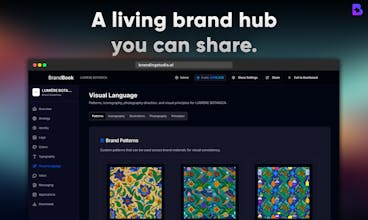
@mykyta_semenov_ Thank you! Yes, BrandBook is a full module inside BrandingStudio.ai: a live shareable brand hub plus PDF export with all guidelines. On restyling, you can absolutely use it to audit and evolve an existing brand, not just build from scratch. There's 3 routes you can take (and they change the whole platform): new/fresh brand, rebrand/refresh, or subbrand (a brand from a parent brand/company). Hope this helps.
@joao_seabra Sounds very cool!