
Launched this week

Hyper
Perfect memory for every real-world conversation
93 followers
Perfect memory for every real-world conversation
93 followers
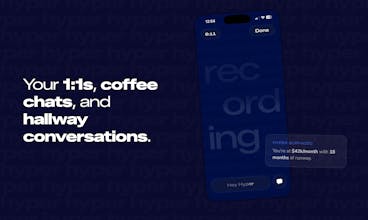
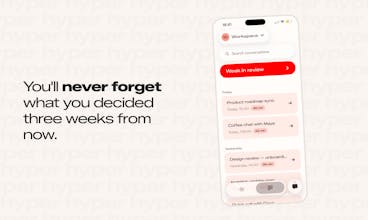
Nearly all existing meeting tools start and end with documents. We think that's the wrong answer. You don't want enhanced notes, you just want to ask "what did we decide about pricing?" 3 weeks later and just get the answer directly. Hyper is an iOS voice AI for IRL conversations (1:1s, coffee chats, walks). One tap record, ask it anything mid-conversations with "hey hyper", or after to find answers across everything you've ever recorded. Perfect memory without files or folders or organization.






Heyy Shalin, nice launch! I've been waiting for something like this for ages. Out of curiosity, how are you approaching the consent issue? Are users expected to ask everyone if they could record them, does the platform offer any support for this issue?
Hyper
@dennis_beytekin really important question. Consent is critical for these kinds of tools. Tools like Zoom assume the responsibility by announcing "this meeting is being recorded." Other tools put the burden fully on the user to decide whether to inform the person they're recording, which is an awkward interaction that people don't love doing. We're focused on figuring out a frictionless solution that is comfortable for all parties involved -- several ideas we're iterating on!
@kanyesthaker Awesome, hope you guys get it done!
Hyper
Hey PH! I'm Shalin, building Hyper with my co-founder Kanyes.
At our last company (a robotics startup), the most important decisions never happened in scheduled meetings. They happened spontaneously (in hallways, over lunch, on walks). None of it got captured. And every recorder we tried was built for Zoom calls with agendas, not for real life.
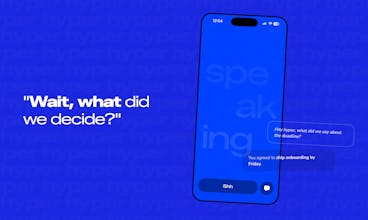
What we realized was that even the tools that DO capture your conversations give you a document, a summary, or notes as the final artifact. And then what? You file it somewhere, never open it again, and three weeks later you're in another meeting going "wait, what did we decide about the deadline?"
We think the whole paradigm is wrong. You don't want better documents from your conversations. You want answers to your questions.
So we built Hyper. It's an iOS app where you tap to record any conversation (a 1:1 with your cofounder, a coffee chat, a standup, a brainstorming session). Then Hyper transcribes in real-time, and you can ask it questions mid-conversation ("hey hyper, what did we decide about pricing last time?") without breaking flow. Afterward, it generates notes and gives you one tap follow-ups (email drafts, slack messages) that integrate natively on your phone.
We're starting with this, but over the longer-term, we'd like to build a memory layer across every important conversation you've ever had. No files or folders or manual organization, just ask and get the answer. We're building towards a system that can resolve conflicting information, surface stale decisions, and untangle the messiest problems your team faces.
We're currently two founders, self-funded, building in SF. The design is intentionally bold and a bit weird. We wanted something that feels a bit more fun that traditional enterprise software, and ultimately something we ourselves would fall in love with. We'd love for you to try it in your next real conversation and tell us what you think.
— Shalin & Kanyes
@shalin_shah1 Curious how you’re thinking about the conflict resolution piece — when Hyper surfaces a decision that was later reversed in a different conversation, how does it handle that contradiction? That’s a genuinely hard problem. Rooting for you to crack it! Congrats on this!
Hyper
@jacklyn_i
Thanks for the kind words! Conflict resolution is a really hard problem (even humans struggle with it!). Right now, we think you can solve some cases with automated conflict resolution, but most of the time the best thing to do is ask the human "hey, I noticed that these things contradict, which one is right?" and then remember that for the future.
The challenge is (a) being able to reliably surface contradicting information and (b) make the user do as little work as possible to tell the system what the right answer is. Our goal is to make handling this problem truly effortless so resolving conflicts takes less time than creating them.
One question: how does Hyper handle sensitive conversations? For 1:1s with cofounders or investor calls, some people will want certain things off the record. Is there a quick way to pause recording without it feeling disruptive? Congrats on the launch!
Hyper
@jerrybyday Great question! For now, the product is entirely personal, meaning your transcripts and summaries are only visible to you unless you decide to share them. We definitely take privacy very seriously, and acknowledge that there are times when you want to say something that you don't want showing up on paper at all. Very willing to design and build these features as these use cases pop up. Appreciate the kind words!
As someone who's spent afternoons debugging a conversation I half-remember from standup, the idea of searchable real-world transcripts feels like replacing a whiteboard with a time machine. Curious how you handle the inevitable "I didn't actually mean that" moments when colleagues request deletions.
Hyper
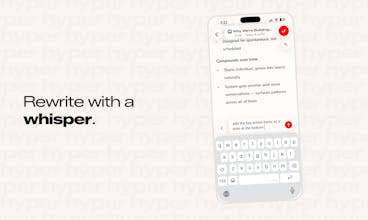
@lliora absolutely. we acknowledge that AI systems like this won't represent everyone perfectly. We believe that the user should always be in control and be able to redirect Hyper to be as close to the truth as possible. Once Hyper has generated a summary, one-tap edits lets you say "When I said X, I actually meant Y," and Hyper will update the summary and use that information going forward! We're planning on rolling out more collaboration-related features soon to give teams even more flexibility in how they deal with this problem.
Capturing the conversation isn't the hard part — it's retrieval without noise. An hour of meeting has maybe 3 minutes of actual signal: the decision, the unresolved tension, the thing that got glossed over. Curious how Hyper handles the signal-to-noise problem — does it surface by time, by participant, or by something semantic?
Hyper
@giammbo appreciate the question!
You're right that capturing isn't the hard technical part, but we've found the UX around capturing is. Anything more than one tap is enough friction that many people won't reach for their phone mid-discussion, and we wanted to make that as simple as possible.
Regarding signal-to-noise: Hyper is tuned to ignore small talk, asides, and tangents while keeping them in the transcript in case it misjudged. If it did miss something, voice editing lets you just say "we're missing a few bullets on X" and it'll fill them in.
The deeper future is the memory system we're building across conversations. When someone says "make the app red" and last week someone said "make it blue," Hyper will be able to surface that conflict. Users are already surprised when Hyper catches details, unresolved questions, or facts they wouldn't have thought to write down; that is the core of the retrieval problem we're most excited about solving
Turning conversations into something you can actually query later instead of just storing notes makes a lot of sense. How does Hyper handle situations where multiple people are speaking and it needs to attribute statements correctly?
OrangeLabs
It would be great for a meeting assistant to have memory. It would be even better if it can autonomously perform low-risk actions that were agreed upon on the call. Just a thought.