
Launching today

Design Agent by Lokuma
The designer for your AI agents (Openclaw, CC, Codex)
494 followers
The designer for your AI agents (Openclaw, CC, Codex)
494 followers
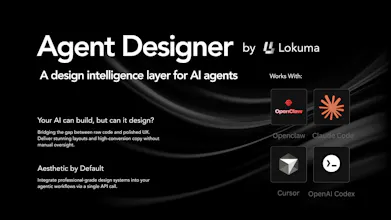
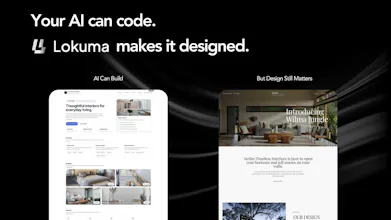
Lokuma Design Agent, is an AI designer your agents can call, a design intelligence layer for agents like OpenClaw, Claude Code, or Codex. AI can generate almost anything. But generation isn’t design. Turning raw outputs into something clear, structured, and visually refined still requires design thinking. Built by design tool makers, Lokuma helps AI reason about layout, typography, and visual balance — transforming outputs into landing pages, websites, and campaign pages that feel designed.




been running openclaw for a week now and the one thing missing was decent UI for the agents' output. this fills that gap nicely. does it support custom themes per agent?
@hikaruai_ Appreciate it, Hikaru! That’s exactly the gap we’re aiming to fill.
Not fully per-agent themes yet, but you can already steer style via prompts. We’re expanding the design capabilities and scope pretty quickly. Would love to hear how you’d want to use it.
Hi Product Hunt,
I’m Mu, founder of Lokuma.
Before this, I built Readdy and Creatie — tools used by over 500,000 designers and creators. Most of my work has been around design systems and how products actually feel, not just how they function.
This time, I’m working with a small indie team — a mix of designers, AI researchers, and people from growth and marketing.
Recently, something started to shift.
Tools like Claude Code, Cursor, Codex, and even things like Google Stitch, are changing how software gets built.
We’re no longer just using tools ourselves.
We’re starting to work with AI, and AI is starting to use tools on our behalf.
That changes the interface.
The new “user” of many tools is no longer a human - it’s an agent.
And most tools today aren’t built for that.
AI can generate almost anything.
But generation isn’t design.
What we see today, including a lot of outputs from varied AI agents, is that AI can produce UI, code, layouts very quickly.
But the results often lack structure, hierarchy, and visual coherence.
They work.
But they don’t feel designed.
That gap becomes much more obvious when AI is the one building.
So we started thinking:
If agents are going to build products,
they need something closer to a designer, instead of just another generator.
That’s why we built Lokuma Design Agent.
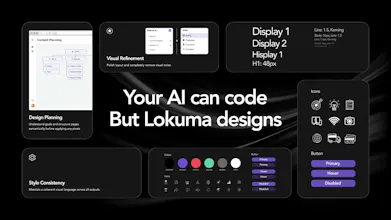
It’s a design intelligence layer for AI - something your agents can call to reason about layout, typography, hierarchy, and visual balance.
Your AI handles logic and generation.
Lokuma handles how it actually comes together.
Why now?
Because we’re entering an agent-first stack.
Coding has agents. Research has agents. Execution has agents.
Design is still missing.
Why us?
Because our team brings together experience across design tools, real product building, AI systems, and growth.
We’ve spent years understanding what makes interfaces actually feel right, and now we’re translating that into something AI can use.
We’re still early, just a small indie team moving fast. But this feels like a new category:
tools built not for humans, but for AI.
Curious how others here see it:
If your AI is already writing code,
what’s still missing for it to ship something that feels complete?
— Mu
@mu_li Congrats on the launch. What's one specific design principle you've encoded into Lokuma that prevents AI-generated UIs from feeling "generic," and how could founders test it in their agent workflows today?
@swati_paliwal Good question. Thanks Swati! I’d say it’s not just one principle, but a combination of layout logic, typography pairing, and patterns we’ve seen work in real products.
That mix tends to make outputs feel less generic. Curious what design issues you’ve been seeing most often with AI-generated UI?
@mu_li @swati_paliwal Thank you for this! It gives us a great opportunity to share something beyond just the product itself.
What we've seen across early users from AI page builders that the "generic" feel usually isn't about the AI model, it's about how much design context the AI gets before it generates. Most tools give the model zero opinion, so it defaults to safe, flat, forgettable outputs.
Lokuma's approach is to front-load structured design intent: brand tone, spatial rhythm, component hierarchy:so the AI is creating within an opinionated system, not freestyling in a vacuum. Feels like how a jazz musician improvises brilliantly not because they have no rules, but because the chord progression constrains their creativity into something coherent.
The easiest way to test it: run the same prompt through your current workflow and through Lokuma side by side. You'll feel the difference immediately, one looks just "correct" or "not bad", and the other looks intentional.
Happycapy
@mu_li Love this direction. Design layer for agents makes a lot of sense. Excited to see where this goes! 🚀
@victoria_wu Thanks Victoria, means a lot! excited (and a bit nervous) to see where this direction goes too!
MockRabit
@ishwarjha Stitch gives humans AI-powered design.
Lokuma gives AI agents design intelligence.
They’re not competing — they actually fit together pretty well.
As more building shifts to agents, design can’t stay human-only. Tools like Stitch help people create faster, while Lokuma makes sure what agents produce actually feels designed.
Both matter. And together, they cover both sides of where things are going.
@vouchy Yeah, we kept seeing outputs that were functionally correct but visually unresolved.
Like the agent knew what to build, but not how it should feel as a whole.
Everything was there, but nothing really related.
And sometimes, it was too correct - almost mechanical - which made it feel less designed, not more.
That gap between correctness and coherence is basically what pushed us to build this.
Glam AI
@olya_vasilevskaya Great question! And yeah, this is exactly where things get interesting.
Short answer: yes, that’s very much the direction we’re building toward.
Right now, agents can already plug into workflows and help with generation + iteration. For a team of 20+ designers, the real value comes from having a shared layer — where the agent understands your design standards, keeps outputs consistent, and helps with feedback loops instead of everyone working in isolation.
We’re actively thinking about:
team-level context (so the agent “knows” your system)
shared assets / patterns
lightweight ways to review and iterate together
Would love to learn how your team currently manages design feedback. It feels like there’s a lot we can build here together.
Hello everyone, I'm Joy, co-founder of Lokuma.
Before starting Lokuma, I was running a branding and marketing agency focused on helping SMBs build their online presence covering social media, branding, and website development. But over time, I noticed a recurring problem: many SMBs were stuck with either an outdated website or no website at all, simply due to limited budgets and resources.
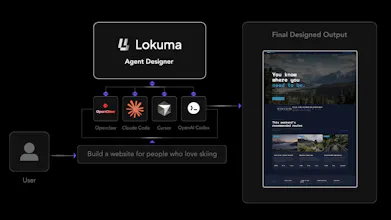
But things are shifting. I saw many entrepreneurs now having AI agents such as OpenClaw, Claude Code to help them. And this is why we're building Lokuma Agent. Simply install our agent with any of yours be it Claude Code, Cursor, Codex and watch your own agent design website in seconds using Lokuma's intelligence.
This will really help individuals to offload heavy lifting tasks to our agents and equip your personal AI agent with website development intelligence to build websites that TRULY knows design & conversion logic!
This is a groundbreaking function in the world of AI agents and we have received many positive feedback.
We'd love to have you to try it and offer us any feedback!
I've been part of the marketing team on two AI website builder tools. We watched the category explode and then hit a ceiling. The category grew fast, but the outputs started converging. Generic layouts, same patterns. Hard to keep up with what actually feels current. AI got really good at generating. It never got a good sense for design.
So when Lokuma decided not to build "yet another AI website builder" and instead focus on being the design layer for AI agents, I thought that was the right call. Crowded category and it really was the yesterday's problem.
It works as a skill that your AI agent can directly call. You just tell Claude Code or Codex to " install and design with Lokuma," and it actually reasons through the layout before generate anything.
It's still early, and to be honestly there's a lot Lokuma can't do yet. But the overall direction feels right to our team. Your agent handles the logic, Lokuma handles how it actually comes together. Hierarchy, balance, what guides the eye.