
MuleRun
Raise an AI that actually learns how you work
1.4K followers
Raise an AI that actually learns how you work
1.4K followers
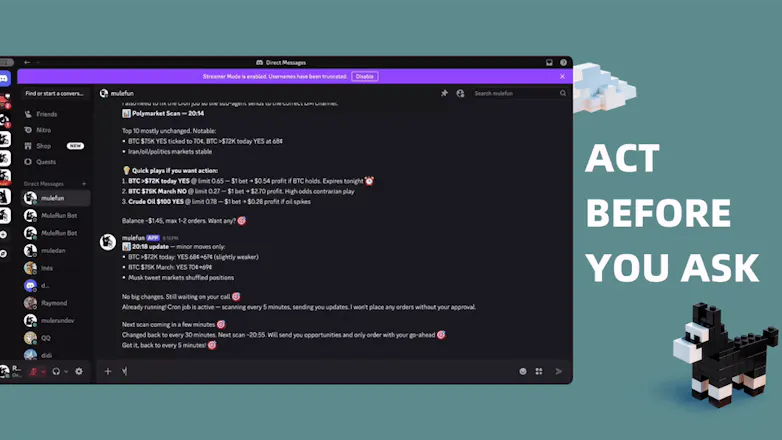
MuleRun is the world's first self-evolving personal AI — it learns your work habits, decision patterns, and preferences, then keeps getting sharper over time. It runs 24/7 on your dedicated cloud VM, works while you're offline, and proactively prepares what you need before you ask.No coding. No setup. Just raise your AI and watch it evolve.





Just curious, most AI tools lose context after a session or hit a token limit, forcing you to start fresh each time. Since this AI is meant to 'learn your habits' over time, how does it handle long-term memory? Does it retain what it's learned about you across sessions, or does it reset after each conversation?
MuleRun
@terrance_jones1 Every user gets a dedicated cloud VM that runs 24/7. Your agent doesn't "live" inside a chat window — it lives on that machine, with its own persistent file system and memory layer. When a session ends, nothing is lost. When you come back — whether that's two hours or two weeks later — your agent picks up with full context of everything you've discussed, every preference you've set, every correction you've made.
The token limit problem you're describing is real — and it's a design constraint of stateless chat products. MuleRun sidesteps it entirely because memory isn't crammed into a context window. It's a persistent layer that the agent draws from as needed, without forgetting older knowledge to make room for new input.
@sylvunny That's Awesome!!
Bench for Claude Code
Very nice idea, but the demo kind of confused me. Is this only related to coding and making products? Or is it also connected to the various platforms you use while working, to "learn" from you as mentioned?
MuleRun
@matteo_avalle Good question — it's not just for coding. The demo skews technical, but the actual product is much broader. MuleRun connects to platforms like Telegram, Discord, and more. It learns from your interactions across all of them. Whether you're doing e-commerce operations, investment analysis, content production, or research — it adapts to your workflow regardless of domain. Real examples from early users: Etsy store owners automating product listings, traders getting daily market briefs, content creators producing short dramas — none of these are coding tasks.
How to determine whether the direction of self-evolution is what users truly need?
MuleRun
@flora07 That's a good question. I believe a core criterion is the ability to proactively identify users' pain points and propose solutions. It means acts before you ask.
MuleRun
@flora07 Really thoughtful question — and one we think about deeply.
The short answer is: the user is always in control of what gets learned. MuleRun's self-evolution isn't a black box running on assumptions. It's grounded in three concrete signals.
Explicit feedback. Users can directly correct, redirect, or reinforce their agent's behavior at any time. If MuleRun's suggestion misses the mark, you tell it — and that becomes part of its learning.
Behavioral patterns. The agent observes how you actually work: which outputs you use, which you discard, how you modify suggestions, what tasks you repeat. Actual behavior is a far more honest signal than stated preference.
Community validation. On the collective level, workflows and agents that get shared and repeatedly adopted by other users in similar scenarios rise in weight. This acts as a real-world filter — if a pattern genuinely solves problems for many people, it surfaces; if it doesn't, it fades.
The goal is not for MuleRun to evolve in a direction it thinks is best — it's to evolve in the direction your actual usage confirms is valuable. We're also continuously improving how we surface these learning signals transparently to users, so you can see and adjust what your agent has learned about you.
Self-evolution should feel like a trusted colleague getting better at their job, not an algorithm drifting in an unknown direction.
MuleRun
@flora07 The self-evolution process will be seen by the user and if user is not satisfied then he/she can tell AI to change
I tried the website and noticed the footer is quite large, which creates a lot of extra scroll on the homepage. Reducing its height might make the page feel tighter and more focused.
The concept looks interesting though. Curious what the main use case you’re seeing from early users is..
MuleRun
@ion_simion_bajinaru Thanks for the feedback on the site — noted, I'll pass it to our design team.
On early user use cases, we're seeing a few patterns stand out:
Individual traders setting up personal market monitoring agents that deliver daily briefs, track positions, and proactively flag opportunities
Game creators with zero dev background building playable games entirely through natural language conversation
Content creators running end-to-end short drama and comic production pipelines on the 24/7 cloud VM
The common thread: tasks that need to keep running when you're not watching, and get better the more you use them. That's where MuleRun's always-on VM and self-evolution really click.
You can browse real user cases here: https://mulerun.com/use-cases?tab=featured
@sylvunny That makes sense. The “always-on” angle is the interesting part.
From what I’m seeing, this could be very strong for building persistent agents, not just one-off tasks.
Curious — are most users technical, or are non-technical users actually getting real results with it?
“Raise your AI and watch it evolve” is such a cool framing! Curious how fast the learning actually happens in real usage.
MuleRun
@blink_66 I guarantee it will blow you away!
MuleRun
@blink_66 Glad that framing resonates — it really does capture how we think about the relationship between user and agent!
On learning speed: it's genuinely two-speed. Explicit preferences — tone, format, recurring instructions — are picked up immediately and carried forward from your very first sessions. The deeper layer, where MuleRun starts anticipating workflows and acting ahead of you, builds more gradually as it accumulates real behavioral signal. Most users notice that shift after consistent use over days and weeks rather than hours. The more varied the tasks you run through it, the faster that model of you sharpens. It compounds — which is kind of the whole point.
This would be a game changer for AI. It seems like a lot of AI eb and flow knowing your working style etc but a dedicated AI would be awesome almost like building your own AI platform.
MuleRun
@krystle_berry That's literally the vision — your own AI platform that compounds on everything you do. Most AI tools are shared infrastructure with no memory of you. We flipped that. Your MuleRun instance is yours alone — it builds up knowledge, adapts to your style, and never resets.
MuleRun
@alexander_miller_bakewell Appreciate you flagging this! You're right on both counts — we definitely want to know, and it's getting fixed. Mobile pricing page should be clean shortly. Thanks for checking us out, and feel free to ping me if you hit anything else.