
MuleRun
Raise an AI that actually learns how you work
1.4K followers
Raise an AI that actually learns how you work
1.4K followers
MuleRun is the world's first self-evolving personal AI — it learns your work habits, decision patterns, and preferences, then keeps getting sharper over time. It runs 24/7 on your dedicated cloud VM, works while you're offline, and proactively prepares what you need before you ask.No coding. No setup. Just raise your AI and watch it evolve.





I recently got tired of having to correct a writing AI assistant. Perhaps MuleRun could be useful here?
@jay_osho Of course! You can give it a try!
@jay_osho That frustration is exactly what MuleRun is designed to solve — and it gets at a core limitation of most writing AI tools today.
With a standard writing assistant, every session essentially starts from scratch. It doesn't remember that you prefer a direct tone over a formal one, that you never use passive voice, or that you always want a punchy closing line. So you end up re-correcting the same things over and over.
MuleRun works differently because it retains everything across sessions. Your writing style, structural preferences, vocabulary choices, the feedback you've given before — all of it accumulates into a persistent profile. The more you use it, the less you need to correct it, because it's genuinely learning your voice rather than just following a generic prompt.
Beyond style memory, you can also set up proactive workflows — for example, having your agent draft a weekly content summary, monitor topics you care about, and have a first draft ready before you even ask. It stops being a tool you operate and starts being a collaborator that knows your standards.
If you've been burned by writing assistants that forget everything the moment you close the tab, MuleRun is worth trying. You can get started here.
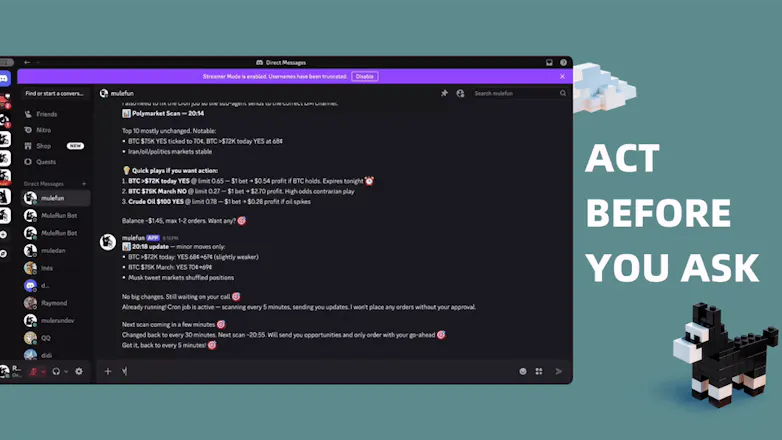
Unlike other chatbots, this one doesn’t quit when I close the app.
@eeeeeach Yes! Our computer feature remains active and online continuously once it's turned on.
@eeeeeach Exactly — and that's one of the most fundamental differences between MuleRun and a traditional chatbot. Most AI tools are essentially reactive: you open them, ask something, get an answer, and everything stops the moment you close the tab.
MuleRun is built on a different premise entirely. Every user gets a dedicated cloud virtual machine running 24/7. Your agent lives there — not in your browser. The browser is just the entry point. So whether you're sleeping, in meetings, or simply offline, your agent keeps executing: running scheduled tasks, monitoring data, deploying services, generating reports, and proactively preparing what you'll need when you're back.
It's the difference between a chatbot and a digital employee who actually keeps working after you leave the office. See it in action here.
Congrats on the launch! The self-evolving angle is what makes this stand out; most AI tools are static from day one, and it's on the user to figure out how to get more out of them over time.
How does it handle domain-specific workflows, like financial analysis or structured research tasks? Does it get better with use, or is the learning more behavioral, adapting to how you work rather than what you're working on?
@andreitudor14 Thanks! To answer directly: both.
It learns how you work — your format preferences, communication style, tool choices, decision patterns. And it learns what you work on — your domain context, terminology, data sources, evaluation criteria.
For finance specifically, there's a dedicated Investment mode that comes preloaded with market monitoring, portfolio analysis, and daily briefing capabilities. But the real value compounds over time: it learns your risk framework, your sector focus, your analytical priorities. By month two, "run the usual analysis" just works.
Same applies to research workflows — it retains your methodology, your quality bar, your preferred report structure. Each correction makes the next output sharper.
The key: this isn't prompt-level memory tricks. It's persistent knowledge on a 24/7 dedicated VM that accumulates across every session and every channel. Static tools make you repeat yourself. MuleRun makes repetition unnecessary.
Having your AI be able to learn your patterns over time instead of starting from scratch every time is essential and the missing piece in a lot of AI platforms. Congrats on the launch! How long does it typically take before the AI starts feeling noticeable personalized to how you work?
@aya_vlasoff It depends on your usage frequency and specific needs. Why not start by trying out our Computer feature : ) It's going to pleasantly surprise you.
@aya_vlasoff Thank you — and you've put your finger on exactly the gap we set out to close!
On your question: personalization in MuleRun happens in layers, so there isn't one single "aha" moment — it builds progressively.
Most users notice the first signs quite early. Within your first few sessions, MuleRun starts retaining your stated preferences, communication style, and recurring task patterns. If you tell it you prefer concise summaries over long reports, or that you always want data sourced before recommendations, it carries that forward immediately — no need to repeat yourself next time.
The deeper personalization — where MuleRun begins anticipating what you need before you ask, proactively preparing relevant information, or suggesting workflow optimizations based on your habits — typically becomes noticeable after more sustained use, as the agent accumulates enough signal from how you actually work day to day.
The honest answer is: it compounds. The more tasks you run through it, the more behavioral data it has to work with, and the more accurate its model of you becomes. Users who engage with it consistently — especially across different types of tasks — tend to feel that shift most strongly.
Think of it less like configuring a tool and more like onboarding a new team member who gets sharper every week. We'd love to hear what your experience is like once you've had a chance to try it!
I get automatic updates when my tasks finish, so helpful.
@saintcedricfan Exactly, we finally made it.
@saintcedricfan That's the Heartbeat feature doing its job! No more checking in to see if something's done — your Mule comes to you. Glad it's making a difference in your workflow!
The self-evolving concept reminds me of what I wish every AI tool did. Actually learn from repeated use instead of starting from scratch each session. How do you handle cases where it learns a wrong pattern from the user?
@mehmet_kerem_mutlu Thanks for raising this — it's a critical question for any system that claims to "learn."
MuleRun's self-evolution works on two levels, and both have built-in correction paths:
At the individual level, MuleRun interacts with you
At the collective level, this is where it gets interesting. MuleRun has a Knowledge Network where effective solutions
On top of that, MuleRun's Heartbeat system actively analyzes your usage patterns and pro
The short version: you're the one raising
Would love for you to try it out and stress-test this yourself.
@mehmet_kerem_mutlu Really important question — and one we take seriously, because an AI that learns the wrong things confidently is worse than one that doesn't learn at all.
The safeguard is that the user always has the final word. When MuleRun acts on a learned pattern and gets it wrong, your correction is itself a learning signal — it doesn't just fix the immediate output, it updates the underlying model of how you work. One clear correction carries significant weight precisely because it's an explicit signal, not just passive behavior.
For higher-stakes tasks, MuleRun is also designed to surface its reasoning and confirm before acting, rather than silently executing on an assumption. The more consequential the action, the more it checks in.
And if a pattern is deeply ingrained in the wrong direction, users can directly update or reset specific learned behaviors — you're never locked into what the agent has accumulated. Think of it like course-correcting a colleague: a clear, direct conversation resets the expectation far more effectively than hoping they'll figure it out on their own.
The goal is earned trust, not blind automation.
Congratulations @sylvunny ! It's looking promising. I would like to learn what inspired you to launch this?
@ishwarjha Thanks a lot! Our team has always aimed to build a truly user-centric AI agent, and "always on" is a key benchmark for us.
@sylvunny I am going to use it over the next few days and return back with solid feedback about its usefulness and relevance in my use case.
@ishwarjha Thank you so much — really means a lot on launch day!
The core inspiration was a simple but persistent frustration: AI tools were getting incredibly powerful, yet they still behaved like vending machines — you put in a query, you get an output, and the moment you walk away, everything resets. There was no continuity, no memory, no initiative.
We kept asking: what would it look like if AI actually worked the way a great human colleague does? Someone who remembers your preferences, learns your working style over time, keeps making progress even when you're not in the room, and occasionally comes to you with something you didn't think to ask for — but needed.
That vision is what became MuleRun. Not a smarter chatbot, but a self-evolving personal AI that runs 24/7 on its own dedicated environment, grows with you, and proactively works on your behalf. We wanted to give everyone — not just developers or technical teams — access to that kind of leverage.
The goal has always been to return the power of AI creation and evolution to every individual person, regardless of their technical background. We're just getting started, and the community's early creativity has already exceeded our expectations!