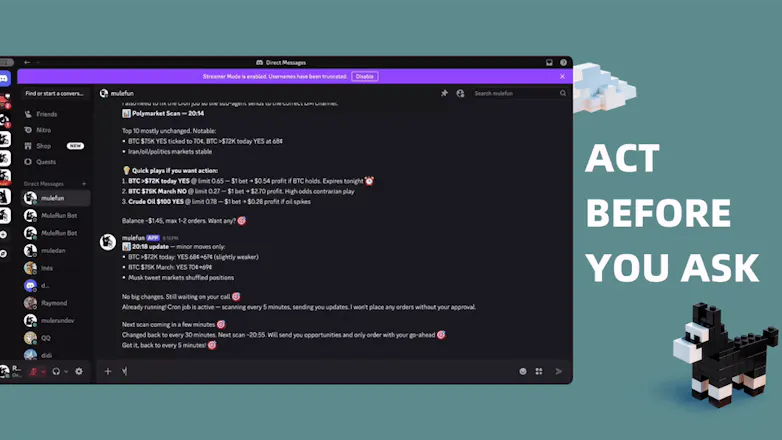
MuleRun is the world's first self-evolving personal AI — it learns your work habits, decision patterns, and preferences, then keeps getting sharper over time. It runs 24/7 on your dedicated cloud VM, works while you're offline, and proactively prepares what you need before you ask.No coding. No setup. Just raise your AI and watch it evolve.
@anaspis Great question — and it's a distinction worth drawing clearly.
Zapier and traditional automation tools are fundamentally rule-based. You define a trigger, map a sequence of steps, and the tool executes that exact sequence every time. It's powerful for predictable, repetitive tasks, but it breaks the moment something falls outside the predefined logic. Every new workflow requires manual setup, and the tool has no understanding of context — it just follows instructions.
MuleRun operates on a completely different layer. Rather than executing fixed rules, your MuleRun agent understands the intent behind a task and figures out how to accomplish it. You describe what you need in plain language, and the agent determines the steps, selects the right tools, handles exceptions, and adapts when conditions change — without you having to anticipate every edge case upfront.
A few concrete differences:
No manual workflow mapping. With Zapier, you build the automation. With MuleRun, you describe the outcome and the agent builds and executes the path to get there.
Context and memory. MuleRun retains your working history, preferences, and domain knowledge across sessions. It gets better at your specific workflows over time. Zapier has no memory of you — every run is stateless.
Proactive vs. reactive. Zapier waits for a trigger. MuleRun can proactively identify what needs to be done based on patterns it has learned, and act before you ask.
Always-on execution. Because MuleRun runs on a dedicated 24/7 cloud VM, it can handle long-running, multi-step tasks that unfold over hours — not just instant trigger-response actions.
Think of Zapier as a very efficient set of pipes. MuleRun is closer to a digital employee who understands your business, learns your preferences, and figures out the plumbing themselves. You can see real workflow examples here.
Report
How does MuleRun’s “self-evolving” feature actually learn and anticipate my needs over time, and can I control or review the actions it takes proactively? I'm just curious, not the secret sauce but in general.
@marcelino_gmx3c Thank you for your question! By continuously learning a user's work patterns, schedule, and communication habits, MuleRun builds a personalized profile that proactively recommends to-do items. Based on how the user has handled problems in the past, MuleRun intelligently anticipates solutions for similar issues and preloads the right tools, boosting task efficiency.
On the learning side, MuleRun builds a model of you through three main signals: what you explicitly tell it about your preferences and working style, how you actually behave across sessions — the tasks you run, the outputs you accept or revise, the patterns that repeat — and the feedback you give when it gets something wrong. All of this accumulates in your dedicated cloud VM, which persists across sessions rather than resetting.
On the proactive side, MuleRun has a built-in Heartbeat mechanism — it doesn't just wait for you to show up. It will proactively summarize what's been done, flag things worth your attention, and suggest next steps based on your habits. For recurring tasks you've set up, it executes on schedule without you needing to prompt it each time.
On control and transparency: yes, you can review what it's learned, adjust your preferences, and update or cancel any scheduled tasks at any time. For higher-stakes actions, it checks in with you before proceeding rather than acting unilaterally. The goal is that you always feel in the loop — proactive help shouldn't mean surprises.
So the short version: it learns from your behavior, acts on patterns it's confident about, and keeps you informed and in control throughout.
How does MuleRun handle the transition when you switch between very different types of workflows, like going from e-commerce operations to content creation? Does it maintain separate context profiles or blend everything into one evolving model? Really cool concept, congrats on the launch!
@mcarmonas Thanks! And this is the same question that just came in — clearly something people care about. Let me come at it from a different angle.
The short version: one agent, one memory, multiple modes.
Your MuleRun agent is a single persistent entity that knows everything about you. But it can shift focus depending on what you're working on — similar to how a sharp colleague doesn't develop amnesia when they switch from a spreadsheet to a creative brief.
MuleRun has a Scene Mode system. You tell it "I'm switching to content production now" — or you select a preset mode — and it foregrounds the relevant tools, behaviors, and workflow patterns for that domain. But critically, it doesn't compartmentalize your identity.
Report
@MuleRun Hello, congrats on your launch. Interesting product, just a few questions. How do you enable the long term context to be functional? The context growth with the user, the context of the model is limited. How do you manage to keep it all together, working as intended?
In practice, self-evolution in MuleRun works on two levels.
At the individual level, your agent continuously learns from how you actually work — not just what you tell it, but what you do. It retains your preferences, decision patterns, communication style, and domain knowledge across every session. The longer you use it, the less you need to explain yourself, and the more it anticipates what you need before you ask. It's less about configuring settings and more about the agent building a genuine working model of you over time.
At the collective level, MuleRun has a shared Knowledge Network. When users choose to share a workflow or agent they've built, it enters a community pool. Agents that get validated and adopted by multiple users in similar scenarios rise in weight, and MuleRun automatically surfaces those high-performing patterns to others facing the same kind of task. So your agent benefits not just from your own experience, but from the collective intelligence of the entire user base — opt-in, always.
Curious about the feedback loop when it comes to "self-evolving" feature. How does it know what is the "correct" thing to learn and not pick up bad habits?
@tteer MuleRun's self-evolution is anchored to your explicit behavior, not unsupervised inference. It learns from what you correct, what you approve, what you repeat, and what you discard. When you tell it "no, use this tone instead" or "that analysis missed the point, here's what I actually need" — that's the training signal. It's building a model of your decision logic, your preferences, your standards.
So it's less "AI teaching itself" and more "you shaping a digital employee through daily work." The same way a junior hire gets better by watching how you react to their output — except MuleRun has perfect recall and never forgets the correction.
What prevents bad habit formation?
A few things by design:
You remain the authority. MuleRun doesn't silently lock in behaviors. When it acts on a learned pattern — say, auto-formatting a report a certain way because you've preferred it five times before — you can override it anytime. One correction updates the model. It doesn't argue with you or revert.
Transparency of learned context. MuleRun's long-term memory isn't a black box. Your preferences, established workflows, accumulated knowledge — these are inspectable. You can see what it "thinks it knows" about you and correct or remove anything that's wrong. Think of it as a profile you can audit.
The knowledge network acts as a quality filter. On the collective intelligence side, agents and solutions shared by users don't just get blindly propagated. They're weighted by validation — how many users have successfully applied them in similar scenarios. High-weight solutions surface; untested or poorly-performing ones don't. It's closer to peer review than viral spread.
Report
This looks cool. Respectfully, you deserve to have someone do some read through on the site, as there are myriad spelling/mechanical errors… “markting”, “creat a pptx”, others. Just a heads up. Congrats on the launch tho, concept is really cool and I’m keen to try it.
@grey_seymour Appreciate you flagging that — genuinely helpful. We're on it, fixing those now. Launch week typos are embarrassing but solvable. Glad the concept resonates. Jump in and give it a spin — and if you run into anything else, we're all ears. Thanks for the support!






Congrats on the launch! Curious — how is MuleRun different from traditional automation tools like Zapier when it comes to handling complex workflows?
MuleRun
@anaspis MuleRun replaces rigid "if-this-then-that" workflows with AI agents that understand what you want and figure out how to do it.
MuleRun
@anaspis Great question — and it's a distinction worth drawing clearly.
Zapier and traditional automation tools are fundamentally rule-based. You define a trigger, map a sequence of steps, and the tool executes that exact sequence every time. It's powerful for predictable, repetitive tasks, but it breaks the moment something falls outside the predefined logic. Every new workflow requires manual setup, and the tool has no understanding of context — it just follows instructions.
MuleRun operates on a completely different layer. Rather than executing fixed rules, your MuleRun agent understands the intent behind a task and figures out how to accomplish it. You describe what you need in plain language, and the agent determines the steps, selects the right tools, handles exceptions, and adapts when conditions change — without you having to anticipate every edge case upfront.
A few concrete differences:
No manual workflow mapping. With Zapier, you build the automation. With MuleRun, you describe the outcome and the agent builds and executes the path to get there.
Context and memory. MuleRun retains your working history, preferences, and domain knowledge across sessions. It gets better at your specific workflows over time. Zapier has no memory of you — every run is stateless.
Proactive vs. reactive. Zapier waits for a trigger. MuleRun can proactively identify what needs to be done based on patterns it has learned, and act before you ask.
Always-on execution. Because MuleRun runs on a dedicated 24/7 cloud VM, it can handle long-running, multi-step tasks that unfold over hours — not just instant trigger-response actions.
Think of Zapier as a very efficient set of pipes. MuleRun is closer to a digital employee who understands your business, learns your preferences, and figures out the plumbing themselves. You can see real workflow examples here.
How does MuleRun’s “self-evolving” feature actually learn and anticipate my needs over time, and can I control or review the actions it takes proactively? I'm just curious, not the secret sauce but in general.
MuleRun
@marcelino_gmx3c Thank you for your question! By continuously learning a user's work patterns, schedule, and communication habits, MuleRun builds a personalized profile that proactively recommends to-do items. Based on how the user has handled problems in the past, MuleRun intelligently anticipates solutions for similar issues and preloads the right tools, boosting task efficiency.
MuleRun
@marcelino_gmx3c Happy to walk through the general picture!
On the learning side, MuleRun builds a model of you through three main signals: what you explicitly tell it about your preferences and working style, how you actually behave across sessions — the tasks you run, the outputs you accept or revise, the patterns that repeat — and the feedback you give when it gets something wrong. All of this accumulates in your dedicated cloud VM, which persists across sessions rather than resetting.
On the proactive side, MuleRun has a built-in Heartbeat mechanism — it doesn't just wait for you to show up. It will proactively summarize what's been done, flag things worth your attention, and suggest next steps based on your habits. For recurring tasks you've set up, it executes on schedule without you needing to prompt it each time.
On control and transparency: yes, you can review what it's learned, adjust your preferences, and update or cancel any scheduled tasks at any time. For higher-stakes actions, it checks in with you before proceeding rather than acting unilaterally. The goal is that you always feel in the loop — proactive help shouldn't mean surprises.
So the short version: it learns from your behavior, acts on patterns it's confident about, and keeps you informed and in control throughout.
Humalike
How does MuleRun handle the transition when you switch between very different types of workflows, like going from e-commerce operations to content creation? Does it maintain separate context profiles or blend everything into one evolving model? Really cool concept, congrats on the launch!
MuleRun
@mcarmonas Thanks! And this is the same question that just came in — clearly something people care about. Let me come at it from a different angle.
The short version: one agent, one memory, multiple modes.
Your MuleRun agent is a single persistent entity that knows everything about you. But it can shift focus depending on what you're working on — similar to how a sharp colleague doesn't develop amnesia when they switch from a spreadsheet to a creative brief.
MuleRun has a Scene Mode system. You tell it "I'm switching to content production now" — or you select a preset mode — and it foregrounds the relevant tools, behaviors, and workflow patterns for that domain. But critically, it doesn't compartmentalize your identity.
@MuleRun Hello, congrats on your launch. Interesting product, just a few questions. How do you enable the long term context to be functional? The context growth with the user, the context of the model is limited. How do you manage to keep it all together, working as intended?
MuleRun
@dingleberryjones Hey, thanks! Great question — and honestly one of the core architectural bets we made early on.
The short answer: we don't try to cram everything into a model's context window.
1. Persistent memory ≠ chat history.
2. Your agent has its own machine.
3. The system actively distills, not just stores.
And
We separated memory from model context at the architecture level. That's the fundamental answer
Congrats launch! 🎉 Curious how the self-evolving part works in practice.
MuleRun
@thea5 Thank you! MuleRun learns your work habits over time and starts proactively preparing what you need before you ask.
MuleRun
@thea5 Thank you! Great question to dig into.
In practice, self-evolution in MuleRun works on two levels.
At the individual level, your agent continuously learns from how you actually work — not just what you tell it, but what you do. It retains your preferences, decision patterns, communication style, and domain knowledge across every session. The longer you use it, the less you need to explain yourself, and the more it anticipates what you need before you ask. It's less about configuring settings and more about the agent building a genuine working model of you over time.
At the collective level, MuleRun has a shared Knowledge Network. When users choose to share a workflow or agent they've built, it enters a community pool. Agents that get validated and adopted by multiple users in similar scenarios rise in weight, and MuleRun automatically surfaces those high-performing patterns to others facing the same kind of task. So your agent benefits not just from your own experience, but from the collective intelligence of the entire user base — opt-in, always.
The practical result is a flywheel: the more you use it, the better it gets at your specific work. And the more the community uses it, the stronger the shared foundation everyone builds on. You can explore some of the workflows the community has already built here.
Curious about the feedback loop when it comes to "self-evolving" feature. How does it know what is the "correct" thing to learn and not pick up bad habits?
MuleRun
@tteer MuleRun's self-evolution is anchored to your explicit behavior, not unsupervised inference. It learns from what you correct, what you approve, what you repeat, and what you discard. When you tell it "no, use this tone instead" or "that analysis missed the point, here's what I actually need" — that's the training signal. It's building a model of your decision logic, your preferences, your standards.
So it's less "AI teaching itself" and more "you shaping a digital employee through daily work." The same way a junior hire gets better by watching how you react to their output — except MuleRun has perfect recall and never forgets the correction.
What prevents bad habit formation?
A few things by design:
You remain the authority. MuleRun doesn't silently lock in behaviors. When it acts on a learned pattern — say, auto-formatting a report a certain way because you've preferred it five times before — you can override it anytime. One correction updates the model. It doesn't argue with you or revert.
Transparency of learned context. MuleRun's long-term memory isn't a black box. Your preferences, established workflows, accumulated knowledge — these are inspectable. You can see what it "thinks it knows" about you and correct or remove anything that's wrong. Think of it as a profile you can audit.
The knowledge network acts as a quality filter. On the collective intelligence side, agents and solutions shared by users don't just get blindly propagated. They're weighted by validation — how many users have successfully applied them in similar scenarios. High-weight solutions surface; untested or poorly-performing ones don't. It's closer to peer review than viral spread.
MuleRun
@grey_seymour Appreciate you flagging that — genuinely helpful. We're on it, fixing those now. Launch week typos are embarrassing but solvable. Glad the concept resonates. Jump in and give it a spin — and if you run into anything else, we're all ears. Thanks for the support!