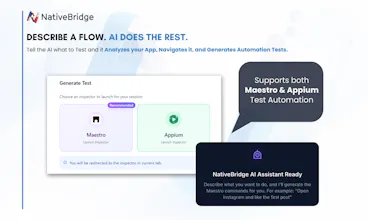
Instant access to real iOS and Android devices with one Magic Link. Run AI-powered tests using Maestro, capture crashes, and share rich bug reports. Turn mobile testing into a superpower.
@ragsyme Good question Raghav. Tools like BrowserStack are strong at device access, and many teams already rely on them for that. NativeBridge focuses more on the day-to-day workflow around testing - not just running tests, but how teams share builds, reproduce issues, and stay aligned.
With NativeBridge, real devices, AI-driven testing, and collaboration live in one place. The Magic Link acts as a single source of truth where everyone sees the same app, on the same device, with full context — we often think of it as Figma for mobile testing.
Another difference is where it fits in the lifecycle. BrowserStack is usually picked up by QA, while NativeBridge is used earlier - starting in development (via our VSCode/Cursor extension) and continuing through QA, reviews, and feedback, all without switching tools or links.






Lancepilot
Congratulations to the maker team! Shipping infra-heavy products deserve a lot of respect for the execution. 👏🏻
NativeBridge
@istiakahmad Thank you! Appreciate the kind words - infra has definitely been the hardest (and most rewarding) part to build 🙏
Nawvel
This feels like a tool built by people who’ve actually felt testing pain themselves. That shows in the details. 👏🏻 👏🏻
Nas.com
How well does this scale for larger test suites?
NativeBridge
@nuseir_yassin1 Good question Nas! Larger suites usually mean a mix of parallel runs on real & emulated devices.
NativeBridge supports that model and we’re actively expanding concurrency and orchestration as teams grow!
Vocably (a language-learning tool)
Very nice!
NativeBridge
@sneas Glad you liked it Dimah!
How does NativeBridge compares with BrowserStack or similar tools in day-to-day workflows? 🤔
NativeBridge
@ragsyme Good question Raghav. Tools like BrowserStack are strong at device access, and many teams already rely on them for that. NativeBridge focuses more on the day-to-day workflow around testing - not just running tests, but how teams share builds, reproduce issues, and stay aligned.
With NativeBridge, real devices, AI-driven testing, and collaboration live in one place. The Magic Link acts as a single source of truth where everyone sees the same app, on the same device, with full context — we often think of it as Figma for mobile testing.
Another difference is where it fits in the lifecycle. BrowserStack is usually picked up by QA, while NativeBridge is used earlier - starting in development (via our VSCode/Cursor extension) and continuing through QA, reviews, and feedback, all without switching tools or links.
CodeDesign.ai
NativeBridge
@mssulthan Appreciate the support!
looks great!