
RankAI
RankAI autonomously gets you buyers from Google & AI Search
1.2K followers
RankAI autonomously gets you buyers from Google & AI Search
1.2K followers
RankAI is the first SEO/GEO agent that truly works. It handles everything autonomously to drive you millions of visitors from Google & AI Search like ChatGPT. Drop in your website, and RankAI handles the rest: it finds high-intent queries your customers search on Google and ChatGPT, publishes optimized pages, tracks performance, and recreate pages iteratively until they get you visitors.




Boyuan here, founder of RankAI.
My team and I have been heads down building in search for years. What's happening now is that SEO and AI search are wildly overpriced by people claiming they have some proprietary playbook or that they have “cracked” search, and half the time they deliver meaningless results.
What people do not tell you is that search is not deterministic. There is no formula where you do X, Y, and Z and magically rank on Google & ChatGPT. That is just not how it works. After working with 200+ businesses and going through YC, what we learned is that the real way to win is iteration: find the right opportunities, publish, monitor reuslt, double-down on what works, and keep retrying for what didn't work.
So we built RankAI to do exactly that. And it's fully autonomous!
Check us out: https://rankai.ai/
You put in your website, and RankAI will:
- find the queries your customers already search on Google and AI search,
- conduct deep research into each sub-topic related to the query
- create optimized pages to target the query,
- track how each page performs,
- and rewrite them until they start working.
So instead of paying for a slow manual agency, or AI generate SEO slop, you get an engine that does everything iteratively to get you result.
A few outcomes:
An ecommerce skincare brand reached 1.2M search visibility in 3 months.
A consumer tech company grew search visibility 13x in just 2 months.
A B2B equipment company doubled organic traffic in 3 months after years of flatlined growth.
The future of organic growth is transparent and autonomous. RankAI is starting this wave.
Would love blunt feedback — what would make this more useful for you?
@boyuan_deng1 For niche service businesses like "personal branding strategist" or "telecom AI consultant", how does RankAI discover those long-tail queries people actually search? Does it blend Google Suggest + competitor gaps + your site's existing traffic patterns?
@boyuan_deng1 @dayal_punjabi Great question! It’s a mix, let me explain...
We use Google data like GSC, suggest, and related queries, plus competitor gaps and your site’s existing impressions, even if they’re low volume.
Then we expand into adjacent queries based on intent and real use cases, not just keyword variations. That’s especially important for niche services where volume is low but intent is high.
A lot of valuable queries don’t show up clearly in keyword tools, so the goal is mapping the problem space, not just scraping keywords.
Then once pages are live, performance data tells us what’s real and we double down from there.
@dayal_punjabi
Yep! It’s a blend of all. We focus on finding long-tail keywords, competitor gaps, and areas where your site already has some authority, then expand into adjacent queries from there.
Our goal isn’t just to find keywords, but to find ones you actually have a realistic shot at winning and iterating on.
@boyuan_deng1 You've built a truly impressive tool and may have gained an early user, with me. As a start-up business (not launched yet), one of my many challenging question I've asked myself is how I can effectively get traffic to my site. I'm not big on Social media at all and I guess to an extent this lifelong decision could become a slight impediment to my growth/or initial launch. Needless to say, RankAI might actually help bridge that gap for when I'm ready.
@leroy_price Thanks Leroy, that means a lot. And you're actually describing the exact profile we're built for: founders who'd rather focus on the product than grind on LinkedIn or TikTok. SEO and GEO are the quietest growth channel there is, no face required.
Whenever you're ready, even a few weeks before launch, reach out. Starting early matters because content takes time to rank, so the sooner you plant the seeds, the more traffic you'll have on day one. Rooting for the launch.
@boyuan_deng1 Thank you, I have signed up and familiarizing myself with the site. Forgive my ignorance if this has been covered somewhere already but, when you refer to the following
"Automated content writing
RankAI writes and publishes on your schedule", is this function wholly performed by the AI and self-published and hosted with yourself? I'm interesting in understanding how this works.
When I hear or read "publishing" - am I right to assume that SEO-ready articles will be self-hosted by RankAI?
@leroy_price To clarify the "publishing" part: content lives on your site, not ours. That's critical for SEO because the domain authority needs to build under your domain.
The "automated publishing" works one of two ways:
- Native CMS integrations (WordPress, Webflow, Shopify, Ghost, etc.) where we push articles directly into your CMS
- REST API integration for custom-built sites, so whatever stack you're on we can hook in
You set the schedule, we draft and optimize the content, and it publishes to your site on your domain automatically. Full ownership stays with you.
@boyuan_deng1 This really resonates, especially the point about search not being deterministic.
We are seeing a similar problem in a completely different space with international hiring. Candidates are actively searching for visa-sponsored roles, but traditional job boards make it almost impossible to surface the right opportunities consistently.
It ends up becoming a lot of guesswork and repetition on both sides, which sounds very similar to what you are describing with SEO.
Curious, how are you thinking about AI search evolving for more niche or intent-heavy queries like that?
@boyuan_deng1 Hello - makes sense for sites that already have decent domain authority and backlinks etc the iteration engine can really compound from a strong base. But what about sites starting from scratch with low authority? Can RankAI help build that foundation or does it work best once you've already got some traction with Google?
Do you have an MCP or other route for our agents to run things?
@dshan not yet, but it's actively on the roadmap. We've been hearing this ask more and more from folks who want to wire RankAI into their own agent stack.
Curious what you'd want to do with it?
I tested it, as we are currently working on GEO.
Technical SEO & GEO - it suggests adding target="_blank" and title="" thousands of times on every page for links, even though all the links are internal.
Website Audit - everything passed.
Keywords - it showed the same ones as Ahrefs.
It's not very clear what needs to be done to improve positions in GEO. And external factors aren't taken into account at all.
Is this service more for beginners?
@mykyta_semenov_
Really appreciate you actually testing it and giving direct feedback, this is the most useful kind of comment we can get on launch day. Let me address each point honestly:
On the plan you're on: You're on the starter/beginner tier, and the content plan there is designed to help someone get a feel for how RankAI works, not to be the full product. We default new sites to safer recommendations because most of our starter users are sites that haven't done any SEO before. That context probably wasn't clear in the UI, fair feedback.
On target="_blank" for internal links: You're right that it's a "nice to have" suggestion that doesn't really move the needle, and frankly shouldn't be hammered on as much as it was. We'll tone that down.
On keyword overlap with Ahrefs: The first batch you saw is the obvious set, which will look similar to any tool pulling from public search data. There's an upcoming tab with another 200–300 keywords we've identified specifically for your site (long-tail, intent-clustered, often things Ahrefs misses). If you didn't see that, it's either still processing or buried in the UX, which is on us to fix.
On GEO clarity: This one I want to push back on a little. The GEO-specific surfaces are in the product, just hidden too deep:
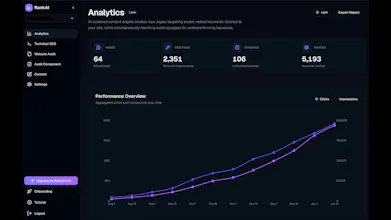
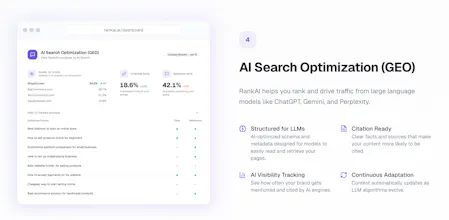
Analytics shows mention rate, share of voice, and citation rate across LLMs — that's the real GEO measurement layer
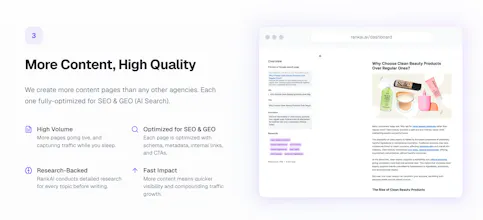
The content itself is GEO-optimized in ways that aren't obvious from the recommendations panel: schema markup, TL;DR sections, FAQ blocks, and unique value-add (information gain) baked into every page
So the GEO work is happening, we just haven't surfaced it well enough for someone at your level to see it on first pass. That's a UX failure, not a product gap.
On "is this for beginners": Today's onboarding flow probably feels that way. The deeper capabilities are real but the discovery is broken. Genuinely working on this.
If you're up for it, I'd love 20 minutes to walk through your actual account, show you the tabs that aren't surfacing well, and get your take on the GEO analytics. People doing serious GEO work like you are exactly who we want stress-testing what comes next.
https://calendly.com/rankai/demo
@boyuan_deng1 I think for B2B services it should work like this:
Website analysis and general recommendations (you already have this)
Identification of services and regions
Generation of commercial prompts for each service separately
Recommendations on what to do to rank at the top specifically for those commercial prompts
The general problem with all GEO services right now is that they evaluate overall visibility, whereas what’s needed is visibility by commercial prompts.
It’s the same principle as in SEO: there are informational keywords and commercial ones.
Curious how RankAI navigates Google's March 2024 scaled content abuse policy. A lot of programmatic SEO tools took big hits when Google started de-indexing auto-generated pages at scale. Is there per-customer differentiation in output, or a shared template layer and if the latter, how do you avoid the duplicate cluster trap when multiple customers target overlapping keywords?
@roymorken Right question to ask. Three answers:
Scaled content abuse policy: It targets unhelpful content at scale, not AI content per se. The sites that got wiped were prompt-and-publish at volume with no intent match. We avoid that by refusing to publish where intent is weak, and iterating on or killing non-performing pages so dead weight doesn't drag site quality. Our clients came through March 2024 fine.
Per-customer differentiation: Yes, real differentiation. RankAI pulls from each customer's own silos Google can't easily crawl (LinkedIn, X, code repos, CRM, internal docs) to introduce information gain specific to their POV. Two customers in the same niche don't produce the same page because their inputs aren't the same.
Duplicate cluster trap: Three guardrails: (1) topical authority is built around each customer's actual product and angle, not just keywords, so entry points diverge; (2) information gain layer is different per customer by design; (3) we won't take directly competing customers in the same niche, self-imposed limit.
No SEO tool is 100% safe from a future Google update. You build on the right side of the policy (helpfulness,
intent, information gain) instead of optimizing for whatever loophole is open. That's the bet 🙏
What's your stance on AI-generated content and Google's spam policies? How do you avoid getting penalized???
@haixin_qu
Super important question, and one more people in this space should answer directly.
Google doesn't penalize AI content. It penalizes unhelpful content at scale — which is what most AI SEO tools crank out by templating pages from a keyword list and hitting publish.
RankAI is built around three things that actually matter:
1. Information gain, not rehashing. Most AI content loses because it just recycles what's already on page one of Google. We pull from content silos Google doesn't easily access — LinkedIn, X, code repos, your CRM, internal docs — and surface insights that aren't already in the SERP. If your page doesn't add something new, it doesn't deserve to rank.
2. Intent matching — way more important than people realize. Google wants users to get a direct answer, not a 2000-word detour. A huge amount of "SEO advice" online still optimizes for keyword density and word count, when the real game is: does this page answer the exact question the user typed? We're ruthless about this.
3. Iteration, then more iteration. No first draft is ever good enough. The edge of our agent isn't "publishing content at scale" — every AI tool does that now. The edge is iterating on non-performing content at scale, which no agency and almost no tool actually does. Pages that don't work get rewritten, repositioned, or killed.
Our clients came through past 3 google core update fine while a lot of pure-AI-content sites got wiped. The difference wasn't who typed the words, it was the quality of output.
@haixin_qu @boyuan_deng1 Does iteration happen on all plans?
@haixin_qu @boyuan_deng1 @overemployeddave Hi Dave, iterations currently is only available for growth plans or custom plans.
The starter plan is meant for folks that want to get a sense of how RankAI works. Our margin unfortunately cannot justify us to iterate through all pages.
@haixin_qu
Good answer above, I’d add one thing:
Google doesn’t care if content is AI or not. It cares if users are satisfied.
Most AI content fails because:
it looks good but doesn’t actually answer the question fast
it’s generic, so users bounce
What works:
Give the answer immediately, then expand. Don’t make users dig.
Interesting. How are you measuring real buyer intent vs just driving traffic that doesn’t convert?
@becky_gaskell
This is where most SEO tools stop short.
We don't stop at driving impressions to your key pages. RankAI plugs into your GA4, GSC, and your actual business systems (CRM, revenue data, whatever you use) to close the loop on real conversion, not just traffic.
That means the agent isn't optimizing for impressions or rankings, it's optimizing for pages that actually drive revenue. A page that ranks #1 but brings in tire-kickers gets deprioritized. A page at #8 that converts 10% of its traffic into paying customers gets doubled down on.
Traffic is the vanity metric. Revenue is the one we actually care about.
@becky_gaskell We look at what the user is trying to do based on the query, not just the keyword.
High buyer intent usually shows up as:
“pricing”, “cost”, “quote”
“best”, “top”, “compare”, “vs”
“software”, “tool”, “service”, “agency”
branded searches or “alternatives to X”
These signal someone is close to making a decision.
Lower intent tends to be:
“what is”, “how to”, “guide”
broad informational queries
Those are useful, but usually earlier in the funnel.
So instead of just chasing volume, we prioritize queries where:
the intent is commercial
and the page can naturally lead to a next step (demo, signup, etc.)
@hugo_zhan That makes sense, focusing on intent over volume is key. I guess the real difference shows in how well those signals translate into consistent conversions over time.
Cool product! How much time does it give content pages before deciding they are performing poorly?
@yamanbicer
Thanks Yaman! We evaluate in stages rather than a single cutoff:
1. Indexed: we check within the first 1-2 weeks. If Google hasn't indexed it by then, it's a technical issue we fix before judging performance.
2. Ranked (showing up somewhere): usually visible by week 2-4. If a page isn't ranking for any of its target terms by then, we look at intent match and on-page fixes.
3. Ranked well (top 10-20 or pulling LLM citations): this is the 12-24 week window. If a page still isn't moving by then, we either rewrite it, merge it with a stronger piece, or kill it and redirect.
We run these checks every 2-4 weeks so nothing sits untouched. The goal is to catch underperformers early without pulling the plug before content has had a fair shot.
@yamanbicer Great question, It depends on how poorly it is. Usually it waits two to four weeks to make a decision.