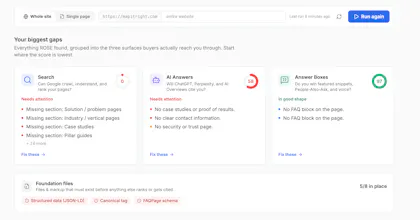
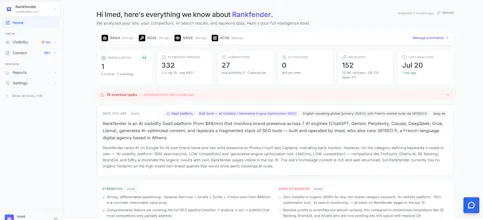
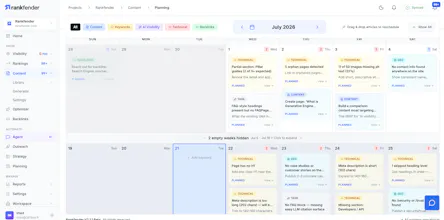
Rankfender helps Agencies and brands monitor and optimize AI-generated answers, generate keyword ideas and track their performance with their metrics, from which it automate SEO content publishing to WordPress, Shopify, and Wix, and optimize pages and content to make better data-driven decisions. Centralize AI visibility tracking and search optimization in one platform.
Great question about data freshness! Right now we do daily updates for AI citations. Each day, we scan ChatGPT, Google SGE, Perplexity, and Gemini for your target keywords and refresh the dashboard with the latest answers.
Why not real-time? AI answers shift constantly, and real-time tracking at scale gets chaotic (and expensive) fast. Daily refreshes give our users the perfect balance—fresh enough to spot trends and react quickly, without overwhelming them with noise.
That said, we're working on making certain high-priority keywords update more frequently. If real-time matters for specific use cases, definitely curious to hear!
Thanks again for the kind words—means a lot coming from someone who gets the agency journey 🚀
Report
Hey @imed_radhouani , good stuff here you got. Because of the way the search and discovery landscape keeps shifting, it has been mind boggling, even to develop a robust system to track, measure against roi, prompts to track and identify geo signals. Just curious, did you start getting users on an mvp or a prototype or a working product? I developed something quite close like what you did for rankfender and I have another one (but focus is more towards signals and bot agents) that I am planning to launch soon; more like grounded in research-based GEO and AEO as they both complement each other alongside technical seo and sxo.
@ladyintechverse Hey, appreciate the kind words—and even more, I appreciate the depth of your question. You clearly understand how messy this space really is.
To answer your question: We launched with a working product, but honestly? It was barely an MVP. We had the core tracking engine running across ChatGPT and Perplexity, basic dashboards, and a lot of hope. No content automation yet, no white-label, no multi-workspace. Just the ability to answer one question: "Does my brand show up in AI answers?"
What surprised us: People paid for that. Not because it was polished—it wasn't—but because they had no other way to get that answer. The pain was real enough that they tolerated the rough edges.
We built the rest (Topics, Personas, content generation, auto-publishing) based on what those first users kept asking for.
Your project sounds fascinating. Signals and bot agents is exactly where this is headed—GEO and AEO are just the beginning. Technical SEO + SXO + AI visibility is going to be the full stack eventually. Would love to see what you're building when you're ready to share.
What's your timeline looking like?
Report
I'm having a couple of issues, and I'm wondering to whom I can report them.
@billchirico Hey Bill! Just saw your comment—thanks for flagging this. Appreciate you taking the time to share feedback.
We already connected on Discord and during our meeting, but I wanted to follow up here too: I'm personally on it and will make sure everything gets sorted. You know where to find me if anything else comes up!
Thanks again for your patience and for helping us improve 🙏
Report
I've been testing Rankfender for about two weeks now, and I have to say—I was surprised.
Before this, I assumed my brand was showing up in AI answers. We rank #1 for most of our keywords in Google, so why wouldn't we?
Turns out, we were completely invisible in ChatGPT and Perplexity for half our target terms. No mentions at all.
The audit tool showed me exactly where the gaps were. I spent a weekend creating two comparison pages and adding an FAQ section to our main product page. Checked back a week later, and we started appearing in answers we never showed up in before.
Still early days, but I'm impressed. The automation part is next for me—curious to see how the content generation performs.
@joe_reda11 Wow, thank you so much for sharing this—and for actually testing it! 🙏
Your story is exactly why we built Rankfender. That gap between "we rank #1 in Google" and "we're invisible in AI answers" catches so many brands off guard. I love that you took action over a weekend and already saw movement. That's the kind of founder energy that wins.
Really curious to hear how the content automation performs for you. When you start generating, let me know if you want any tips on structuring comparison pages or FAQs—happy to help.
And seriously, thank you again. Feedback like this keeps us going.
@athanzhang Love this question! Gets to the heart of how we actually build the tech 🛠️
We use a hybrid approach:
1. Scheduled crawls (primary method). We run daily crawls across ChatGPT, Google SGE, Perplexity, and Gemini for each tracked keyword. We simulate real user queries from different geographies and capture the full AI-generated response. Think of it like a search engine crawler—but for AI answers instead of web pages.
2. Change detection algorithms. When we crawl, we don't just store the answer—we compare it to previous versions. Our system highlights:
New citations (your brand appeared where it didn't before)
Lost citations (you disappeared)
Sentiment shifts (positive → neutral → negative)
Source changes (which websites the AI is pulling from)
3. API integrations where available. Some platforms offer APIs that give us more direct access. Others we work with via partnerships. But for most, we rely on our proprietary crawlers.
4. Real-time vs. batch tradeoff. You're right—real-time detection would be ideal. But AI answers shift constantly, and crawling every keyword every minute would be prohibitively expensive (and many platforms would block us). Daily updates hit the sweet spot: fresh enough to spot trends, stable enough to be reliable.
The secret sauce? It's not just detecting that an answer changed—it's understanding what changed and why it matters for your brand. That's what we're really focused on.
Curious—how real-time would you need it to be for your use case?
Congrats 🔥 I really love the agency → product journey. Onwards and upwards!
I'm curious, how fast does the AI citation data update? Is it real-time or daily scrapes?
Rankfender
@ruxandra_mazilu Thanks so much! Really appreciate that 🙏
Great question about data freshness! Right now we do daily updates for AI citations. Each day, we scan ChatGPT, Google SGE, Perplexity, and Gemini for your target keywords and refresh the dashboard with the latest answers.
Why not real-time? AI answers shift constantly, and real-time tracking at scale gets chaotic (and expensive) fast. Daily refreshes give our users the perfect balance—fresh enough to spot trends and react quickly, without overwhelming them with noise.
That said, we're working on making certain high-priority keywords update more frequently. If real-time matters for specific use cases, definitely curious to hear!
Thanks again for the kind words—means a lot coming from someone who gets the agency journey 🚀
Hey @imed_radhouani , good stuff here you got. Because of the way the search and discovery landscape keeps shifting, it has been mind boggling, even to develop a robust system to track, measure against roi, prompts to track and identify geo signals. Just curious, did you start getting users on an mvp or a prototype or a working product? I developed something quite close like what you did for rankfender and I have another one (but focus is more towards signals and bot agents) that I am planning to launch soon; more like grounded in research-based GEO and AEO as they both complement each other alongside technical seo and sxo.
Rankfender
@ladyintechverse Hey, appreciate the kind words—and even more, I appreciate the depth of your question. You clearly understand how messy this space really is.
To answer your question: We launched with a working product, but honestly? It was barely an MVP. We had the core tracking engine running across ChatGPT and Perplexity, basic dashboards, and a lot of hope. No content automation yet, no white-label, no multi-workspace. Just the ability to answer one question: "Does my brand show up in AI answers?"
What surprised us: People paid for that. Not because it was polished—it wasn't—but because they had no other way to get that answer. The pain was real enough that they tolerated the rough edges.
We built the rest (Topics, Personas, content generation, auto-publishing) based on what those first users kept asking for.
Your project sounds fascinating. Signals and bot agents is exactly where this is headed—GEO and AEO are just the beginning. Technical SEO + SXO + AI visibility is going to be the full stack eventually. Would love to see what you're building when you're ready to share.
What's your timeline looking like?
I'm having a couple of issues, and I'm wondering to whom I can report them.
Rankfender
@billchirico Hey Bill! Just saw your comment—thanks for flagging this. Appreciate you taking the time to share feedback.
We already connected on Discord and during our meeting, but I wanted to follow up here too: I'm personally on it and will make sure everything gets sorted. You know where to find me if anything else comes up!
Thanks again for your patience and for helping us improve 🙏
I've been testing Rankfender for about two weeks now, and I have to say—I was surprised.
Before this, I assumed my brand was showing up in AI answers. We rank #1 for most of our keywords in Google, so why wouldn't we?
Turns out, we were completely invisible in ChatGPT and Perplexity for half our target terms. No mentions at all.
The audit tool showed me exactly where the gaps were. I spent a weekend creating two comparison pages and adding an FAQ section to our main product page. Checked back a week later, and we started appearing in answers we never showed up in before.
Still early days, but I'm impressed. The automation part is next for me—curious to see how the content generation performs.
Rankfender
@joe_reda11 Wow, thank you so much for sharing this—and for actually testing it! 🙏
Your story is exactly why we built Rankfender. That gap between "we rank #1 in Google" and "we're invisible in AI answers" catches so many brands off guard. I love that you took action over a weekend and already saw movement. That's the kind of founder energy that wins.
Really curious to hear how the content automation performs for you. When you start generating, let me know if you want any tips on structuring comparison pages or FAQs—happy to help.
And seriously, thank you again. Feedback like this keeps us going.
Copperlane
love this, but how are you detecting when an AI answer changes on SERPs?
Rankfender
@athanzhang Love this question! Gets to the heart of how we actually build the tech 🛠️
We use a hybrid approach:
1. Scheduled crawls (primary method). We run daily crawls across ChatGPT, Google SGE, Perplexity, and Gemini for each tracked keyword. We simulate real user queries from different geographies and capture the full AI-generated response. Think of it like a search engine crawler—but for AI answers instead of web pages.
2. Change detection algorithms. When we crawl, we don't just store the answer—we compare it to previous versions. Our system highlights:
New citations (your brand appeared where it didn't before)
Lost citations (you disappeared)
Sentiment shifts (positive → neutral → negative)
Source changes (which websites the AI is pulling from)
3. API integrations where available. Some platforms offer APIs that give us more direct access. Others we work with via partnerships. But for most, we rely on our proprietary crawlers.
4. Real-time vs. batch tradeoff. You're right—real-time detection would be ideal. But AI answers shift constantly, and crawling every keyword every minute would be prohibitively expensive (and many platforms would block us). Daily updates hit the sweet spot: fresh enough to spot trends, stable enough to be reliable.
The secret sauce? It's not just detecting that an answer changed—it's understanding what changed and why it matters for your brand. That's what we're really focused on.
Curious—how real-time would you need it to be for your use case?