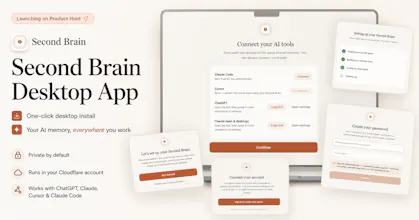
The decentralized architectural design introduces a unified Model Context Protocol (MCP) continuity layer that bridges fragmented AI clients like Claude, ChatGPT, and Cursor. By decoupling contextual memory from individual application vendor boundaries and hosting it directly inside the developer's personal Cloudflare account, the platform establishes an open-source, serverless state machine. It handles multi-hop recall, graph-based relationship synthesis, and hard duplicate detection down to the vector layer—leveraging Cloudflare Workers, D1 SQLite, and Vectorize to run semantic operations with 100% data ownership.
Second Brain for AI
Second Brain for AI
The team stuff got the headline. Here is what else went into v3.
Your memories are better at knowing how they relate to each other. Before, everything was connected to everything in the vaguest possible way, which is another way of saying nothing was really connected. Now a memory can know that one thing came after another, or caused it, or was the decision that settled it. It also stopped connecting near-identical notes to each other and calling that an insight.
Setup got a proper going over. We had people who were not me try to install it and write down every place it annoyed them, which was humbling and useful in that order. It now checks it is pointing at the right account before it starts making changes, warns you properly before anything irreversible, and works in Italian.
If someone invites you to a team, you get an actual product rather than a wall of "admins only". You can see who wrote what and when. Invites work without you explaining them in Slack afterwards.
Code: github.com/rahilp/second-brain-cloudflare
Dial
the private-by-default, share-on-request model is the right instinct, but I'm not sold on the edges yet. what happens to someone's private memory when they leave the team - deleted, orphaned, or does it need an explicit handoff? and since "remember this and share with the team" is just a phrase decided in the moment with no separate review step, what stops someone from assuming something was shared when it wasn't, once there's no UI to double check after the fact?
Second Brain for AI
@galdayan Yep, we handle both of these explicitly.
When someone is removed, their private workspace is deleted with them. Anything they already shared stays in the team layer, with the original attribution preserved in the audit trail. There’s also a separate suspend option that cuts access without deleting their data.
And private vs shared isn’t just something you have to infer from the conversation. The UI has explicit private/shared layers, shared-state indicators and controls to share or make memories private again. The graph uses the same layer distinction, and admins have an activity/audit view. Underneath that, the boundary is enforced at the query layer, so even an admin can’t recall, list or search another member’s private memories.
DocsAlot
great product, congrats on the launch.