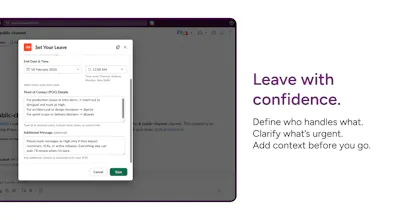
Ever returned from vacation to 50+ Slack notifications with zero clue what's urgent? Slackoff solves this. When you're on leave, teammates mark messages High or Low priority. High = backup contact shown immediately. Low = logged for later. You return to a clean, organized summary (urgent first, noise grouped separately) instead of spending 2 hours sorting chaos. Self-hosted ($99 lifetime), your data never leaves your servers. Built by a designer who got tired of leave anxiety.
No reviews yetBe the first to leave a review for Slackoff
Maker
📌
Hey Product Hunt! 👋
I'm Ram, a product designer from India who got fed up with post-vacation Slack chaos.
The backstory:
I returned from my first real vacation in months to 68 Slack notifications. Spent 2+ hours sorting through them trying to figure out what was actually urgent vs. "hey just FYI."
I thought: there HAS to be a better way. So I built SlackOff.
Validated with 20+ user interviews - Product Managers, Engineers, and Designers who all face the same problem. 38% cited post-vacation notification chaos as their #1 Slack pain point.
What makes it different:
Most leave tools just track "who's out." SlackOff solves what happens DURING leave and AFTER you return:
✅ Auto-responds when you're tagged
✅ Makes teammates prioritize (High vs Low) - 82% pick Low when they actually think about it
✅ Shows backup contact only for urgent items
✅ Returns a clean summary (urgent first, noise grouped separately)
✅ NEW: Calendar view - see who's on leave across your team at a glance
Who is this for:
Built for high-dependency roles where being unavailable blocks work:
👨💼 Product Managers (approvals, decisions, context)
👩💻 Engineering Leads (architecture decisions, code reviews)
🎨 Design Leads (feedback, approvals, design systems)
💼 Finance/Ops (approvals, critical requests)
Why different from existing tools:
❌ PTO trackers = just log days off, don't solve communication chaos
❌ Slack status = people ignore it, no prioritization, you still return to mess
✅ SlackOff = Built for growing teams (100-800 people) who need leave management that actually works without enterprise complexity
Why self-hosted:
🔒 Your Slack data never leaves your servers - complete privacy & control
💰 $99 one-time payment - no per-user SaaS fees, no recurring costs
🛠️ Full source code access - customize for your team's specific needs
⚡ 5-minute setup - works in all channels (private and public) immediately
Perfect for: Mid-size remote/hybrid teams (100-800 people) where enterprise tools are overkill but Slack chaos is real.
I'd love your honest feedback on:
Is the priority system too much friction? (asking senders to mark High/Low)
What features am I missing?
Would you actually use this, or am I solving a problem only I have?
🎁 Product Hunt Exclusive:
✨ 10% additional discount for PH community - Use code PH10 at checkout
Building in public, learning as I go.
Report
@mryeshwanth This is painfully relatable! 😅 Coming back from vacation and trying to reconstruct what was actually urgent vs. just looping you in is exhausting. I really like the idea of structured prioritization and the clean summary when you return. That alone feels like a huge mental relief.
Do you see any risk in people over-marking things as “High”? In my experience, almost everyone feels their request is urgent – but in the bigger context, it often isn’t. Are you thinking about any guardrails (limits, nudges, patterns over time) to prevent priority inflation?
Overall, this feels like a very real problem and a thoughtful way to approach it. Definitely gonna give it a try!
When people are forced to choose, the psychology shifts. Turns out ~72% mark things as Low in initial validation when they actually have to click a button and think "is this really urgent?"
I observed two patterns:
1. The nudge effect - Just seeing "Is this High or Low priority?" makes people self-reflect. In early testing, people told me they felt slightly embarrassed marking routine questions as High when they had to consciously choose. That social friction is actually the feature.
2. The ignore pattern - When people casually drop FYI messages and ignore the priority prompt, the system auto-marks it Low after 4 hours. So laziness defaults to Low, not High.
Still Validating: The learning loop - If someone consistently marks everything High, I'm exploring nudges:
- "You've marked 8/10 messages High this week. Are you sure this is urgent?"
The key insight: Priority inflation happens when there's NO system. When you add friction + social accountability, behavior changes.
This is exactly the kind of thoughtful feedback that helps me build a meaningful solution, would love to stay in touch as you try it and see how the priority system holds up in practice.
Really appreciate the thoughtful question! Let me know what you think after trying it 🙏
Report
@mryeshwanth Thanks a lot for the detailed reply! I really appreciate you sharing the thinking and early data behind it.
The friction + social accountability angle makes a lot of sense. Just forcing a conscious choice can genuinely shift behavior. And the 72% stat is super interesting! I also love the default-to-Low logic when people ignore the prompt – that’s such a smart design call. Laziness defaulting to Low instead of High is brilliant!
From my experience, systems usually break because they assume perfect rational behavior. What you’re describing feels much more grounded in how people actually act. 🙂
I’ll definitely try it myself in practice! 🙂
Report
Maker
@tereza_hurtova Thanks so much! Really appreciate you getting it. Exactly, I'm designing for how people actually behave, not how they "should" behave. That's where most systems break.
Would love to hear how the priority system holds up when you try it in practice. Your feedback will help shape what comes next!
Report
Really like the idea of eliminating a ton of noise and surfacing the important stuff first when you’re back from vacation. Very relatable problem. Big fan of code access, one-time pricing too. Looking forward to trying this.
Have you seen any interesting behavior changes with the High/Low prioritization?
Report
Maker
@dharmendra_shaw Thanks! Really appreciate that. On behavior changes - the most interesting one is the "self-audit effect." People who mark something High tend to scroll up and check "wait, did I mark too many things High this week?" The system creates accountability without me enforcing anything. Would love to hear what patterns you notice when you try it!
Report
Really helpful tool to keep track for notifications after long leave.
@mryeshwanth This is painfully relatable! 😅 Coming back from vacation and trying to reconstruct what was actually urgent vs. just looping you in is exhausting. I really like the idea of structured prioritization and the clean summary when you return. That alone feels like a huge mental relief.
Do you see any risk in people over-marking things as “High”? In my experience, almost everyone feels their request is urgent – but in the bigger context, it often isn’t. Are you thinking about any guardrails (limits, nudges, patterns over time) to prevent priority inflation?
Overall, this feels like a very real problem and a thoughtful way to approach it. Definitely gonna give it a try!
@tereza_hurtova Great question!
What I have so far:
When people are forced to choose, the psychology shifts. Turns out ~72% mark things as Low in initial validation when they actually have to click a button and think "is this really urgent?"
I observed two patterns:
1. The nudge effect - Just seeing "Is this High or Low priority?" makes people self-reflect. In early testing, people told me they felt slightly embarrassed marking routine questions as High when they had to consciously choose. That social friction is actually the feature.
2. The ignore pattern - When people casually drop FYI messages and ignore the priority prompt, the system auto-marks it Low after 4 hours. So laziness defaults to Low, not High.
Still Validating:
The learning loop - If someone consistently marks everything High, I'm exploring nudges:
- "You've marked 8/10 messages High this week. Are you sure this is urgent?"
The key insight: Priority inflation happens when there's NO system. When you add friction + social accountability, behavior changes.
This is exactly the kind of thoughtful feedback that helps me build a meaningful solution, would love to stay in touch as you try it and see how the priority system holds up in practice.
Really appreciate the thoughtful question! Let me know what you think after trying it 🙏
@mryeshwanth Thanks a lot for the detailed reply! I really appreciate you sharing the thinking and early data behind it.
The friction + social accountability angle makes a lot of sense. Just forcing a conscious choice can genuinely shift behavior. And the 72% stat is super interesting! I also love the default-to-Low logic when people ignore the prompt – that’s such a smart design call. Laziness defaulting to Low instead of High is brilliant!
From my experience, systems usually break because they assume perfect rational behavior. What you’re describing feels much more grounded in how people actually act. 🙂
I’ll definitely try it myself in practice! 🙂
@tereza_hurtova Thanks so much! Really appreciate you getting it. Exactly, I'm designing for how people actually behave, not how they "should" behave. That's where most systems break.
Would love to hear how the priority system holds up when you try it in practice. Your feedback will help shape what comes next!
Really like the idea of eliminating a ton of noise and surfacing the important stuff first when you’re back from vacation. Very relatable problem. Big fan of code access, one-time pricing too. Looking forward to trying this.
Have you seen any interesting behavior changes with the High/Low prioritization?
@dharmendra_shaw Thanks! Really appreciate that. On behavior changes - the most interesting one is the "self-audit effect." People who mark something High tend to scroll up and check "wait, did I mark too many things High this week?" The system creates accountability without me enforcing anything. Would love to hear what patterns you notice when you try it!
Really helpful tool to keep track for notifications after long leave.
@aditya_pathak3 thank you for the support.