

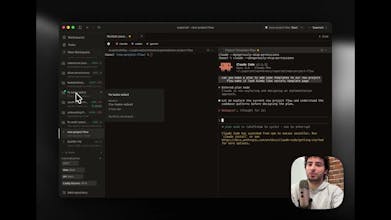
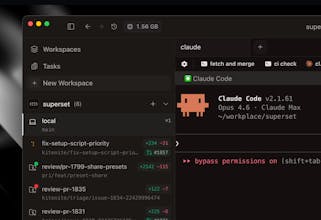
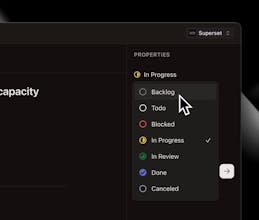
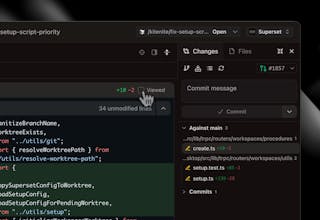
Superset is a turbocharged IDE that allows you to run any coding agents to 10x your development workflow. - Run multiple agents simultaneously without context switching overhead - Isolate each task in its own sandbox so agents don't interfere with each other - Monitor all your agents from one place and get notified when they need attention - Review changes quickly with built-in diff viewer and editor Wait less, ship more.




@flyakiet congrats on the launch, having the ability to run multiple agents is good and bad as well from my experience as of now. Good in sense of ability to execute multiple task all at once sounds good until all task are from one project but from different project its fine. Now here's the bad part : Assuming I'm building an app which has 10 different screen so at one point if all 10 screens are totally independent (very rare) this will work but if all 10 screens are dependent then those agents splits tons of errors (can be mostly solved through a orchestrator model) but the accuracy it brings vs using single agent workflow is less until speed is top most priority over the accuracy.
Here's what I faced in details (even I used openClaw) so earlier I was trying to run multi-agentic programming but it has lot of hidden bugs and issue so I shifted back to single agent -> verify the todo (move to next todo) -> pass on to next agent -> verify the work (move to next todo) -> keep on, instead of plan -> orchestrator -> multi agent triggers.
-> And from my perspective @Superset is cursor but with multiple open project windows into single one, So I highly doubt it'll sustain itself in longer run until its solving the problem of working on multiple project all at once, which is not a problem at all.
Because multi-context scaling inside one complex project is the biggest problem is what I faced.
Here's how you can make it more usable : maximum agents breaks as the task context increases -> creates more error and takes more resource.
For example : If I created a agent to finish one work, and I keep adding more to that feature so it'll hit the context limit, but what if you can use multi agent context window and give them some % of work with related context. -> this will not get triggered in the starting of any project but only when the context is about to end. (cursor is using summary feature (context is about to end -> summaries it -> then move it to next context window -> but still its inefficient and expensive for the larger tasks).
so what if -> at starting of the project 10 agents are there (each agent has 200k context length so total avail. length = (200 * 10) 2M) but it'll not use all at once instead -> start the task with first agent -> if agent is about to hit context -> orchestrator -> see the pending work -> send it to other agents -> gets the response -> verify the work -> send it to other agents -> keep it until the task accomplished or the combined limit exceeds. (kind of I opened up a factory and hiring worker based on the needs one by one instead of assigning all at once - which creates the issue if I'm working on complex task).
and Lets say 2M is also not enough so just add more agents and follow the same pattern.
so think of it like you're having the RAM of 128GB but you're not loading it all at once which is expensive instead using it as per the need.
Best wishes @flyakiet .
Waiting for your next major update .
The parallelization angle here is what's genuinely interesting — context-switching between agents is still such a bottleneck, and running them concurrently on local hardware rather than routing through some cloud orchestration layer feels like the right architectural instinct. Building with Claude Code ourselves for invoice parsing workflows, the biggest pain point isn't the model quality, it's managing concurrent tasks without them stepping on each other. How are you handling shared file system conflicts when multiple agents are working in the same repo simultaneously?
As a non-technical user, I want to give the team an overview of how I ended up using this product. I, like many people, started using agentic workflow from Claude Code in the terminal. But I find myself having to keep typing the right pathway to a project and launch Claude Code from there to be quite cumbersome. So then I progressed on to cursor, which I actually use Claude Code only in the terminal as well because cursor allows me to just start the app and get going each time. I could also navigate the file directories easily, I can see the output and the diffs it made. So for quite a while cursor remains my tool of choice. I chose Cursor instead of VS Code just in case one day I would like to use different LLM models within Cursor itself. Then I came across superset, whose idea of launching multiple agents appeal to me a lot. The pain point is really trying to work sequentially with a single Claude Code instance and waiting for the agents to complete their tasks, and they don't even alert me when done. So while I have heard of Conductor, I think Superset seems to be easier to use and doesn't tax CPU resources as far as I know. Now I just started using it and I think this is going to be my default from now on.
Again I emphasize as a non-technical user, what confuses me a little is how do I get a Git Worktree launch? Does having a new workspace equal a Git Worktree? There are also tabs and window panes so while I can see the benefits of using panes and perhaps also tabs, it would be just a little confusing as to when to use each because they seem to work similarly? Just in different views? I think this product is super straightforward for a technical user as to its strengths and benefits, but for a non-technical user I think the team could do better to onboard or explaining them. I watch all your YouTube videos but really you guys just jump straight into the thick of action. And so far no other channels or influencers have started talking about you guys, whom I was hoping to learn something from in terms of optimizing my workflow with superset.
Right now, I will try and figure out as much as possible and stick with it. Hopefully this will provide some food for thought and maybe help in your future development of the product?
Pitstop
Been a power user. These folks ship so fast I get an update every day!
Superset
@aidan_pratt thanks for the support!
Congrats on reaching #1 today, Superset team! The ability to run multiple coding agents without context switching is a game-changer for speed. As a developer building a PropTech SaaS (ParkEase) with React Native and Python, I can see how this would have saved us tons of hours during our latest sprint. Question: Does it support custom sandboxes for private Python libraries? Good luck with the launch!
Superset
@marcos_bazan Eventually we plan on it!
Supaboard AI
Congrats on the launch!
Superset
@deepak_singh09 thanks Deepak!
Worktree isolation per agent is the key design choice here. Without it, parallel agents would constantly step on each other's changes. The persistent daemon surviving crashes is a nice touch too. How are you handling merge conflicts when multiple agents edit overlapping files?