
The Map of Human Ideas
Discover where the world’s greatest ideas were born
590 followers
Discover where the world’s greatest ideas were born
590 followers
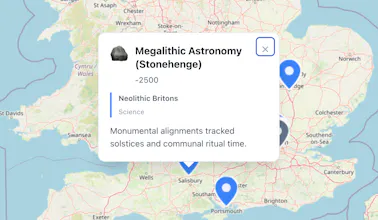
Ever wondered where the world’s biggest ideas came from? The Map of Human Ideas visualizes over 250 discoveries, philosophies, and inventions across centuries. Each point on the map marks the origin of an idea that changed our collective story. Built as a side project to celebrate curiosity and creativity.


I wonder how come you did not include not even one in Croatia 😨
Just to name a few a bit more significant ones:
Nikola Tesla - Alternating current mother of all the technology in modern times
Faust Vrancic - Parachute
Ivan Vucetic - Fingerprint identification system
Josip Belusic - Speedometer
Slavoljub Penkala - Mechanical Pencil & Fountain Pen
Ivan Blaz Lupis - Torpedo
necktie - originally worn by Croatian soldiers and adopted as fashion piece
@tonci4 thank you so much for pointing that out!
you’re absolutely right, Croatia has an incredible legacy of innovators, and I should definitely represent that.
I’m adding entries for Tesla, Vrancic, Vucetic, and others in the upcoming dataset revision. really appreciate you noticing this gap 🙌
@tonci4 hi! I have updated the dataset to include key Croatian contributions, and will definitely make further additions for further releases to create a more comprehensive list. Thanks again
@tonci4 I was going to suggest Dactilography by Vucetich as an Argentinian invention, since he was already living there when he developed it! I think that one is definitely an Argento-Croatian invention!
@tonci4 @juan Then put Tesla in New York. To put him in Zagreb is an offense to his family legacy. He was born in Austria-Hungary, on the territory of current Croatia, as a descendant of a Serbian family. Almost 100 members of his family were killed by the Croatian army during WW2. So its best to say he was American, where he found better life, instead of provoking arguments.
@juan @filip_ilic1
Reading my initial comment would really help before commenting and going down the ugly path of history.
I never suggested that Tesla should be placed in Zagreb. I’m very well aware of his life, and I’d be perfectly fine with him being shown on the map anywhere he ever set foot - it still wouldn’t do justice to everything he achieved
Before trying to spark argument and provoke, it would really help to read 😁
“I am equally proud of my Serb origin and my Croat homeland.” 😉
@juan @tonci4 My intention was to suggest a solution that would avoid provocation. We both know how sensitive this topic.
Cool idea. Great launch!
Can we add other inventions? Maybe integrate from Wiki (another option)
Also, adding search and filter would make it more friendly.
@chilarai i will have a look, thank you for your feedback
Dude, this is insane, but I like it!
Here is my question: What should I do if I want to get in touch with some idea owner who left 0 contact info?
@rylynn You are absolutely right. This is my first launch so i am still learning. You can contact me via zudiay.dev@gmail.com
@jollytango Esp. for Slovakia, many people do now know where my country is, not talking about things we have :D
这是我见过比较糟糕的产品之一,原因如下:
1、地图移动非常笨拙。放大到一个级别后,滚轮缩放直接失灵,只能靠键盘,这在人机交互(HCI)和交互一致性上是硬伤。谷歌地球早就把滚轮缩放、惯性平移这套交互范式固化为行业标准,你这边却强迫用户改学习成本,典型的高认知负荷、低可用性(Usability)和差 UX。
2、每个点子点开就三行字,信息密度极低;时间戳不准,分类还行,解释却语义模糊。用户来是找知识,不是看简介。至少要有基本的信息架构(IA)、术语表与一致的字段:时间精度、地点粒度、事件描述、参考来源。现在这套内容模型和元数据设计几乎为零。
3、没有任何链接,完全断了引用链路。没有外部引用、来源可追溯(Traceability)、版本记录和DOI/URL锚点,用户怎么判断权威性与可信度?起码要有参考文献、数据出处、API/数据集链接与校对记录。
4、没有互动。用户只能干看地图,然后呢?没有反馈入口、众包补充通道、审核机制和反馈闭环,也没有像wiki那样的协作工作流与权限模型。看起来想中心化做“权威”,但既无专业编辑规则,也无社区共建,可信度自然崩。
5、UI呆板,整体像2000年的风格。2025了,起码该有清晰的视觉层级、排版系统、响应式布局、可访问性(a11y)、可读性优化、状态提示、深浅色模式,以及一致的设计语言与组件库,不是随便拼。
6、数据库使用完全失败。用户当然想按国家/地区(地域维度)、时期(时间维度)、主题/学科(主题维度)去探索人类贡献,看看哪个时期大爆炸、哪些区域贡献集中,这需要基本的维度建模、事实表/维度表设计、时空索引与聚合分析,而不是只给学科分类。缺少筛选/聚合、时序分析、地理可视化(如热力图)、探索路径设计,结果就是20秒就关闭走人,留存与转化直接见底。
This is one of the worst products I’ve seen, for the following reasons:
1. The map interaction is extremely clumsy. Once you zoom in to a certain level, the mouse wheel stops working—you have to rely on keyboard controls. From a human–computer interaction (HCI) and interaction consistency standpoint, that’s a fatal flaw. Products like Google Earth have long standardized zooming and panning behaviors; forcing users to relearn a less efficient model creates high cognitive load, poor usability, and a terrible UX.
2. Each marker opens to just three lines of text—information density is near zero. The timestamps are inaccurate, the categorization is passable, but the explanations are vague. Users come here to learn, not to read short blurbs. There’s no information architecture (IA), terminology consistency, or metadata schema—no proper fields for time precision, spatial granularity, event description, or source attribution. Essentially, the content model and metadata design are nonexistent.
3. There are no links at all, which completely breaks citation traceability. Without references, external sources, version history, or DOI/URL anchors, there’s no way to assess credibility or authority. At minimum, there should be citations, dataset/API references, and validation records.
4. No interactivity whatsoever. Users just stare at the map—then what? There’s no feedback form, no crowdsourced contribution channel, no moderation workflow, and no collaborative editing system like a wiki. It looks like the author wanted central control, but without editorial standards or expert governance, it fails both professionally and socially.
5. The UI is rigid and outdated—straight out of the 2000s. It’s 2025; at least provide a coherent visual hierarchy, typographic system, responsive layout, accessibility (a11y) compliance, readability optimization, state indicators, dark/light modes, and a consistent design language with reusable components. Right now, it looks like a prototype frozen in time.
6. The database design is a complete failure. Users naturally want to explore by country/region (spatial dimension), time period (temporal dimension), or topic/discipline (thematic dimension) to see patterns—like which eras had explosive innovation or which regions made key contributions. That requires dimensional modeling, fact/dimension tables, spatiotemporal indexing, and aggregation logic. Instead, you only provided subject-based categorization. No filtering, aggregation, temporal analysis, or geographic visualization (e.g., heatmaps). No exploratory pathways. Result: users close the tab in 20 seconds, retention and engagement hit rock bottom.
Where do you get your data from? Interesting data foundation that basically completely erases African thinkers and innovators.