

Vozo AI — Video localization
Translate every layer: voice, subtitles & on-screen text
4.5•13 reviews•3.3K followers
Translate every layer: voice, subtitles & on-screen text
4.5•13 reviews•3.3K followers
Vozo AI delivers complete video translation — across voice, subtitles, lip-sync, and on-screen text.
Unlike traditional dubbing tools, Vozo translates every layer while keeping speech natural, lips perfectly synced, and visuals consistent. Turn one video into multilingual versions that look and feel native.
This is the 3rd launch from Vozo AI — Video localization. View more
Visual Translate by Vozo
Launched this week
Fully translated videos — finally.
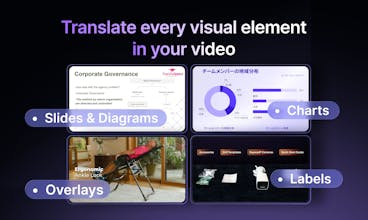
Visual Translate adds the final layer — translating text inside videos — on top of voice dubbing, lip-sync, and subtitles. It detects and translates on-screen text, from slides and diagrams to callouts and labels, while preserving the original layout, style, and animation. Turn slide videos and explainers into multilingual versions and reach a global audience — without recreating visuals from scratch.





Free Options
Launch Team / Built With


Elser AI
How well does Vozo handle animated text or kinetic typography?
Vozo AI — Video localization
@stella_yu5 Good question.
In the current beta version, we mainly support entry and exit animations for on-screen text. For kinetic typography or text that keeps moving within the frame, the results may not be perfect yet.
Visual Translate currently works best with videos like slides and explainers, where text animations are relatively simple. Supporting more complex motion is something we’re actively working on next.
Vozo AI — Video localization
@stella_yu5 Hi Stella, thanks for your question! Here’s a demo of a Gemini intro video we translated. It’s very close to the use case you mentioned, so feel free to check out the result.
Vozo AI — Video localization
@stella_yu5 Thanks for the great question! In the current beta, complex motion like kinetic typography may not always translate perfectly. We’re actively working on updates to improve support for more advanced animations.
Vozo AI — Video localization
@tereza_hurtova Thanks! Our system tries to preserve the original styles and positions of the text as much as possible so that the translated result looks similar to the original video.
For complex slides, the results can vary. In most cases the system works well, but there may still be some artifacts when text appears on heavily moving or complex backgrounds.
Mixed languages are a great point as well. Currently, users need to select the primary source language, and text in other languages may not be automatically translated. However, we provide a “re-recognize” feature, which allows you to select a specific region for additional detection. This will add the newly detected text into the text layer so it can also be translated.
Vozo AI — Video localization
@angolin64 Thanks! While our AI model can fully understand the text animations in a video, we currently support intro and outro animations best.
We’re actively working on solutions to handle other types of animations as well, such as translation and scaling effects. Stay tuned!
Tonkotsu
Congrats on the launch! This is really cool. How do you think about realtime translation? I can see this being useful at conferences and live events.
Vozo AI — Video localization
@derekattonkotsu Thanks! Real-time translation is definitely an exciting direction, especially for conferences and live events.
Right now we focus mainly on post-production video localization, where accuracy and layout reconstruction are critical for translating subtitles, dubbing, and on-screen text together. Real-time scenarios introduce additional challenges around latency and visual reconstruction, but it’s something we’re actively exploring for the future.
Smart call starting with slide videos and explainers. Those are the ones where the on-screen text basically IS the content. Quick question though, how does the editable text handle cases where the translated version is way longer than the original? Like English to German where labels can almost double in length. Does it auto-resize or does someone need to go in and adjust the layout?
Vozo AI — Video localization
@juelz Great question. This happens quite often when translating between languages like English and German.
Vozo analyzes all the text elements in the frame and understands their layout. After translation, it recalculates the placement and size of the text to generate a new layout that fits the translated content as naturally as possible.
Everything remains editable in the editor, so you can still adjust wording, font size, or positioning if you want to fine-tune the layout.
Vozo AI — Video localization
A small backstory on how Visual Translate started.
The idea goes back to October 2025. Around that time we noticed that many great educational videos weren’t being translated well. A big reason was that a lot of key information wasn’t only in the narration, but in text inside the visuals — slides, diagrams, labels, and callouts.
When we looked at existing video translation tools, we realized that this layer was still largely unsolved.
So we decided to try building it.
Huge credit to our engineer Naro. She started experimenting with the idea back in October and built the very first prototype and pipeline herself. The demo she showed the team was still rough, but the results were already surprisingly impressive.
Naro is honestly one of those engineers who are both brilliant and delightful to work with — sharp, curious, and incredibly creative when exploring new ideas. That early experiment she built convinced us this was worth turning into a real product, and the rest of the team quickly rallied around the idea.
Vozo AI — Video localization
The project was officially green-lit in December, when we started the actual product design. Our founder CY, Tech Lead Fei, and I worked closely together to define the product direction and what Visual Translate should really be.
I also want to give a big thanks to our former engineer Yetong, who co-created the editor UX with me. Building the editing experience was one of the most challenging parts. There really wasn’t anything comparable on the market to reference.
Designing something this new has been incredibly exciting for me. I’m genuinely proud that we were able to create an editor that makes this workflow possible.
Vozo AI — Video localization
After the project was officially started, a huge part of the work moved into the modeling and engineering side.
I want to give special thanks to our algorithm engineers Xin Jin, Pengfei, and Boya. They built and shipped the models and pipelines behind this feature.
Handling text inside videos is actually a very challenging problem. The text can appear in many different forms — different languages, fonts, layouts, styles, and even animations. Every video can present a new combination of cases.
Thanks to their work, we’ve already gone through three iterations of the system, and each version has become more stable and more accurate.
They are truly brilliant algorithm engineers, and their work laid a strong foundation for this entire project.
Vozo AI — Video localization
Another person we’re deeply grateful to is our Tech Lead Fei.
He designed the core text layout algorithm behind Visual Translate. When translating from one language to another, the length of the text often changes significantly. Making sure the translated text still fits naturally in the video while keeping the visuals clean is not trivial.
It becomes even more complex when there are multiple text elements on the same frame — their spatial relationships and layout all need to be preserved.
Fei’s algorithm makes this possible. It ensures the translated text can be reflowed and presented properly inside the original visuals. His work played a key role in making the whole system usable in real-world videos.
Vozo AI — Video localization
I also want to thank the engineers who made the product actually come to life.
Our frontend engineers Junjun and Kiya built the entire frontend workflow and the Visual Translate editor. As mentioned earlier, this is a completely new type of product — there wasn’t really anything similar on the market to reference. Many of the interactions and editing behaviors had to be designed and implemented from scratch.
Their work turned these ideas into a real, elegant editing experience. The editor you see today — smooth, intuitive, and flexible — would not exist without their craftsmanship and attention to detail.
I also want to thank our backend engineer Lucas. He built the backend architecture for this feature almost entirely by himself. At the same time, he was also responsible for several other feature developments across Vozo, which made the work especially demanding.
Despite that, he managed to design and implement a solid backend foundation for Visual Translate. We’re very grateful for his dedication and the reliability of the work he delivered.
Finally, I want to give another special thanks to Naro, who served as the engineering lead for this entire project.
Her role went far beyond frontend development. She was deeply involved in shaping the overall technical approach — from algorithms and pipelines to the product workflow. She also coordinated engineering progress across the team and kept the project moving forward.
Thanks to her leadership and persistence, the whole project was delivered on time and at a very high quality. We’re incredibly grateful for everything she contributed to making Visual Translate possible.
Vozo AI — Video localization
We’d also like to thank our QA engineers Menghan and Meixia, who were responsible for testing this entire feature.
As a brand new product, there were many aspects that needed to be tested — from product logic and interaction flows to algorithm performance and the quality of the generated results.
The first version of this feature was especially challenging. The system went through multiple rounds of model and algorithm updates, and the behavior could change significantly between iterations. That made the testing process far more demanding.
Thanks to their persistence and attention to detail, we were able to keep improving the system while maintaining stability. Their work played a crucial role in making sure Visual Translate could launch on time with reliable quality.
Vozo AI — Video localization
I’d also like to thank our website designer Ushuan. She led the upgrade of our entire website’s visual design and was almost entirely responsible for the design, build, and implementation herself.
For example, the landing page for Visual Translate was designed and built by her. She turned a complex product concept into a clear and elegant presentation that helps people quickly understand what this feature can do.
If you’re curious to see it, take a look here:
https://www.vozo.ai/visual-translate
The onboarding experience is seamless, the UI is exceptionally well-designed, and the final results are impressive. Excellent work on this, though the queue time seem long, i guess it has to do with the launch day traffic
Vozo AI — Video localization
@x_ronxo @x_ronxo Thanks a lot for the kind words!
There actually isn’t a queue on our side. The waiting time mainly comes from processing the video visuals themselves, so depending on the video length and complexity it may take a bit of time to finish.