
X-Pilot
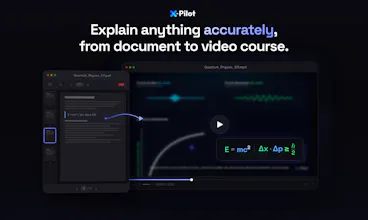
Explain anything accurately, from document to video course
714 followers
Explain anything accurately, from document to video course
714 followers
X-Pilot turns docs into video courses for people who explain anything and can't risk hallucinations. Every visual is rendered programmatically via Remotion in isolated sandboxes — deterministic, not generative. Formulas, diagrams, and code stay accurate.






When you mention 'knowledge visualization,' do you mean preset templates or support for custom styles? If I want to make the video in a minimalist style or with a brand color scheme, can I adjust that?
@eeeeeach When we say “knowledge visualization,” we mean the system extracts the underlying ideas and relationships from your material and presents them using structured visual components (charts, diagrams, step‑by‑step visuals, etc.) so the viewer can grasp the content intuitively—not just narration over generic b‑roll.
On styling: The product includes six built‑in video styles you can choose from up front: Auto Style, Clean Lecture, Science Explainer, Professional Training, Product Showcase, and Cinematic Story. For colors and logo, you configure your Brand Kit so the palette and branding stay consistent across scenes.
If the first draft still isn’t visually “on‑brand,” you can usually adjust it with plain‑language feedback (e.g., “switch to a cleaner lecture style,” “more cinematic,” “use our primary blue for accents” ).
What impressed me most is the pedagogical intelligence. X-Pilot doesn't just convert text to video — it structures content using Bloom's Taxonomy principles with proper scaffolding. The AI Syllabus Generator alone saved me 8 hours on my last course design. For anyone in instructional design, the learning objective mapping feature is worth the switch.
@libin_yao Thank you
We’re thrilled you felt the pedagogical intelligence land in practice: that X‑Pilot isn’t just “text → video,” but that it helps structure learning with proper scaffolding—and that the AI Syllabus Generator and learning‑objective mapping saved you meaningful time on course design.
Why Bloom’s Taxonomy is part of our design (not just a buzzword)
Bloom’s Taxonomy is essentially a cognitive ladder: it describes how understanding deepens from remembering facts → grasping meaning → using ideas in new situations → breaking problems apart → judging tradeoffs → creating something new. Instructional videos fail most often when they skip rungs—jumping straight to flashy conclusions while learners still lack definitions, mental models, or worked examples.
We use Bloom‑aligned principles because good teaching is sequential: you scaffold prerequisites, release information at the right pace, and align visuals and narration with the learner’s current cognitive step—not only what “sounds smart” in a script. That’s also why features like learning‑objective mapping and an AI syllabus generator matter: they help translate “what the course must achieve” into a coherent progression (what to introduce first, what to practice next, what evidence of mastery looks like), instead of producing a narrated slide deck that mentions everything but teaches nothing.
Thanks again for taking the time to share your experience.
As a physics professor, I've always struggled to turn my LaTeX-heavy lecture notes into video. X-Pilot nails the formula rendering — every equation is programmatically rendered, not some blurry AI-generated image. I converted a 40-page quantum mechanics PDF into a 6-chapter video course in under an hour. My students' exam scores went up. This is what "accuracy-first" actually looks like.
@anthony_cai Thank you so much for sharing this
For equation accuracy, we don’t “guess” math from pixels. We carefully parse the document and route formulas through a purpose‑built, formula‑focused visual pipeline so expressions are programmatically rendered (crisp, consistent, and reproducible) rather than being approximated as blurry generated imagery. That’s what we mean by accuracy‑first: the video should preserve the same mathematical objects your students need to trust on exams.
We’re also really glad the 40‑page → structured multi‑chapter course workflow saved you time — and it’s wonderful to hear your students benefited.
Thanks again for taking the time to write such a detailed note.
does this actually prevent hallucinations in the formulas and diagrams, or just reduce them? been burned before by AI-generated math visuals that looked right but werent. the Remotion approach sounds promising tho
@lumm To ensure absolute accuracy, we have implemented a four-layer verification process—spanning from the data source to code generation, animation rendering, and finally, the export stage.
The "Expert Paradox" is real — I see it constantly in finance. The best modelers often produce the worst training materials because they skip steps they've internalized. X-Pilot solving this for video is compelling. I teach Excel for financial modelling on Udemy and structuring course content that works for both beginners and intermediate practitioners is genuinely hard. A tool that can take a document and render accurate multi-module content around it would be a game changer for technical finance education. Congrats on the launch!
@samir_asadov thx,I would really appreciate receiving your feedback on your experience using it.
Congrats On the launch
@sandy_liusy Thank
@leo_aj haha, Feel free to leave your feedback after use.