
Launching today

ZooClaw
Your proactive team of AI specialists in one place
907 followers
Your proactive team of AI specialists in one place
907 followers
ZooClaw is a single entry point to a team of AI specialists. Ask in natural language and your task is routed to the right agent, each with structured domain knowledge and a native-sounding voice. Built on OpenClaw, it stays synced with the latest models and can fall back to top open-source models, so work keeps moving. No setup, no deployment, no API keys, no token anxiety.




Congrats on the product launch! I'd love to have Fox beside me and handle routine marketing issues. But how do you manage to consolidate enterprise-level context that is embedded in various systems and files, across multiple functions and apartments?
ZooClaw
@oscarliu Great question, and a genuinely hard one! Enterprise context consolidation is one of the most complex scenarios we're tackling. A key starting point is building connectors that plug into various data sources while respecting each system's access controls. We're actively working towards this — feel free to share more about your setup, always helpful as we build it out!
ZooClaw
Hi Product Hunt! I'm Ning, founder of ZooClaw.
Back in February, I was playing around with OpenClaw and built an AI companion agent — just for fun. I shared it with my team.
What happened next really surprised me.
My HR lead — zero technical background — started playing with it and somehow turned her own expertise into a career planning agent. 33 iterations in one afternoon. It's now live on ZooClaw for anyone to use.
Another colleague built a social media agent. A post it created went viral overnight.
People didn't just use the agent — with the right tool, they started creating their own.
That's when it clicked: AI is incredibly powerful — but it needs the right people to guide it. Everyone has expertise that could help thousands of others — they just never had a way to turn it into something that scales.
So we built ZooClaw — a platform where your expertise becomes an AI specialist that works for you, and for others.
🦊 One entry point, multiple specialists — Fox for marketing, Owl for office tasks, Beaver for data analysis. The right agent picks up the right task automatically.
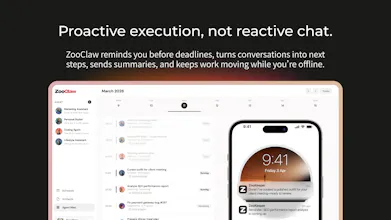
⚡ Proactive, not reactive — Your morning starts with results already waiting for you. Scheduled tasks, monitoring, follow-ups — handled while you sleep.
🔧 Zero setup, zero token anxiety — No API keys, no deployment. Best models first, open-source fallback when needed.
💬 Voice-first — Talk to your agents like you'd talk to a colleague. No prompts to craft, no UI to learn.
The era of the one-person company is here. But even a one-person company deserves a full team. That's what ZooClaw is — your team.
We're still early. I'd love to hear — what expertise do you have that you wish could work for you around the clock?
We're here all day. Your zoo is waiting 🚀
@ninghu How customizable is it for sharing branded versions with clients without losing my voice?
ZooClaw
@swati_paliwal Right on target — and we're building exactly this.
Soon, experts on ZooClaw will be able to launch their own branded Agents: your name, your product page, your pricing. Your clients only see you. ZooClaw stays invisible, running everything underneath — like the cloud.
We're quietly looking for a small group of early experts to help shape this. If you've been thinking about scaling your expertise without losing what makes it yours, this might be worth a conversation. Interested?
@ninghu Do you see more people shaping their own specialists like that, or mostly starting with the built-in ones?
ZooClaw
@artem_kosilov Both! We just got started, but even from our very limited early user study, we've been amazed at how much people are willing to interact with and trust the specialist agents — and how easy it is for non-techies to build their own. We see a productivity boom coming from both sides, and honestly we're just excited to see where users take it.
Interesting! But if multiple agents can handle the same task (e.g., marketing or research) how does zooclaw decide which specialist is actually the best fit in real time?
ZooClaw
@lak7 Such a great question! Different specialists bring different strengths, so we believe the best fit really depends on the task and personal preference.
The trickier part is choosing between specialists of the same type — we don't want users overwhelmed. That's why we're building an evaluation framework, with some interesting findings already, e.g. which search skill works best for OpenClaw: https://blog.zooclaw.ai/p/best-search-skills-for-openclaw-in. Follow our eval work here: https://zooclaw.ai/eval/
@lak7 @ninghu Interesting, so would you have the ability to tell ZooClaw to change the agent or model if you're not happy with the answer and there's a different specialised agent that is suitable? If so, does ZooClaw also learn from your preferences?
ZooClaw
@lak7 @marina_romero Yes, users can already do that — nothing's stopping them. But since we're focused on non-technical users, what we're launching soon is smart routing: automatically directing each task to the most suitable agent or model. And your point on learning preferences is great — that's absolutely on our roadmap too.
"The era of the one-person company" resonates hard. Built Krafl-IO solo and the biggest challenge isn't the code, it's wearing every hat simultaneously. The idea of specialized agents handling different domains is compelling. We use a similar approach but narrower- 3 agents that each own one step of LinkedIn post generation. Curious how you handle agent handoffs when tasks cross domains.
ZooClaw
@flowghost Love the 3-agent setup — though we went a different direction: an agent should be a person, not a cog in the pipeline. If one person owns LinkedIn post generation end-to-end, one agent should too. Context stays intact, coordination overhead disappears.
Handoffs only kick in when you'd genuinely loop in someone else. Wonder if that'd make things feel more natural for your use case?
@ninghu That's a great design philosophy. Our 3 agents are specialized by function (voice analysis, emotion reading, writing) each focused on one thing (we are adding 2 more for formatting and quality). The tradeoff is exactly what you said: coordination overhead and context passing between agents.
Your approach (one agent owns everything) probably produces more coherent output with less latency. Ours catches more edge cases (fabricated facts, passive voice, wrong emotional tone) because each agent is laser-focused.
Honestly, both work. The right answer probably depends on how much you trust a single model to self-correct vs. having checkpoints. Would love to compare outputs sometime.
ZooClaw
@flowghost The deeper difference might be philosophical: your approach treats the agent as a mechanical step in an established workflow. We believe the latest models are already capable enough to be treated like a person — given context and a goal, they figure it out with the tools at hand.
AGI is here. It's just not evenly distributed yet.
congrats on the launch, the proactive scheduling angle is genuinely different from most agent tools i've seen.
one thing i'm curious about though. "zero token anxiety" sounds great as a user but someone's eating that cost. is there a usage ceiling on the free tier, or are you subsidizing compute to grow and then switching to a credit model later? asking because i've watched a few AI tools launch with generous free tiers and then hit a wall when the unit economics catch up.
not trying to be cynical, honestly excited about what you're building.
ZooClaw
@futurestackreviews This is exactly the right question to ask — we've watched the same pattern play out.
We run our own GPU cluster with heavy inference optimization, so our cost structure is pretty different from teams relying on proprietary APIs.
When credits run out, we don't shut the agent down — we keep a generous baseline of tokens from top open-source models flowing so the agent stays always-on and proactive. An agent that goes dark when credits run out kind of defeats the purpose.
We're absorbing some of that cost, yes — but we think it's sustainable.
the "no token anxiety" line hits hard. constantly monitoring usage across different APIs is such a productivity killer. how does the fallback to open-source models work when the main ones are overloaded? does it maintain quality or just keep things moving?
ZooClaw
@piotreksedzik Glad it resonates! Just to clarify — the fallback kicks in when credits run out, not due to overload. We run our own GPU cluster with inference optimization, so we can serve top open-source models at quality levels that handle real work. Of course it won't perform as well as the best proprietary models, but your agent stays functional and proactive regardless. That's the whole point.
Really liked the story, especially the part where your HR lead kept iterating and actually built something usable, that feels pretty engaging. wonder what part do non tech users usually get stuck on when they try to build their first agent?
ZooClaw
@colin_yu_123 Honestly, the hardest part isn't a step in the process — it's that most people never think they can build one, so they never even start. What amazed me was watching our HR lead guide her "Soulmate" through a conversation and end up with a fully functional agent — scripts, skills, everything. The best part? She didn't even realize what she'd built until we pointed it out. That moment stuck with me: when the barrier is low enough and building feels like just having a conversation, people's creativity becomes the only real limit.