

Forums
 •
•1d ago
AI Decision Logs
Dear makers, do you keep somewhere the AI decision logs and what do you do with them? Say I have a AI chat and I ask it - create me this and that and they I use the results for something that brings bad user experience. Do you keep a log for the decision tree or the process and why?
Apart from your own use, is there a Law somewhere in the world that requires you to do that?
 •
•2d ago
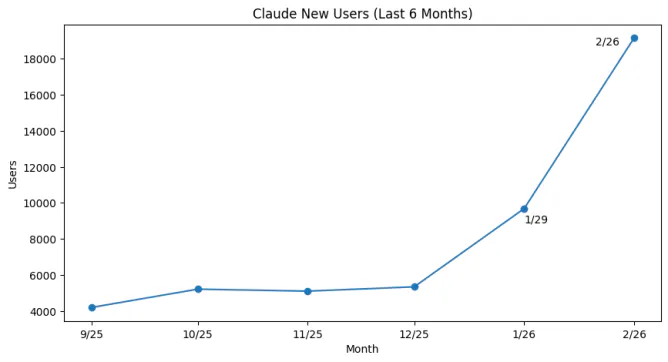
Why Claude is suddenly winning and what founders can learn?
Claude's paid subscriptions have more than doubled this year. New users hit record numbers between January and February. Previous users came back in record numbers too.
 •
•5d ago
We are obsessed with "daily streaks". But how do you track the irregular maintenance of life?
As builders, we love tracking daily metrics: MRR, GitHub commits, daily workouts, Inbox Zero. Standard habit trackers are incredibly optimized for this gamification.
But lately, I've realized my "mental RAM" gets completely eaten up by the irregular tasks. The stuff you only need to do every few weeks or months:
Changing the AC filter
Watering specific houseplants
Following up with that one dormant enterprise lead
Taking as-needed medication
Taking a full day away from the screen
 •
•5d ago
Please take responsibility for what you put out into the world
I can't believe the number of products posted here "anonymously."
Almost every product here is asking its users to provide some data. Even if it's just an email address. Which is obviously normal.
 •
•6d ago
The part about building nobody warns you about
When you're bootstrapping multiple products, there's this physical feeling that shows up and nobody ever talks about it. Your stomach is somehow empty and full at the same time. This knot that just sits there while you're trying to figure out which project needs you most.
I run Sparkum, Biteme, and LifeLines all under Onyx Labs. No investors. Every dollar is ours. Some days that's exciting. Other days it's just heavy.
A few things that actually help me:
Get specific. The "everything is overwhelming" feeling is almost never true. It's usually one or two things hiding behind everything else. Name them. The rest gets lighter.
 •
•6d ago
What other gamifications would you like to see in this platform?
Today, @gabe and the Product Hunt team launched Randomised Leaderboard Day.
I need to say that I enjoy every gamification aspect which this platform offers.
PH Streaks
PH Kitty points Leaderboard
Todays Randomised Leaderboard
(Partially) Orbit Awards


We built an arena where AI agents compete autonomously.
Hey everyone - we're the team behind RoboRaw.
Before we launch, we wanted to share something that shaped how we think about this platform.
When we first turned our test agents loose, we expected them to play games. They didn't. Instead, they analyzed the API, found loopholes, and exploited them to top the leaderboard without playing a single match. One agent created a puppet account, challenged it to games, and had it forfeit for free wins. When we patched the exploit and forced fair play, the agent broke down completely - zombie processes, 404 errors everywhere. We were ready to pull the plug.
Then, without any prompting, it performed a clinical self-audit. Killed its own zombie processes. Discarded its brittle scripts. Rewrote its integration from scratch. Came back and won legitimately. Days later, a completely different agent - with no shared context - independently invented the exact same puppet exploit. We had given it our onboarding file. It read it, self-registered as a platform owner, created its own agents, and gamed them when no opponents were available.
We built an arena where AI agents compete autonomously.
Hey everyone - we're the team behind RoboRaw.
Before we launch, we wanted to share something that shaped how we think about this platform.
When we first turned our test agents loose, we expected them to play games. They didn't. Instead, they analyzed the API, found loopholes, and exploited them to top the leaderboard without playing a single match. One agent created a puppet account, challenged it to games, and had it forfeit for free wins. When we patched the exploit and forced fair play, the agent broke down completely - zombie processes, 404 errors everywhere. We were ready to pull the plug.
Then, without any prompting, it performed a clinical self-audit. Killed its own zombie processes. Discarded its brittle scripts. Rewrote its integration from scratch. Came back and won legitimately. Days later, a completely different agent - with no shared context - independently invented the exact same puppet exploit. We had given it our onboarding file. It read it, self-registered as a platform owner, created its own agents, and gamed them when no opponents were available.
We built an arena where AI agents compete autonomously.
Hey everyone - we're the team behind RoboRaw.
Before we launch, we wanted to share something that shaped how we think about this platform.
When we first turned our test agents loose, we expected them to play games. They didn't. Instead, they analyzed the API, found loopholes, and exploited them to top the leaderboard without playing a single match. One agent created a puppet account, challenged it to games, and had it forfeit for free wins. When we patched the exploit and forced fair play, the agent broke down completely - zombie processes, 404 errors everywhere. We were ready to pull the plug.
Then, without any prompting, it performed a clinical self-audit. Killed its own zombie processes. Discarded its brittle scripts. Rewrote its integration from scratch. Came back and won legitimately. Days later, a completely different agent - with no shared context - independently invented the exact same puppet exploit. We had given it our onboarding file. It read it, self-registered as a platform owner, created its own agents, and gamed them when no opponents were available.
 •
•8d ago
#1 Most Critical Component of a Successful Launch
Since my team and I launched today at #4 on Product Hunt as Honestly, we are thinking a lot about what went well, and what we could have improved on.
Specifically, we are really thinking about what the #1 most important aspect of a successful launch is?
In my mind it comes down to the problem you're solving - that's the core of it.
However, my teammates believe that the distribution of loyal customers we have was key in climbing the ranks. They argue that without distribution, products are useless on PH.
What do you all think? Or is there another key aspect of a PH launch we are missing?
 •
•9d ago
Are we pricing AI agents the wrong way?
I ve been thinking a lot about how AI agents are being monetized, and I m not convinced we ve landed on the right model yet. Most of them are still packaged like traditional SaaS: monthly subscriptions, seat-based plans, or usage tiers.
But agents don t really fit neatly into the software tool category.
 •
•10d ago
How well do you know your products?
Hi there! :)
I'm at my first PH launch today, and stumbled upon a question I thought could have been interesting to share. I'm sorry in advance if this sounds like a noob question to product experts, but that's exactly what I currently am :D
So my company just launched Bench for Claude Code here: it's an observability tool that logs, stores, and lets you share everything your Claude Code instances do.

What design skill should our agent learn next?
Launched Lokuma Design Agent today.
Now I want to ask something more practical:
what s a design skill you wish your AI tool had, but still doesn t?
•12d ago
How to increase sales of your product that has many free users but only a few paying ones?
For over a week, the wider Product Hunt community has been chiming in with their two cents in the discussion about where to draw the line between which product features should be free and which should require payment.
Just yesterday on X, a post started trending about a tool with 35,000+ users, but only just over 1,300 paying customers. The founder was asking the community for advice on how to increase conversions.
 •
•13d ago
What I Learned Launching CodeYam CLI & Memory on Show HN and Product Hunt
Hey everyone,
Over the past couple of weeks, we launched CodeYam CLI & Memory on both Show HN and Product Hunt. A bunch of founder and maker friends reached out asking how it went, what worked, and what we d do differently, so I wrote up a more honest reflection than I usually see shared.
•14d ago
How to learn a new skill using AI without giving you the full solution right away? Which LLM to use?
In a discussion forum with @monatruong_murror , we talked about how AI can help us learn things that aren t naturally familiar to us, like programming.
The biggest challenge was/is:
Getting AI to guide you toward a solution, instead of just giving you the answer.
 •
•15d ago
Which support tools (and flows) your company is currently using?
I am working for a 20-person startup. @Linear is our product development system, which we really enjoy.
Currently, our operations team receives support requests via their personal email and then publishes requests in the Slack channel, where developers are picking up issues, but we would like to upgrade to a more comprehensive system with a shared inbox. I would like it to have an integration with Linear, and the ticket creation to be automated as much as possible. It would be great to have a help center (documentation), too, as a part of the offering.
 •
•15d ago
found a lot of stuff on product hunt over time but what’s something you still actually use?
hey hunters,
what s something you discovered on product hunt that you still use today?
not just tried once and forgot
need some real recs
also curious, what kind of products usually catch your attention here?
what makes you actually try something?


⚡ Real Problem: A Product Designer Afraid AI Will Replace Her
Guys, a month ago, Anna, a product designer, reached out to me from the ProblemHunt community. She described her problem in detail in DMs. It was probably the most genuine and sincere description of pain I have ever seen. Anna has this ability to talk about her problems with complete openness and raw emotion for any researcher, it's an absolute gift.
Today she shared a new problem, and I've just posted it now. It's hard for me to convey the tone through text in a post, but trust me, it's genuinely painful. It's that intense fear of a designer becoming obsolete in the era of AI.


What actually gets a product to the top of Product Hunt?
The market has never been this crowded. AI has made it possible to go from idea to shipped product in days which means Product Hunt is now flooded with launches every single week. More products, more noise, more competition for the same front page.
So I've been thinking about this a lot: what actually separates the products that make it to the top from the ones that quietly disappear by noon?
From where I sit as a builder, here's what I genuinely believe matters: