Focido is built on a simple insight: people don t just want motivation - they want to give it too. Research shows that helping others can increase wellbeing, strengthen belonging, create a helper s high, and make people feel more purposeful.
That s why Focido turns accountability into a social role, not just a personal productivity tool.
Curious: "Human Premium" why human support trumps AI in productivity apps. Research: Supportive Accountability model shows humans excel via rapport. Gen Z leans human 55-70%.
As we build (like social to-dos), how are you weaving this in?
We ve just joined the Limb accelerator, a 5-week program focused on fundraising readiness, investor materials, and turning an early startup into something a bit less chaotic and a bit more investable.
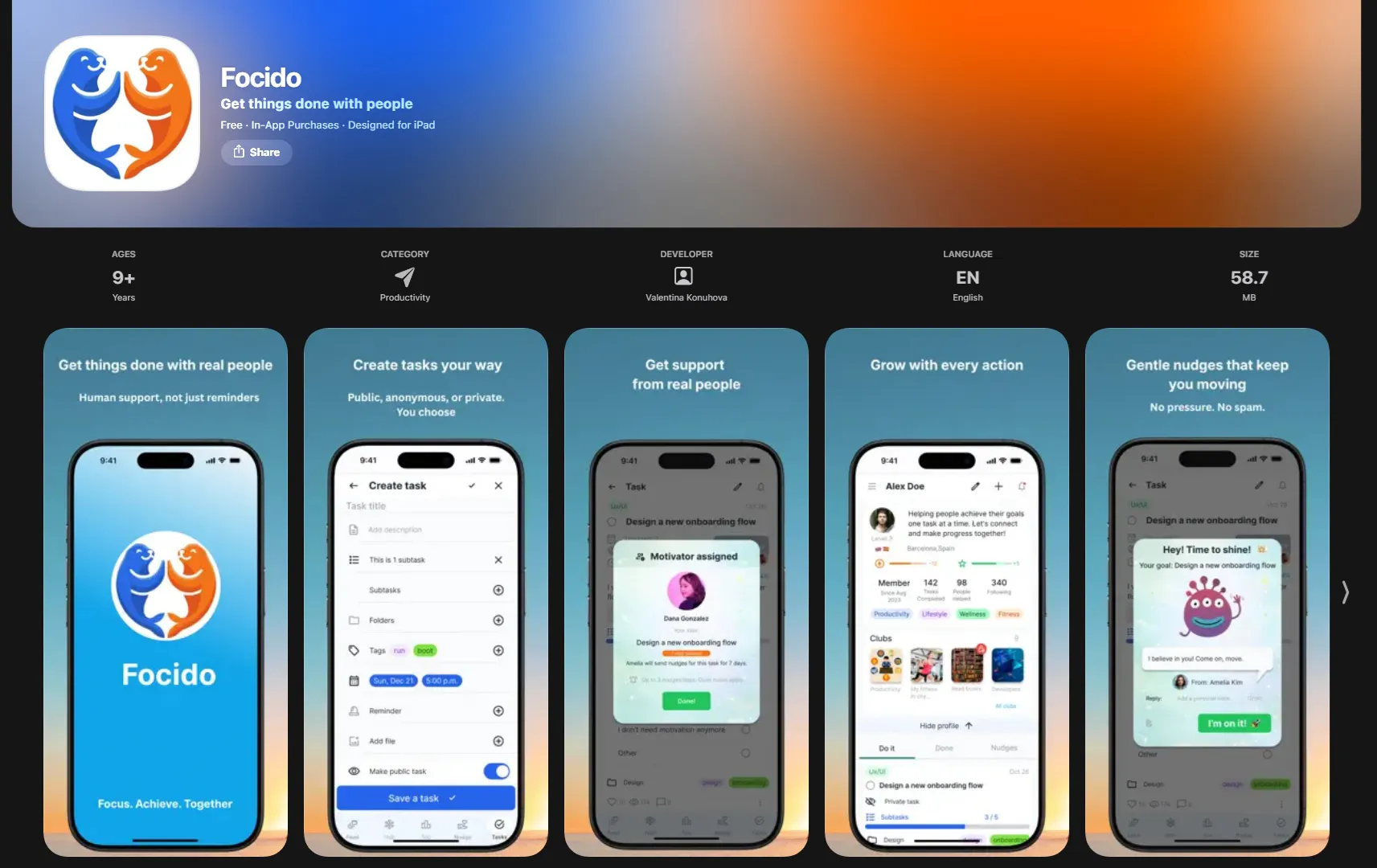
We re building Focido, a social to-do app based on one simple idea: people follow through more often when another human is part of the loop. Not more productivity noise, not more AI fluff, not another system that looks smart and gets ignored after 3 days. Just real human accountability, in a lightweight format that helps people actually do the thing.
Hey PH community, genuinely curious about this one.
We are building Focido, an app where real people act as motivators for each other's goals and tasks. The research behind it is pretty clear: human accountability beats generic nudges, AI alone, or the honor system you make with yourself at midnight.
One question we keep getting: "Can I actually make money as a motivator in Focido?"
Short answer: yes, and we're building the infrastructure for it.
Long answer: we designed Focido around a role called "Motivator." Not a bot, not a notification, but a real person who helps another user follow through on their goals. Sessions are tracked. Quality scores are built over time. The better your helpfulness score, the more visibility you get.
I think HFTN (Human Follow-Through Network) is now a distinct product category, especially for users whose real problem is execution rather than planning.
A lot of makers build for planning, tracking, and optimization. All useful. But behavior often changes fastest when another person becomes part of the loop.
Not in a corporate, guilt-heavy way. More in a human way.
Someone notices. Someone asks. Someone expects the update. Someone celebrates the small win.
AI productivity apps: reminders, quotes, "motivation." But it doesn't work. People abandon 80% of tasks.
Focido where humans remain. Real users see your goals, send personal nudges, wait for replies. Because only a human understands why "tomorrow" never comes.
Solving procrastination with real human accountability: we re two people building Focido, a mobile app for the moment you look at a task and freeze.
What procrastinators are up against
Procrastination usually isn t laziness , it s a coping response to stress, fear of failing, or a task that feels too big and fuzzy. Then the loop hits: you delay, you feel guilty, anxiety spikes, and starting gets even harder.
We kept seeing a pattern in user feedback: people were turning off notifications, not because Focido wasn't working, but because it was working too aggressively.
Accountability breaks when it starts feeling like surveillance.
We shipped something users kept asking about: control over when you get nudged.
You can now pick a custom start and end time for reminders. Sounds small. But if you're a night owl getting pinged at 8am by your motivator, it's everything.
What's new:
Favorites redesigned into People, Tasks, and Clubs tabs
Share user profiles via deep links
Leaderboard: tap any user to open their profile
Custom nudge start/end time
Password change + profile visibility settings
Premium success screen and cleaner profile edit menu
We added the settings screen people have been asking for (notifications, language, account deletion) and made categories tappable from anywhere. Small but mighty.
Last year we hired a design agency to build our marketing site for @Basedash. They did an incredible job. The headline makes it sound like I'm dunking on them, but I'm not. The site was genuinely great. They built it in Framer so we could manage content ourselves, which was a completely reasonable bet at the time (and something we explicitly asked for).