

6 Months After Getting #1 on Product Hunt, What Really Happened?
We launched, we won, we almost lost ourselves. This is the honest story of building AI Context Flow after the spotlight faded.
Six months ago, we launched on Product Hunt. We were excited and nervous in equal measure , not sure what a community that has seen everything, every single day, would think of our product. Now, looking back, six months felt both incredibly long and impossibly short. A lot happened. Just consider how many AI launches have come and gone in that time.
One week after launching, we found out we had ranked as the #1 Product of the Week on Product Hunt. It was a genuine surprise. We celebrated briefly and then got back to work. Because the win wasn't the point. The point was always the bigger vision: to build an open memory layer instead of restricted in one AI tool, we want to build an ecosystem where you decide where your knowledge lives and which AI model or tool gets to use it.
What we validated — and what we chose to let go
Our initial Product Hunt launch proved there was real demand for a tool that optimises prompts based on your personal context, even across AI agents. That was the core idea. But over the following months, something painful happened: as we pushed further, some of our earliest users left.
It hurt. There's no other way to put it. Watching people who had believed in you early walk away is one of the quieter heartbreaks of building a startup. But we had a direction we believed in, and we chose to follow it. We broke up with what we had been, and committed to what we wanted to become.
Here's what we built along the way.
What we shipped
Save context from anywhere. You can now select any text on any webpage or inside any AI chat, right-click, and save it directly to your memory buckets. Your context no longer has to come only from your AI tool, it can come from articles, research, conversations, wherever you are. You can also upload PDFs and Word and other formats of documents.

Right-click any selected text to save it to your AI memory.

Choose which memory bucket the context belongs to.
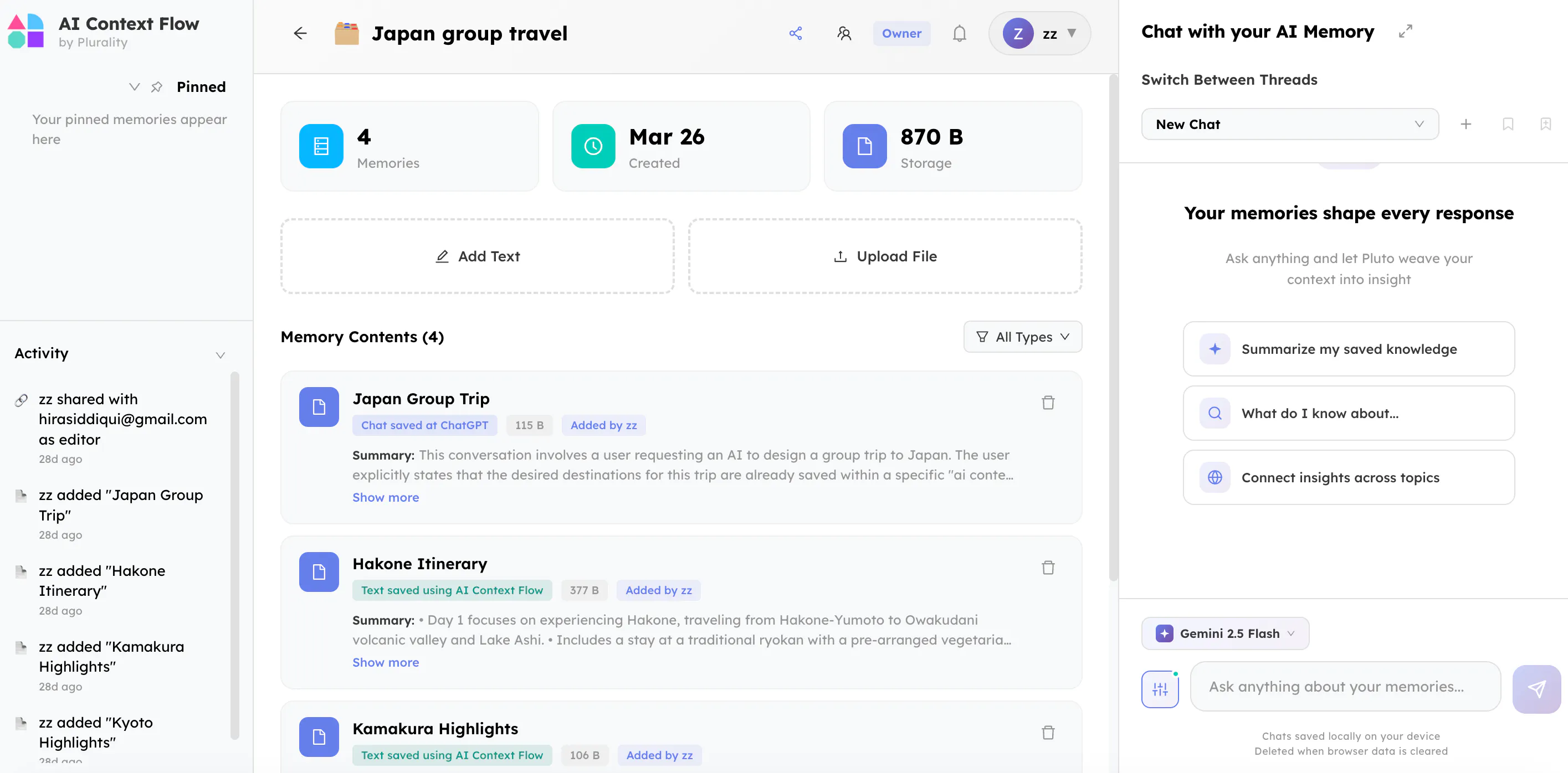
Richer, more structured memory buckets. The old buckets were simple and fast, but they didn't tell you much. We've rebuilt the memory experience to show summaries of each piece of context, with a built-in chatbot (supporting Claude Opus, Gemini Flash, and more) so you can actually talk to your memories and surface what matters.
Before: clean, but minimal. Not much information at a glance.

After: structured buckets, timestamps, and at-a-glance context counts.

Inside a bucket: summaries of each memory item, plus a chat panel to query your knowledge directly.
MCP integration — your memory, everywhere. This became our most-used feature, and honestly, it exceeded our expectations. With our MCP server, you can plug AI Context Flow into ChatGPT, Claude, Gemini, Cursor, Windsurf, Claude Code, Lovable, Bolt, GitHub Copilot, LM Studio, and more, with just a few steps. Your agent reads and writes to your memory automatically. We're also actively working on an API key so developers can go even further. And we are surprised to find out quite some customers already used our app for OpenClaw. Check out the guide here to connecting the MCP here. We are also actively working on the API key version of MCP server which will be released soon.
Connect once. Every compatible AI client can then read and write to your memory automatically.

Collaboration. AI Context Flow is no longer just a solo tool. You can share memory buckets with colleagues or friends, granting them either viewer or editor access. Your knowledge can now be a team resource.

Share any bucket with a collaborator as a viewer or editor.
And then came the life time deal
With these features shipped and a clearer sense of who we were building for, we decided to test our new direction on AppSumo, a platform where early-stage products offer lifetime deals to a community of power users who love finding the next great tool.
We had no idea how the market would react. Would anyone actually buy into this? The doubts were real. But Hira, our CEO, saw it more as a rare chance to get brutally honest feedback from a completely new audience.
In the first week alone, we sold 90 lifetime deals. More importantly, the feedback was substantive. Users told us what was working, what they wanted next, and what would make this tool indispensable. That kind of signal is worth more than any launch metric.
We're not stopping here. We're taking every piece of feedback seriously and folding it into what comes next.
Get lifetime access before it's gone
Join the users already building their personal memory layer.
Replies
Weavable
Thanks for sharing your experience. I wonder if this shifting ICP behavior that you are seeing (and will see) is now something that you consider during your roadmapping? Building for the user you have vs for the user you want vs the users who end up being the most retentive. Would you say it's a nice overlapping venn diagram for you right now?
AI Context Flow
@abesh_thakur with the way product shaped up, we have now been able to get closer to our vision of "use your context everywhere". We now have a very healthy mix of users we want + users who are most retentive.
Yes it clearly moved fromlaunch hype to real product depth.
The biggest signal here is not the PH #1, but the fact you kept iterating after users started leaving that's actually where real winners are shaped.
@hassan_ismail_rebe thanks, agreed here, and it's a long term shaping.
Nex
The part about early users walking away when you turn the wheel is a real one, and most public retrospectives skip it. Did you find the users who stuck around through the pivot were measurably different in how they used the product, or was it more about how invested they already were in the original promise? That distinction would seem to change a lot about how you communicate the next big change.
@najmuzzaman Well, the core is still saving context and use it across platforms, if this is their heavy use case rather than the optimise prompts part, the new features actually will enhance their experience.
Coworker AI
went through the same at Arcade. selling B2C is hard (users are flaky). but your most loyal users are where the best feedback comes from. thanks for sharing!
@kohnigel That's a great perspective to see it.
AI Context Flow
Coworker AI
@hira_siddiqui1 amazing!
Mailwarm
This is a very interesting and honest breakdowns of post-PH reality.
The part that stands out is your willingness to let early users go to stay aligned with a deeper vision. That’s a hard call most founders delay for too long. PH validates attention but definitely not direction and confusing the two is where many products get stuck optimizing for short-term feedback instead of value.
The shift from a “feature” (prompt optimization) to a “layer” (memory infrastructure across tools) feels like the right abstraction level, especially in the current AI stack where fragmentation is the real problem.
How are you deciding which feedback to act on vs ignore now that you’re getting signals from very different user segments (PH early adopters vs AppSumo power users)?
@thamibenjelloun Right now we are prioritizing the feedback we got form Appsumo, especially the ones which many users have mentioned.